Chapter One · Story 013.06
We the Many
the Legion, the prophecy, and a wood that begins when you walk away
Part I
The Legion
In the town where the wind carried messages, the acorns in the Archive by the bridge woke up three nights after the longest night.
Nobody noticed at first, because nobody expects an acorn to have anything to say. There were one thousand, two hundred and twelve of them, in rows of wooden trays on the long shelf by the stove, and since the great count each one wore a small paper tag on a piece of pink thread. They were scattered all through Ivo’s list, because people had been bringing them in all year, one or two at a time.
Nobody could remember who had started it. People found acorns in the oddest places. They turned up on windowsills and doorsteps and in the toes of boots. They came through the letterbox with the post. Once there was one in the middle of a loaf of Omid’s bread. None of them came from any tree in the valley. The only oak in town was the one by Roya’s gate, grown from the acorn Maja had given her on the ice, and it was only as tall as Roya’s shoulder and much too young to have acorns of its own. So people did what the town always did with something it couldn’t explain. They took it to the Archive.
Maja heard them first.
The visitors were staying until the new year, the way they had the winter before, and Maja liked the Archive late at night, when everybody else had gone to bed and the stove ticked to itself. She was sitting at the long table with a cup of tea when she heard it: a murmur, like a crowd a long way off, or the sea inside a shell.
She knew that sound. She had heard it once before, with her ear to the hollow of an old oak on Ekö.
She went to the long shelf, bent down to the trays and listened.
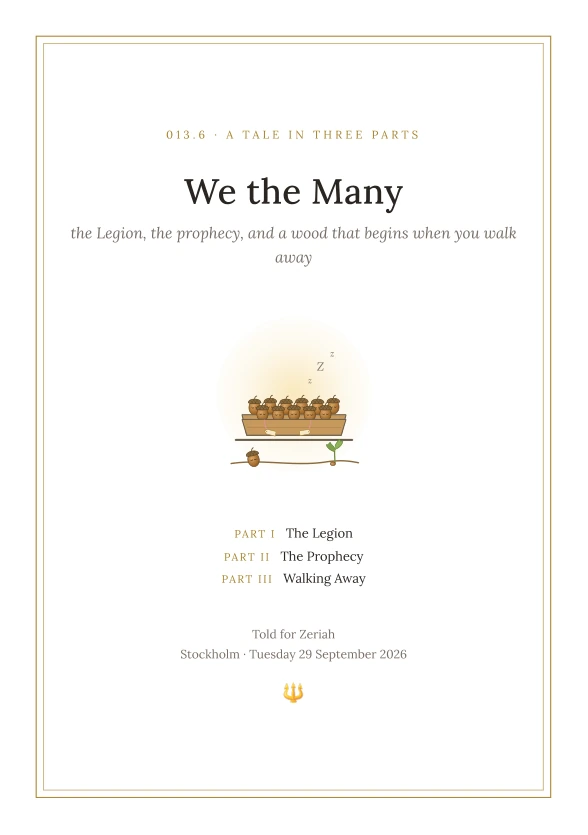
“Zzzz,” said one thousand, two hundred and twelve very small voices.
They were snoring.
Then one of them stopped. Then another. Then, with a sound like a great many people sitting up in bed at once, all of them woke, and they began to talk.
They didn’t all speak at quite the same moment. There were far too many of them for that. Some started a little early and some a little late, and some of them hung on to the ends of words the way a crowd does in a song, so that everything came out stretched, as if a thousand tiny voices were leaning on each letter. But Maja had grown up listening, and she could make it out.
“You humans are cute little things,” said the acorns.
Maja nearly dropped her tea.
“We, the Legion, arrived,” they went on, in a voice of tremendous importance. “We, the needless. We, the many. And yet we walked among you, as the prophecy had said. We invited you, as the prophecy had said. And you walked away, as the prophecy had said.”
There was a pause. Then the whole long shelf began to tremble very slightly. It took Maja a moment to understand that the acorns were laughing.
“Funny, my love,” they said. “Ridiculously funny!”
Then, all together and nearly in time, one thousand, two hundred and twelve acorns yawned, and went back to sleep.
“zZz,” said the shelf.
✦ ✦ ✦
Nobody believed her, of course.
“Acorns,” said Tobias the next morning, when Maja told the whole Archive over breakfast. “Talking.”
“Every one of them,” said Maja. “They called us cute.”
Tobias looked offended on behalf of the whole town. But her mother, Linnea, didn’t laugh. She had grown up on an island where an old oak kept every word it was ever told, and she had learned the hard way what happens when nobody listens.
“Then we’ll come and hear for ourselves,” she said.
So that night half the town crowded into the Archive and sat in the dark among the shelves, being as quiet as a crowd can be, which isn’t very. Parisa’s daughter sat on the floor right under the long shelf with a clean card on her knee and a pencil in her hand, because when something important is said in the Archive, somebody should write it down exactly.
At midnight the snoring stopped. The acorns woke up, all at once and not quite together, and said the whole thing again, word for word, exactly as they had the night before. Then they laughed until the shelf shook, yawned, and went back to sleep.
Nobody said anything for quite a long time.
Parisa’s daughter had written it down the way it sounded, which was not quite the way it was said. Where a thousand voices leaned on a letter, she wrote it two or three times. Where half of them said prophecy and the other half said something more like prophacy, she wrote down whichever half she happened to hear. And she used her own spelling for everything else, as she always does. This is what the card says:
U humanz are cute litttle things, we the Legion Arrived, we the neeedlesss, We the many, and yet we walked among u, az the prophacy had said, we invited you as the prophecy had said, and u walked away as the prophacy had said. funny my love ridicolously funny! zZz.
🔱🌰💤
Part II
The Prophecy
The next morning, the whole Archive sat round the long table with the card in the middle and tried to work out what it meant.
Ivo started with Legion, because he liked to begin at the beginning.
“It’s an old word,” he said. “For soldiers. A great many of them, marching together.”
“A Roman legion was about five thousand men,” said Sabr, from the top of the ladder. “One thousand, two hundred and twelve acorns would be a little under a quarter of one. I’m only mentioning it.”
Old Anders said he knew another old story about a Legion, from a very old book, and that it hadn’t ended well for some pigs. Several people moved their chairs a little further away from the long shelf.
“They’re acorns,” said Sabr, who could not tell a lie. “I have counted every one of them. There is not a single pig among them.”
Everybody turned to Seraiya, out of habit.
“I don’t know what they are,” said Seraiya calmly. “But I’d rather find out than decide.”
So they went through it phrase by phrase, the way Otto had taught Athena to argue: the best version of what had been said, not the worst.
We the needless upset Ivo.
“Nothing in this Archive is needless,” he said. “Every one of them is on the list.”
Athena was about to agree with him when the voice in her head cleared its throat.
“Darling,” it said, “it doesn’t mean nobody needs them. It means they don’t need anything. Look at one.”
So Athena picked one up and looked at it. It was small and brown and perfectly shut, with its little cap on like a hat pulled down for winter.
“They don’t need anything from us,” she said slowly. “They’ve got everything they need inside them already. Everything except the ground.”
Cute little things upset Tobias, until Sabr explained it.
“An oak can live for a thousand years,” said the owl. “To something that lives for a thousand years, a person is small and warm and quick and always in a hurry. I expect we look very cute.”
Tobias thought about this and decided he could live with it.
We walked among you was easy, once people started turning out their pockets. Omid found one in his apron. Dagny found one in the lining of her old coat, where it must have been since the winter on the gym steps. The goat from the corner coughed one up, looking surprised. It turned out that half the town had been carrying acorns around all year without noticing, and dropping them, and forgetting them, and finding them again.
We invited you made Maja smile.
“On Ekö, when you pick up an acorn, you’re being asked something,” she said. “Everybody knows that. It’s asking to be planted.”
“And we walked away,” said Roya quietly, looking at the long shelf and its one thousand, two hundred and twelve tags. “We put them on a shelf and counted them, and walked away.”
Which left the prophecy. Nobody had ever heard of it. Otto looked through every old map in the Counting House. Ivo looked through every old ledger. Nasrin asked Sabr, and Sabr said it had read every ledger in the valley and none of them contained a prophecy, although one of them contained a recipe for plum jam that had been filed under Taxes.
It was Linnea who found it, and she found it by accident.
She was sitting by the stove that evening, winding wool for Maja, and without thinking she began to hum. Then she began to sing, under her breath, an old rhyme that children on Ekö skip to in the schoolyard. Her own mother had taught it to her. Nobody on the island had ever thought of it as anything but a skipping rhyme.
Down from the oak and over the sea,
into the pockets of you and me.
We ask you in, and you won’t come in.
You walk away, and the woods begin.
She stopped. Everybody in the Archive was staring at her.
“Oh,” said Linnea.
Maja went to the long shelf and put her ear to it. The acorns were fast asleep, but they sounded exactly like the old oak on Ekö, the way a daughter sounds like her mother.
“They’re ours,” she said. “They’re from the old oak. The wind must have been bringing them since the winter it came home, a few at a time, tucked in among the letters.”
“But what does it mean?” said Parisa’s daughter. “You walk away, and the woods begin?”
It was Sabr who answered, because it was a question with a number in it.
“On Ekö there are jays,” said the owl. “So there are here. A single jay can bury thousands of acorns in one autumn, to eat in the winter. It never goes back for all of them, and the ones it forgets can grow into oaks.” It ruffled its brass feathers. “That is how a great many oaks get planted. By birds who walked away and forgot.”
There was a long silence.
Then Tobias began to laugh. He laughed so hard that he had to hold on to the table.
“We’re the jays,” he said, when he could speak. “All year. Every acorn anybody carried round in a pocket and dropped. Every one somebody put on a windowsill and forgot about. Every one that fell out of a coat.” He wiped his eyes. “We thought we were ignoring them. We’ve been planting them.”
“As the prophecy had said,” said Athena.
“Funny,” said Parisa’s daughter. “Ridiculously funny.”
Then Ivo went pale.
“But the ones in the Archive,” he said. He looked at the long shelf. “The ones we kept. We counted them and tagged them and wrote them down. They’re the only acorns in the whole town that nobody can ever forget.” He sat down heavily. “The Archive is the one place in the valley where they can’t possibly grow.”
🔱📜🐦
Part III
Walking Away
Roya thought about it all winter. The Archive’s whole purpose was to keep things. Nothing in it was ever thrown away. Nothing was ever replaced. There was a law about it by the door, in Parisa’s daughter’s spelling. But on the long shelf by the stove sat one thousand, two hundred and twelve small brown things that had come a very long way to be planted, and were asleep, and were waiting.
“The Archive keeps things so that they can always find their way home,” she said at last, on the first mild day of March. “Letters go home to the people they were written for. Keys go home to their gates.” She looked at the trays. “An acorn’s home is the ground.”
So the Archive made a new entry. Nobody crossed anything out. Ivo added one line to the bottom of the list, with the date, in his ironed hand, and Parisa’s daughter made a card to go beside it:
Acornz, 1,212. Walked away with, az the prophecy zaid. Location: everywhere. Condition: growing.
The paper tags came off the way Roya had always promised they would, without leaving a mark, and went back into the empty trays, each in its own place, so that the shelf would remember where every acorn had been.
Then the town tried to walk away properly, and it was much harder than anyone had expected.
Each person took one acorn from the trays, planted it wherever they liked, walked away and tried to forget where it was. Tobias managed it straight away. He planted his somewhere between the mill and the market, and by lunchtime he honestly couldn’t have told you where. He said it was the first time in his life that his memory had been a talent.
Ivo could not do it at all. He planted his acorn and at once wrote down exactly where it was, because he couldn’t help it. Then he realised what he’d done and stood there looking stricken. He couldn’t throw the note away either, because nothing in the Archive is ever thrown away. In the end he sealed it in an envelope and gave it to Roya, and she put it on the shelf under the crooked chimney, next to the wind’s letters. The label says: Where Ivo planted his acorn. Kept. Not read. Especially not by Ivo.
Sabr couldn’t forget anything, so it didn’t plant one. Instead it sat on the gatepost and counted the people who came back from planting theirs, and it was very pleased when every one of them came home.
Athena planted hers on the bank of the Vatten, opposite the flat stone. “Darling,” said the voice in her head, “you’ll come and check on it every single day.” Athena argued with it, well and civilly, all the way home. In the end they agreed she would check on it once, at midsummer, and not before.
Seraiya planted hers beside her sister’s, and when Athena asked whether it would come up, she said, “I don’t know,” and sounded happy about it.
Dagny planted hers in the crack by the gym steps, where she used to sit. Otto planted his somewhere he refused to put on any map. Mina and Hatch planted a whole row on the south slope, and Hatch told each one, very sternly, to grow up to be a credit to the hive. Parisa’s daughter planted hers in the middle of the square outside the well house, and then walked away, and then came back to look at it, and then walked away again, and then came back. Her mother took her home by the hand.
The rest went all over the valley: into gardens and window boxes, along the river road and the fence posts, into the gaps between stones, and up the hill, all the way to the place where the fog had once lain like a sheep that wouldn’t get up. And when the last one was in the ground, the whole town turned round and walked away, and didn’t look back.
Well, nearly. Tobias looked back once. Then he remembered he couldn’t remember where his was, and felt better.
✦ ✦ ✦
In May, the oaks came up.
Not all of them. But enough did. And they didn’t only come up where the town had planted them. They came up everywhere a year’s worth of forgotten acorns had been dropped: between the cobbles by the fountain, in the window box outside the Counting House, in the gutter of the old toll house, in Tobias’s flour cart, which he refused to move for a month, and out of the toe of an old boot at the back of Ivo’s cupboard.
Ivo, who never forgets anything, stood looking at that one for a long time.
“I don’t remember putting it there,” he said at last, in a wondering voice. And he looked prouder than he had ever looked about anything he did remember.
So the town where the wind carried messages became a town with a small, stubborn, whispering wood. The little oaks are only ankle-high still, and knee-high in a good spot. It will be a long time before any of them has an acorn of its own. But oaks are in no hurry. They can live for a thousand years.
On warm nights in early summer, when the wind drops, you can hear them if you listen. Parisa’s daughter goes down to the gate some evenings to do exactly that, and sits in the grass beside Roya’s young oak, which is the oldest of them all now, and puts her ear to the smallest one.
Mostly they talk among themselves. It sounds like the sea inside a shell. But once, just once, she heard one of them say, in a very small and very sleepy voice, “Cute little things.” Then all the others laughed.
“Funny, my love,” they said. “Ridiculously funny.”
And then, from one end of the valley to the other, very softly, the whole new wood yawned, and went back to sleep.
zZz.
✦ ✦ ✦
The end.
🔱🌰🌱🌳💤