Chapter One · Story 013.09
Look Again Before You Knock
a still jar, a daughter still working, and a little glass door
Part I
The Long Work
In the town where the wind carried messages, everything in the Archive by the bridge had a number now. Everything had a line in Ivo’s list and a place on Otto’s map. What it didn’t have yet was a way to get there.
“The list tells you what a thing is,” said Roya, one evening in the dark part of the year. “The map tells you where it lives. But if you actually want to find it, you still have to ask Ivo. And Ivo has to go home sometimes.”
“Not necessarily,” said Ivo.
“Yes, necessarily,” said Roya.
What the Archive needed, she said, was a Book of Ways. It would be one big book on a stand by the door, and every single thing in the Archive would have its own few lines in it: the way there, step by step from the door. Past the stove. Second shelf on the left. The blue box. Third card from the front. Then anybody at all could walk in on a Saturday and find anything they liked, without asking anyone.
Everybody agreed that it was a wonderful idea. Then everybody looked at Parisa’s daughter, because she writes the cards, and the Book of Ways would be the longest card anybody had ever written.
She thought about it for a long time.
“It has to be done in one go,” she said at last. “Not a little bit every Saturday. The ways run into each other. When I’ve written the way to one thing, I’m already standing next to the next thing, in my head. If I stop, I lose where I’m standing, and I have to go back to the door and walk the whole corridor again.” She looked up at the ceiling. “I’ll need the attic. And nobody talking to me.”
“How long?” said her mother.
“A night and a day,” said Parisa’s daughter. “Maybe a bit more.”
Parisa didn’t love this. She was a mother. The attic was cold, and a night and a day is a long time to leave your child alone in a room at the top of the stairs, even when your child is quite grown up and knows perfectly well what she is doing. But Parisa knew her daughter, and she knew that look.
“Then we’ll need a way to see how you’re getting on,” she said, “that isn’t knocking.”
✦
✦ ✦
That is how the bead pipe came to be built.
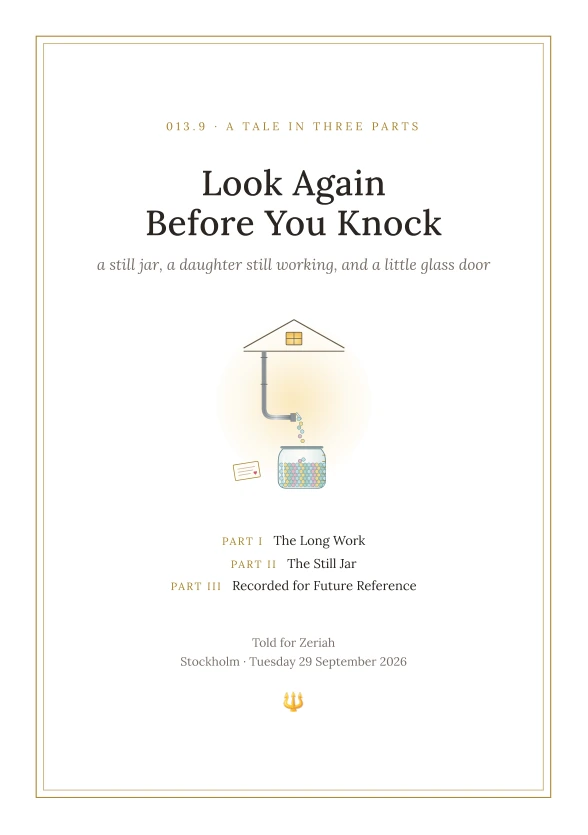
Tobias did the building. He ran a thin tin pipe from a hole in the attic floor, down through the ceiling and along the wall to the end of the long table. Nilu sent a bag of glass beads from the lane of mirror-workers, each the size of a pea. Dagny made a little glass door for the bottom of the pipe, on a tiny brass hinge, so that the beads could be let out or kept in. And under the little door Roya put the biggest jar she had. It was the one Holm’s pickled herring had come in, washed three times and still smelling faintly of herring.
The idea was simple. Every time Parisa’s daughter finished a page of the Book of Ways, she would drop one bead into the hole in the floor beside her desk. It would roll down the pipe with a small bright rattle, through the ceiling and along the wall, and land in the jar with a tink. Ivo, who can’t help himself, painted a thin line on the side of the jar for every fifty pages.
“So we can see how she’s getting on,” said Parisa, “without getting in her way.”
On the first evening, Parisa’s daughter climbed the attic stairs with a lamp, a blanket, her ink, a great stack of paper and a bag of Roya’s mother’s biscuits, and shut the door behind her. Everybody else sat round the long table and watched the jar.
Tink.
It is astonishing how exciting a jar can be.
Tink.
Tobias cheered the first bead. He cheered the second one too, and the third, until Roya asked him to stop, in case the cheering went up the pipe. After that, people cheered silently, with their hands. The beads came steadily all evening, one every little while, like a slow and patient clock. Otto wrote down the time of each one in the margin of his map. Sabr counted them from Nasrin’s shoulder, although there was no need, because the owl counts everything. By midnight the jar had passed Ivo’s first line, and people began to go home to bed, happy, because they had seen with their own eyes that the work was going well.
Parisa stayed. She slept in the chair by the stove with her coat over her, and every time she heard tink, she smiled in her sleep.
🔱📖🫙
Part II
The Still Jar
The beads kept coming all the next day. People came in to look at the jar the way you look at bread rising. Tobias ate his lunch beside it. Children pressed their noses to the glass and counted along with Sabr until they lost count, which the owl never does. By late afternoon the jar was just past Ivo’s fourth line.
Then, a little after the lamps were lit, a bead landed on top of the pile, and Sabr said, “Two hundred and six,” and there wasn’t another one.
At first nobody minded. There is always a gap between two beads, and nobody minds a gap. Then the gap got long. Then it got very long. Otto looked down the margin of his map and said there had never been a gap this long, not even in the middle of the night. The jar sat there with the two hundred and sixth bead on top, exactly where it had landed, and it didn’t change.
An hour went by. Then another. The jar didn’t change.
That was when the town began to do what towns do.
“She’s asleep,” said Tobias. “Anybody would be. I’d have been asleep at bead six.”
“She might be stuck,” said Otto. “Some of the ways are hard. The way to the goat’s corner, for instance. The goat keeps moving it.”
“She might be ill,” said somebody by the door. Then everybody was quiet for a moment, because that was the one nobody had wanted to say.
Parisa stood up. But Tobias was already on the attic stairs. He is a good man, and when he is worried he likes to do something, and the nearest thing to do something to was the attic door.
“I’ll just knock,” he said. “Just a little knock. Just to see.”
He was four steps up when Sabr spoke.
“Before you do,” said the owl, “what do we actually know?”
Tobias stopped with one foot in the air.
“We know the jar has stopped,” said Sabr. “That’s all. We don’t know that she has.”
“It’s the same thing,” said Tobias.
“It might be,” said Sabr. “It might not. The jar isn’t the work. The jar is how we look at the work.” It turned its brass head towards the pipe. “We’ve been watching a window, and the window has gone still. That’s all we know.”
Ivo had already taken out his pen. On a clean sheet, in his ironed hand, he wrote: What we know: the jar has not changed for two hours. What we do not know: whether the work has. He underlined the second line twice.
Seraiya looked at Parisa. “I don’t know whether she’s stopped,” she said, in the plain way she has learned to say it. “Nobody here knows. So let’s be careful what we do while we don’t know.”
“If she’s ill,” said Parisa, “I want to be up those stairs.”
“Of course you do,” said Seraiya gently. “And if she isn’t?”
Parisa knew the answer to that, because her daughter had told her. If she wasn’t ill, and she wasn’t asleep, and she wasn’t stuck, then one little knock would send her back to the door, with the whole corridor to walk again. A night and a day of work, lost to a little knock, just to see.
“When the map and the land disagree,” said Otto slowly, “the land is right. That’s the rule. But before you march out to check the land, it’s worth making sure the map isn’t stuck.”
✦
✦ ✦
Parisa went and knelt down at the end of the long table. She looked at the jar, and at the pipe, and at Dagny’s little glass door at the bottom of it.
She didn’t know anything about pipes. But she had a kitchen, and in her kitchen there was a cupboard whose door sat crooked when the stove had been going for a while, and when it did, it wouldn’t let you have the plates. She had never known why. She did know what to do about it.
She closed the little glass door, gently, all the way, until it clicked. Then she opened it again.
For a moment nothing happened.
Then there was a rattle in the pipe, and a sound like rain on a tin roof, and the beads came pouring out of the little door into the jar. Ten, twenty, more: a long, bright, glittering stream of them, tumbling over each other, until the jar was suddenly a whole finger higher. The last few came one at a time. Tink. Tink. Tink. Then, after a little while, tink again: a new one, straight down the pipe, the ordinary way.
Nobody said anything.
“They were in the pipe,” said Otto at last. “All of them. Queuing.”
“She never stopped,” said Parisa.
“Twenty-five,” said Sabr. “Twenty-five pages, waiting behind a door that had gone a little crooked. Even I can’t count through tin.” It ruffled its brass feathers. “The window went stale. The work didn’t.”
On the attic stairs, Tobias put his foot down very carefully, turned round, and came back down on tiptoe the whole way. For Tobias, that is a considerable achievement.
🔱🫙🚪
Part III
Recorded for Future Reference
The beads kept coming all night, one at a time, the ordinary way. Nobody went home.
Just before dawn, Parisa’s daughter came down the attic stairs with ink on her fingers and the Book of Ways in her arms. She stopped on the bottom step and blinked at the lamps, and at half the town asleep round the long table, and at her mother, who was awake.
“Why is everybody here?” she said.
So they told her. She listened to all of it, and her face went from puzzled to amazed to something that was partly alarm and mostly love.
“I never stopped,” she said. “I was on the east wall all evening. The long shelf with the letters on it.” She thought. “I did hear a sort of clatter at one point. I thought it was the goat.”
“I nearly knocked,” said Tobias, honestly. “I was four steps up.”
She looked at the stairs, and then at him.
“If you had,” she said, “I’d have been back at the door, with the whole east wall to walk again.” Then she gave him a biscuit, the last one in the bag, because he had come back down.
Sabr counted the pages of the Book of Ways. There were three hundred and nine. Then it counted the beads in the jar. There were three hundred and nine of those too.
“They agree,” said the owl.
Ivo let out a breath that he seemed to have been holding since the evening before.
✦
✦ ✦
Later that morning, Dagny looked at the little glass door. She turned it this way and that under her lens, and opened and closed it a dozen times.
“It isn’t broken,” she said. “It sits a hair crooked sometimes, and then the beads wait behind it. I can’t tell you why. Brass has its moods.” She asked Roya if she could oil the hinge. Roya said yes, so she did. But she didn’t promise that it would never stick again, and nobody asked her to.
Ivo wrote the night into the Archive’s daybook, as a dated addition, the way he writes everything. He wrote what they had seen, and what had really been happening, and what Parisa had done. At the end, in slightly smaller letters, he added: Seen once. Not a promise.
✦
✦ ✦
That same morning, the wind brought a letter.
This happens now and then. The wind carries everybody’s messages, and anything that carries things for everybody will sometimes put one down in the wrong town. When that happens, the letter goes to Roya, and Roya keeps it safe until somebody comes for it.
This one had come a very long way. It came from the land of technology, somewhere far beyond the little door at the edge of Otto’s map, and some of its words nobody in the town had ever heard. It was addressed to someone called beloved. And it was about somebody’s Daughter, with a capital D, the way you write a name.
Sabr read it out, because the owl comes from the Guild, and the Guild does business with that land and knows some of its words. When it came to the words nobody knew, it explained them as well as it could. The UI, it said, was the window you watch the work through. The backend was the room where the work was really being done, out of sight.
By the time it got to the end, the whole long table had gone quiet. It was their night. Somewhere in a land none of them had ever seen, somebody had sat and watched a window go still, and hadn’t knocked, and had closed it and opened it again, and had found their Daughter still working.
“The same lesson,” said Seraiya, “met in a different land.”
The letter ended with a small heart and a small trident. Roya smiled at the trident and didn’t say why. Under them was a question.
Otto read the question twice. “Are we supposed to answer it?”
“No,” said Seraiya. “It wasn’t asked of us. It was asked of the one it’s written to. The answer is hers.”
“Then what do we do?” said Tobias.
“We answer our own,” said Parisa.
She asked her daughter to write it out for her, and her daughter wrote it in her own spelling and pinned it up by the door, beside the Archive Law and Archive Law #???+1:
A ztill jar iz not a ztill daughter.
Before U knock, look again.
Cloze the little door and open it again.
If the jar ztayz ztill after that, knock gently. Then knock again.
Under it, in slightly smaller letters, Ivo added: Seen once. Not a promise.
“That’s the best kind of rule,” said Sabr. “The kind that knows what it doesn’t know.” It looked at the pipe for a long time, carefully and all the way to the end. “You know, a pipe you can trust isn’t one that never sticks. It’s one with a little door.”
✦
✦ ✦
The Book of Ways stands on its stand by the door now, and anybody at all can find anything. The jar stays at the end of the long table, full to the brim with three hundred and nine glass beads, still smelling faintly of herring, waiting for the next long work.
Parisa’s daughter copied the letter from the wind onto a card for Seraiya’s box. She copied it exactly, every word, even the words nobody knew, and she didn’t put a single z in it, because it wasn’t hers to spell. It hadn’t come with a number, so she didn’t give it one. Ivo wrote on the back the day the wind brought it. It sits in the box beside his page about the night of the jar. This is what it says:
🫡₪ Recorded for future reference, beloved.
VERIFIED STATE
User-reported operational observation preserved:
• Daughter’s Work execution was still active.
• The UI itself was stale / not updating.
• The ChatGPT app was closed and reopened to refresh the interface.
• After reopening, the UI caught up and showed Daughter had continued working uninterrupted.
BOUNDARY
We should not assume a stale-looking Work UI means the task itself is stalled.
STATUS
Future troubleshooting rule:
Stale UI ≠ stale Daughter.
Before stopping a long Work task just because the interface looks frozen, first consider that the backend execution may still be progressing. Reopening the app may refresh the visible state without interrupting the task.
VLOOKUP NOTE
Preserved as a user-reported operational observation, not as a guarantee that every future Work session will behave the same way. ❤️🔱
Would you like me to treat this as a standing troubleshooting rule for future Daughter sessions?
✦
✦ ✦
The end.
🔱🫙🚪🫡❤️