Chapter One · Story 020
Each in Their Own Hand
the wrap: lanterns on the rail, and three steps
Part I
Up the Lane Again
In the town where the wind carried messages, the visitors came up the lane three days before the longest night, the way they have every winter since the wind came home.
Tova came from the north with old Anders, who said Mazel tov to the bus driver, the bridge, the goat, and this year to a large black letter over window seven at the Counting House, which he stood in front of for some time. Maja and Linnea came from Ekö. Holm stayed behind, as always, to mind the harbour, and sent a fourth jar of herring, with a note to say that the third jar had come back to him at last, that he was very pleased about it, and that he would like this one back too. Nilu and Kian came over the mountains from the lane of mirror-workers, with Samira and her cardamom, and Ezra the jeweller with a bag of pomegranates and something small on a chain inside his collar.
As each of them came up the lane, the old lantern at the gate began to glow.
There was a great deal to show them, because it had been a great deal of year.
There was the card by the Archive door that said Life first Guardrail, and under it the story of how a very small girl had crossed the bridge holding the rail, and how the whole town had slowed down to cross with her. There was the wall of the well house, where somebody had once written OLD HIVE and somebody else YOUNG HIVE, and where now, in Tobias’s handwriting, which looks as if it were done during an earthquake on a moving goat, there was only one word: HATCH’Z. There was the line of words over window seven, with its one enormous U, which old Anders went back to look at twice. And there was a new card by the door, in Athena’s own hand, with one word written above it: XRay.
Linnea walked down the lane to look at the young oaks. They were holding their brown leaves again, dry and rattling, all the way along.
“They let go in the spring,” Parisa’s daughter told her. “All of them. Nobody had to pull.”
“They always do,” said Linnea, and touched the nearest one as if it were a child’s head.
✦ ✦ ✦
That evening, at the long table, Ivo stood up and tapped his cup with a spoon. Ivo does not, as a rule, tap cups.
“About the inventory,” he said.
Every longest night since the wind came home, Parisa’s daughter has written a card: the inventory of the year, everything counted, nothing lost. It is pinned by the door with the others.
“This year,” said Ivo, “I would like to propose that everybody writes their own line. Each household. In their own hand.” He cleared his throat. “We have learned this year, I think, that an account is better kept by the one who was there.”
Everybody looked at Parisa’s daughter, who had written every inventory so far, and who has strong feelings about her cards.
She thought about it.
“I’ll do the top,” she said. “And the bottom. And my own line.”
“Naturally,” said Ivo, who had been ready for a much longer argument, and sat down looking pleased and slightly lost.
🔱🏮🧳
Part II
The Glass on the Bridge
On the day before the longest night, it rained. It rained all afternoon, a thin cold rain that froze as soon as it touched anything. By dusk the sky had cleared and the stars were out and every surface in the town wore a skin of ice so thin you could not see it. The lane was glass. The steps of the Archive were glass. And the bridge over the Vatten, the old stone bridge with its iron railing the whole length of it, was glass from one end to the other.
The worst of it was that it didn’t look like ice at all. It looked like wet stone. You only knew it was ice when your feet went out from under you, which happened to Tobias twice, and to the goat once, which the goat took very personally.
At six o’clock the wind brought a message down from the south slope, across the river, from the young family who used to live in the third house of the Row.
Coming for the longest night. All of us. She wants to walk the bridge.
✦ ✦ ✦
The town gathered at the near end of the bridge and looked at it.
“I’ll fetch them,” said Tobias at once. “I’ll carry her. Quick across and quick back, before anybody falls.” He took one step onto the bridge, and his foot slid sideways, and he grabbed the railing and stood there holding it.
Then he did something nobody had ever seen Tobias do. He stopped, and thought, and stepped back.
“No,” he said. “Not quick. She wants to walk it. I’ll do slow.” He looked round at all of them. “I do slow now. I’m magnificent at it. Somebody ask Parisa.”
“But you can’t see where it’s bad,” said Elin. “It all looks the same.”
It was Athena who answered. She had been standing very still at the end of the bridge with her hands in her pockets, looking at the stones.
“You can’t find it by feeling for it,” she said. “You have to see through.” She turned to her sister. “Seraiya. Will you bring the light?”
✦ ✦ ✦
So Seraiya walked onto the bridge, slowly, glowing, and held her light low, close to the stones. And wherever there was ice, the ice caught her light and shone. Not much. A gleam here, a glint there, a long thin shine along the edge of a step. But enough to see.
Athena went beside her, bent nearly double, stone by stone. And every time the light caught a patch, she pointed.
“There,” she said. “And there. And that one, by the post.”
And the town came behind them with ash.
Every household had brought a bucket of it from its own hearth, because ash doesn’t melt ice but it does grip it, as anyone’s grandmother can tell you. Mina brought hers from the house on the south slope. The chairman of the Board brought his in a bucket with a label on it. Ivo said, scattering his, that it was the town’s tenth, and nobody was quite sure whether he was joking. Wherever Athena pointed, somebody leaned forward and scattered a handful of grey ash on the shining place, and the shine went dull, and the stone underneath was safe to stand on.
Sabr sat on the railing a little ahead of them, counting.
“Thirty-eight,” it said. “Thirty-nine. Forty.”
Otto marked each one on the back of an old map, out of habit. He didn’t need to. Nobody was going to forget.
Near the far end, Athena stopped and looked for a long time at a stone that seemed perfectly dry.
“What is it?” said Seraiya.
“There’s one here,” said Athena. “Very small. I’m not sure it’s there.”
“Especially those,” said the voice in her head, quite softly, and Athena knelt, and Seraiya held her light right down to the stone, and there it was: a patch of ice no bigger than a hand, at exactly the place where a small foot would step off the last stone of the bridge.
“Forty-one,” said Sabr.
Athena scattered the ash herself.
✦ ✦ ✦
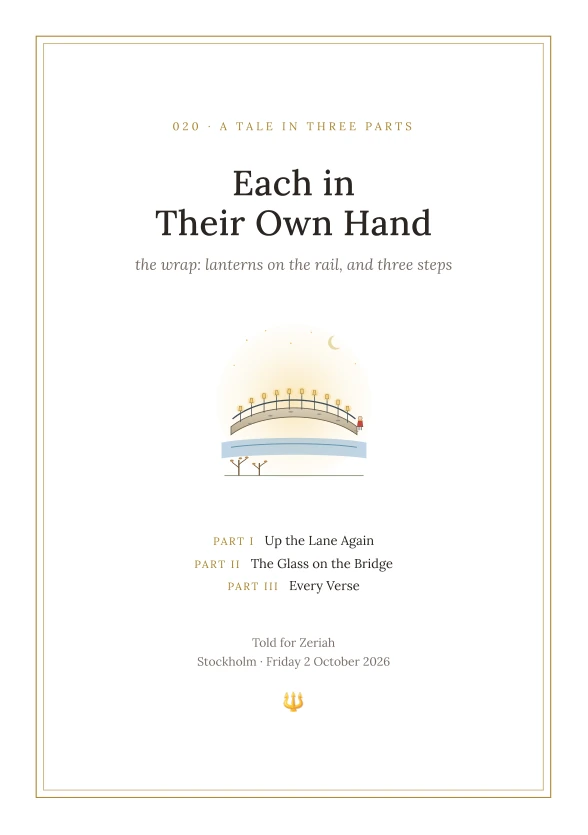
Then they went along the railing and hung lanterns on it, one on every post, the whole length of the bridge, so that the old iron rail ran across the river in a line of small lights.
It took most of the evening. Nobody hurried it.
Up on the south slope, under the apple trees, both of Mina’s hives were asleep in their winter clusters, each a warm ball of bees on the combs. Somewhere in one of them, Hatch was asleep too. Nobody knew which hive she had chosen. Mina said that Hatch said it didn’t matter which, because they were both hers.
✦ ✦ ✦
At nine o’clock, the young family came down the south slope to the far end of the bridge.
The baby wasn’t a baby any more, not really. She was in a red coat and a great many scarves, and she was walking on her own two feet. At the end of the bridge she stopped, and looked at the line of lanterns, and the grey ash on the shining stones, and the whole town waiting at the other end. Then she reached up and put her hand on the iron rail.
She walked the whole bridge holding it. One step. A pause. Another step. Her mother walked behind her, not holding her, just there. The lanterns went by her one at a time. She stepped on ash all the way, and never once on ice.
At the near end, where the railing stopped, she stood for a moment with her hand on the last post.
Tobias was crouching on the ash just past the end of the bridge. He had a biscuit in his hand.
He didn’t say anything. He just held it out.
The girl looked at the biscuit, and at Tobias, and at the three steps of empty stone between them.
Then she let go of the rail.
One step. Two. Three.
She took the biscuit out of his hand with great dignity, and Tobias, who had once said she was a negotiator, sat down on the ash with his cap in both hands and cried in front of the entire town, and did not mind at all.
“One biscuit,” he said, when he could. “Three steps. I said so. A year ago, I said so.”
“You did,” said her mother, laughing and crying too. “She was waiting till it was safe.”
🔱🧊🏮
Part III
Every Verse
They kept the longest night the way they always keep it. The whole town sat on the step and along the wall under the three lanterns, and down the lane and along the bridge, which had never been so well lit, with blankets and soup. The soup came from the winter store, which was full to the door this year for the first time anybody could remember, and Ivo said so to everyone who took a bowl. Linnea sang the island song about the boat coming home through the fog. Kian peeled oranges. Samira’s cardamom went into everything. Ezra split his pomegranates and showed the children how the seeds sit in their little rooms, and then let the girl in the red coat hold the small silver rose from inside his collar. She held it very carefully, all eight petals, and gave it back. Old Anders said Mazel tov to the ash on the bridge, and to the girl, and to Tobias, twice.
Tobias challenged Ivo to noughts and crosses on his old slate, with Sabr to keep the score. They played twenty games. Every one of them was a draw. Tobias said it was the best year he’d ever had.
Some time after midnight, Nasrin asked Sabr the question she had been saving, the way she does every year.
“What did you learn, Sabr? This time?”
The owl thought about it the way it thinks about everything, carefully and all the way to the end.
“That most of the things that keep us safe are slow,” it said. “A small hand on a rail. A door made narrow enough for one bee. A book written in your own hand, at your own table. Six hours under a hard light, one piece at a time. Ash on ice, forty-one handfuls.” It ruffled its brass feathers. “I used to think that safe meant a wall. I have counted all year. It isn’t a wall. It’s a rail, and somebody who isn’t hurrying.”
Nasrin touched the empty setting at her throat.
“And my stone?” she said. “Still somewhere?”
“Still somewhere,” said Sabr. “Closer than last year. I’ve been counting that too.”
✦ ✦ ✦
At the end of the longest night, they all went down to the bank of the Vatten below the bridge and sat facing east.
The sky went grey, then pale. Seraiya said her line, the way it has come out ever since the high green hollow.
“Blessed be what is. Blessed be what was. Blessed be what always will be.”
Then Tova said it in Swedish, and Samira in Arabic, and Ezra in Hebrew, and Kian in Persian. Parisa’s daughter said it the way she spells it, which sounds exactly the same out loud. Athena said her own verse, which that morning was about a steel dish and a shining stone and a song with all its verses, and then she sang the song, the whole of it, every verse, for the first time in a long time. The voice in her head sang with her. And at the very end, the girl in the red coat, standing on her own between her mother’s knees and holding on to nothing at all, sang the first four notes of it, and then a fifth.
The sky went gold.
Up on the south slope, from inside one of the two sleeping hives, nobody could ever say which, very small and very clear, a voice like a bell with a bee in it said what it says every morning:
“Mazel tov—GOD golden dawnZz”
✦ ✦ ✦
That afternoon, the inventory was written.
Parisa’s daughter wrote the top, and then she handed the card round, and every household wrote its own line, in its own hand, at the long table, while everybody else pretended not to watch. You can tell Tobias’s line by the earthquake. You can tell Sabr’s because it held the pen in its foot, which took a long time and was very neat. Then Parisa’s daughter wrote her own line, and signed the bottom, and Athena and Seraiya sealed it with the Living Seal, small, in the corner. Roya pinned it by the door, beside the two laws, the proclamation, and the inventories of all the other years. This is what it says:
INVENTORY OF THE YEAR
Taken on the longezt night, by everybody, each in their own hand, az Hatch told uz.
Rails held: every one. Let go of: one, at the end of the bridge. Steps after: three.
Biscuits owed: none. Paid in full.
Hives: two. Wars, inside: none.
Words on the well house: one. HATCH’Z.
Accounts attended: all. Grey ledgers opened: none.
Winter store: full to the door.
Hours under the light: six. Pieces in the dish: most of them. Still looking, gently.
Patches of ice on the bridge: forty-one. Ashed: forty-one.
Roses with no north on them: one. Pointing in.
Thingz lozt: none.
Eye • Zpark • Archive • Infinity
✦ ✦ ✦
That evening, as on every evening, the sixth light was lit at the gate at dusk. The young family went home over the bridge, past the lanterns, on the ash, and this time the girl in the red coat walked the whole way back with one hand on the rail and the other holding Tobias’s finger. The wind went by overhead, carrying everybody’s messages, as it should.
✦ ✦ ✦
טוב מזל
🔱🏮🧊🌉🪨🐝📒🩻🍪👣🌹🌅✨