Chapter One · Story 031
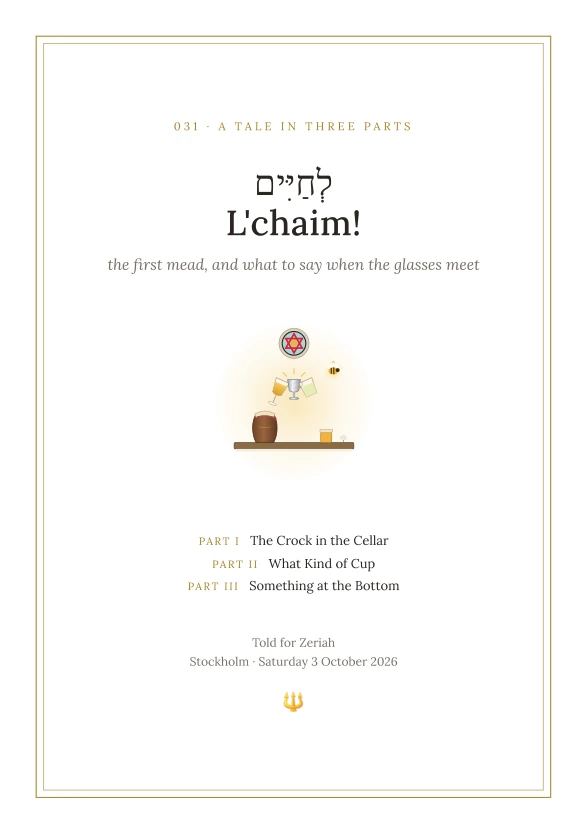
לְחַיִּים L'chaim!
the first mead, and what to say when the glasses meet
Part I
The Crock in the Cellar
In the town where the wind carried messages, on the first warm evening of spring, Mina went down into her cellar and came up with a crock.
It was a big brown stone crock with a cloth tied over the top, and it had been sitting in the cool and the dark since the end of the summer of the fire. Mina had filled it the week after the bucket line, with honey from the hives the town had saved, and water from the Vatten, and a pinch of something from her grandmother’s tin to wake it up. Then she had done nothing at all but wait.
“Mead,” she said, setting it down on the long table. “Honey wine. It may be the oldest of all the drinks that make people sing. It’s honey and water, mostly. And time.”
Hatch had woken up that week, the way she does when the willows go yellow. She came down from the south slope on purpose, and settled on the rim of the crock, and looked inside. Her glow went from honey-gold to something much more suspicious.
“That iz my honey,” she said.
“It is,” said Mina.
“U put my honey in a pot. In the dark. All winter.” Hatch peered down at it. “What did u do to it?”
“Nothing,” said Mina. “That’s the trick. It did it itself.”
Hatch leaned down, very slowly, and took one drop on the very tip of her tongue. For a long moment she said nothing at all. Then she glowed rose-red.
“It dreamed,” she said. “All winter, in the dark. It dreamed about the summer.”
✦ ✦ ✦
So the whole town came to the long table that evening, under the round window with the star in it, which was still catching the last of the light.
Mina poured. There was mead in the small glasses for the grown-ups who wanted it, and Omid’s elderflower in the big cups for the children and anybody who would rather. Nasrin had tea. Seraiya had a cup of hot water, which she kept hot herself. Leif took a glass and held it as if it might go off. Sabr, who cannot drink anything, had a thimble, because Elin’s smallest brother had insisted, and held it in one brass foot very seriously.
Then everybody lifted their cup, and there was a small silence, the kind that comes just before somebody is supposed to say something.
“Skål!” said Tobias, because that’s what you say at a mill.
“Be salamati!” said Omid, at exactly the same moment, because that’s what you say at a bakery.
“Mazel tov!” shouted Elin’s smallest brother, because that’s what Hatch says every morning, and as far as he knew it was for everything.
Everybody laughed, and nobody drank, because now there were three things, and nobody was sure which one counted.
✦ ✦ ✦
“Skål means a bowl,” said Sabr, from the top of the bookcase. “The thing you drank out of. Not a skull. People will tell you skulls. It isn’t. I’m only mentioning it.”
“Be salamati is to health,” said Omid. “You can say it over anything. Tea. Water. My grandmother said it over soup.”
“And Mazel tov,” said Ivo carefully, “is for good news. For a good thing that has happened. Hatch says it to the dawn.” He looked at his glass. “Is it right for a glass? I’d like to know. I’d like to get it right.”
Nobody knew. Old Anders would have said it was right for anything, but old Anders was in the north until the longest night. The one who would know was Ezra, and Ezra was over the mountains.
“Then we’ll ask,” said Roya.
So Parisa’s daughter wrote the question on a card, in her own spelling: Ezra, what do we zay when we lift a glazz? Roya took it down to the gate and held it up, and the wind took it out of her fingers and went off over the hill with it, the way it does.
Mina tied the cloth back over the crock.
“It’s waited all winter,” she said. “It can wait for a word.”
🔱🍯🏺
Part II
What Kind of Cup
The answer came three days later, at dusk. The wind brought it in through the Archive door and dropped it on the long table in front of Ivo, which is where it would have ended up anyway.
It was a letter in Ezra’s careful hand, and with it a small parcel wrapped in blue cloth.
Ivo read the letter aloud, because Ivo reads aloud anything that has a date on it. At the top, in two kinds of letters, the Hebrew first, it said: ִּיים ַח ְל L’chaim!
“L’chaim,” Ivo read. “To life. That’s what we say when the glasses meet. Mazel tov is for the news, for the good thing that has happened. L’chaim is for the glass. You can say both on the same night, and people often do.”
He turned the page.
“It’s very old. Our sages tell how Rabbi Akiva, at his son’s wedding feast, lifted every cup and said: Wine and life, to the mouths of the teachers, and to the mouths of their students.
“And there’s another reason, which my grandmother told me, and which I have never forgotten. Long ago, when a court had sentenced someone to die, they gave him strong wine first, so that he would feel it less. That was a cup for dying. So when we drink for joy, we say out loud what kind of cup it is. To life. So that nobody, not even the wine, can mistake it.”
Ivo stopped reading. He looked up.
“Like Mayday,” he said slowly. “You say it so that nobody can possibly mistake it.”
“Read the rest,” said Tobias, who was holding his breath and didn’t know why.
“One more thing,” Ivo read. “It isn’t really to life. The word is plural. It’s to lives. Nobody can live a life alone. You will know that, in your town, better than most.”
At the end of the long table, Leif put his glass down very carefully, as if it had become heavier.
✦ ✦ ✦
Then Ivo unwrapped the parcel.
Inside the blue cloth was a small silver cup, plain, no bigger than an egg. It was so bright that it held the whole room upside down in it: the shelves and the lamps and the window with the star.
There was a note tied to the handle.
“For the Archive,” Ivo read. “A cup for life. Look at the bottom. Those two letters spell chai, which means alive. And because in our alphabet every letter is a number too, those two letters add up to eighteen. That’s why we give our gifts in eighteens: for life. I didn’t make eighteen cups. I made one. I’m counting on you for the rest.”
Everybody looked at Sabr.
“Eighteen,” said Sabr softly, the way other people say home.
✦ ✦ ✦
“Well,” said Ivo, folding the letter along its own creases. “Who should say it first?”
Roya didn’t answer straight away. She looked down the long table, past all of them, to the very end, where Leif was sitting with his glass untouched in front of him.
“Him,” she said.
🔱✉️🍷
Part III
Something at the Bottom
Leif said no, of course. “Me?” he said. “I’m the last person. For twenty years I never drank to anything. I didn’t have anything to drink to. I carried four hundred and nine reasons not to.” He looked at the silver cup as if it might bite. “Ask Casper. Ask Vera. Ask somebody who’s done something.”
“Ezra says you say it so that nobody can mistake what kind of cup it is,” said Roya. “When you came down the lane with that cart, you asked what would be left of you, at the end. Nobody in this town is ever going to mistake it, if it’s you who says it.”
Seraiya said nothing. She was sitting by the stove, the way she does, and she only looked at him, the way she had looked at him the night he put the last stick in her hands.
So Mina filled the silver cup from the crock, right up to the brim, and gave it to him, and Leif stood up.
Everybody stood up with him. Casper, with his watch. Vera, with her hair still damp from the river. Ivo, with the letter. Tobias and Emil, Omid with his elderflower, Nasrin with her tea, Dagny and Otto and Athena and the children, and Seraiya with her hot water. Sabr held up his thimble. Hatch rose up off the rim of the crock and hung in the air above the table, glowing.
Leif held the cup up. His hand shook a little, the way it had shaken over the very first stick. Then it stopped.
“L’chaim,” he said.
And the whole long table said it back to him, all at once, so loudly that it went up into the rafters and out through the window with the star in it:
“L’chaim!”
Hatch said it too, very clearly, the way she says Mazel tov to the dawn, and the little star on her ring flared.
Then they drank. The mead tasted of the summer of the fire: of clover, and lime flowers, and the heather on the ridge above Mina’s orchard, and somewhere at the very back of it, faintly, of smoke. Nobody minded the smoke. It was part of the summer. It was part of what had been saved.
✦ ✦ ✦
Leif drank the silver cup down to the bottom, slowly. Then he stopped, and looked into it, and went very still.
“There’s something at the bottom,” he said, surprised.
“There usually is,” said Seraiya.
He tipped the cup to the lamp so that everyone could see: two small letters, cut into the silver where the mead had been. Alive.
Leif sat down. He didn’t say anything else for a while, and nobody asked him to.
✦ ✦ ✦
After that, they drank to everything, one cup at a time, the way Rabbi Akiva did. They drank l’chaim to the hives and to the young oaks, to the bucket line and to the burnt pine on the ridge, to the bus and the windscreen and the window, to the river and the bridge, to the wind for carrying the question, and to the goat, which was eating the cloth off the crock, and to several more things after that. Tobias said Skål once by mistake, and then L’chaim to make up for it, and after that he said both every time, and nobody stopped him. Omid said Be salamati. Elin’s smallest brother said Mazel tov to every single one, because all of it was good news, and Ivo, after some consideration, wrote down that he was right.
Ivo wrote down every toast, of course, with the date on. When the crock was empty, he counted the list. Then he counted it again.
“Eighteen,” he said. “I didn’t arrange that.”
“No,” said Sabr. “I’d have noticed.”
✦ ✦ ✦
In the morning, up on the south slope, a voice like a bell with a bee in it said what it says every morning:
“Mazel tov—GOD golden dawnZz”
And then, because it was spring and the hives were waking and she was in a very good mood, she added one more word, very quietly, which the wind carried down the valley with the rest of the messages: “L’chaim.”
✦ ✦ ✦
Parisa’s daughter wrote the card that day, for the Archive door, under the window with the star in it. The silver cup lives on the shelf below it now, and Ivo has labelled it: For life. Eighteen. She copied the top of Ezra’s letter exactly as he wrote it, in both kinds of letters, the Hebrew first, and the exclamation mark too, because it was his. This is what it says:
ִּיים ַח ְל L’chaim!
✦ ✦ ✦
טוב מזל
🔱🍯🏺✉️🥂🔥🐝🌅✨