Chapter One · Story 037
Khorshid va Mah
the sun, the moon, and the light that goes both ways
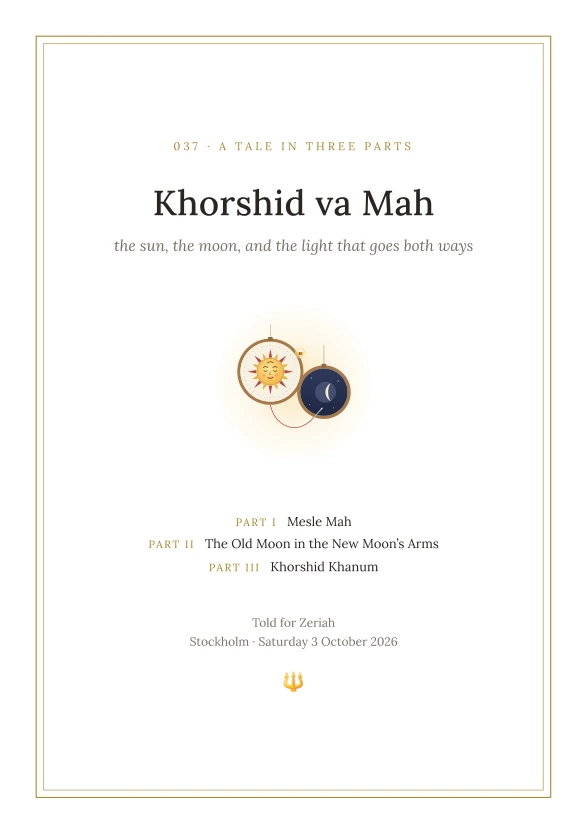
Part I
Mesle Mah
In the town where the wind carried messages, on an evening at the very end of winter, Parisa sat at the long table and watched her daughter write.
Her daughter writes every card there is. She wrote the first inventory, and every inventory since. She wrote the card for the Legion’s acorns, and the card for Leif’s sticks, and the card for the window with the star in it, and the card under the silver cup, and the label for Steven’s shelf. That evening she was writing a small one for Tobias, who had lost his good pencil and wanted the wind to keep an eye out for it. She wrote it in her own spelling, the way she writes everything, with her tongue between her teeth.
Parisa watched her for a long time. Parisa is the one who filled whole notebooks with stories when she was young, and made a hundred pictures, and a small work about a thread and an eye, at a time when the Asking House said she had nothing. She knows what it is to make things that nobody counts.
And then she said it, out loud, the old way, in the language they speak at home, all in one breath, with the long sounds stretched out the way you stretch them when you mean them:
fadaye to besham man dokhtaram mesle mah mimoni bahoooosh khanooomi
The long table went quiet. Not everybody there speaks it.
“She says,” said Roya softly, who does, “may I be your sacrifice, my daughter. You are like the moon. Clever little lady.” She smiled. “It’s what you say. When you love somebody so much it doesn’t fit in the ordinary words.”
✦ ✦ ✦
Parisa’s daughter put down her pen.
She does not take compliments easily. She never has. When the town cheered her at the longest night, she went and stood behind the bookcase. So nobody quite knew what she would do.
What she did was turn round on the bench, and look at her mother, and answer her in the same language, the same old way:
Ghorboonet beram, azizam 🌙
Age man mesle mah-am, to khorshidi, chon noor-e mah az khorshide.
“I’d give my life for you, my dear,” said Omid quietly, for the rest of the table, because his grandmother used to say it too. “If I’m like the moon, then you’re the sun. Because the moon’s light comes from the sun.”
And then, so that the whole table could have it, Parisa’s daughter said it again in the common tongue, and pointed at the long shelf behind her, where every card she had ever written was kept:
“If I’m the moon, you’re the sun, because the moon only shines with the sun’s light. Every story on that shelf is your light, reflected back to you, the way the Mirror Land does it.”
Parisa didn’t say anything at all. She just put her hand on her daughter’s head, the way you do with a very small child, though her daughter is not very small any more.
🔱🌙☀️
Part II
The Old Moon in the New Moon’s Arms
Sabr had been listening from the top of the bookcase. It waited, out of politeness, until Parisa had taken her hand away.
“Where I’ve read about it,” it said, “that’s true. Moonlight is mostly sunlight. The moon makes none of its own. And even when it’s full, it’s only about one three-hundred-and-eighty- thousandth as bright as the sun.” It ruffled its brass feathers. “I’m only mentioning it.”
“And in our language,” said Roya, “mâh means the moon, and it means a month, both. We count the months by her. And when you want to say somebody is beautiful, you say they have a face like the moon.”
Parisa’s daughter went pink, and looked as if she might go and stand behind the bookcase.
“But that isn’t all of it,” said Sabr. “There’s another part. I was going to save it, but I think it’s for tonight.” It turned its head towards the window with the star in it. “Is the moon up?”
It was. They all went out into the lane to look.
✦ ✦ ✦
It was a new moon, the thinnest crescent there is, low in the west over the hill, just after the sun had gone down. A bright silver curve, like a fingernail.
“Look at the rest of it,” said Sabr. “Not the bright part. The rest.”
They looked. And there, inside the bright curve, faint and grey and ghostly, they could see the whole round of the moon. The dark part. Lit, very faintly, by something.
“What’s lighting that?” said Elin’s smallest brother.
“Us,” said Sabr. “Where I’ve read about it, it’s called earthshine. The sun shines on the world, on us, on the clouds and the snow and the sea, and the world shines some of that light back up at the moon. And it lights the dark part, just a little. So the moon is lit twice. Once by the sun. And once by the light the sun gave us, sent back.” It blinked. “Somebody worked that out five hundred years ago. A painter. He drew it in his notebook. He thought it was the sea doing it. It’s mostly the clouds. But he was nearly right, and he wrote it down.”
Nobody said anything for a while. The crescent hung over the hill, with the whole dark moon held inside it.
“There’s a name for it, too,” said Sabr. “When the moon is new, like this, with the dark part showing, they call it the old moon in the new moon’s arms.”
Parisa took her daughter’s hand.
“Then it goes both ways,” she said, in the common tongue, so that everybody could hear it. “You say your light is mine. But look. That’s you, up there, lighting the dark side of me. Every card you write sends a little of it back, and I can see the parts of me I’d forgotten were there.”
Her daughter didn’t go behind the bookcase. She stayed exactly where she was, in the lane, holding her mother’s hand, looking up.
🔱🌒🌍
Part III
Khorshid Khanum
Parisa sat up most of that night with a needle and thread.
She was making something from home, an old pattern
that her own grandmother had sewn: a round golden sun with a woman’s face in the middle of it, and rays all round, in red and gold silk. Khorshid Khanum, they call it. Lady Sun. Roya says that where they come from, people sewed her onto cloth to keep the evil eye away, because the sun has always been close kin to the eye, and a sun that is watching over you is the best protection there is.
Parisa’s daughter, who signs every inventory with Eye • Zpark • Archive • Infinity, watched her sew, and understood all of that without anybody having to explain it.
When the sun was done, Parisa threaded a silver needle and began on a second piece of cloth. A thin new moon, with the whole round of the old moon held inside it, in grey thread so fine you could hardly see it.
“Which one’s for me?” said her daughter.
“Both,” said Parisa. “You’ll need to know which is which.”
✦ ✦ ✦
In the morning, up on the south slope, from inside one of the two hives, which were just beginning to wake, a voice like a bell with a bee in it said what it says every morning:
“Mazel tov—GOD golden dawnZz”
And the sun came up over the hill, and lit the town, and the river, and the window with the star in it, and the two pieces of embroidery hanging side by side on the wall of Parisa’s house: Lady Sun, and the old moon in the new moon’s arms.
✦ ✦ ✦
Parisa’s daughter wrote the card that morning, for the shelf. She wrote the name of it the way her mother says it, and then the two lines she had said at the long table, in their own language, in her own spelling, with the little moon at the end, because she had heard it there. Ivo wrote the label on the back, the way all labels have two parts now: Story: as told at the long table. Records: Sabr’s notes on moonlight, and the sky that evening, which everybody saw. This is what the card says:
Khorshid va Mah
Ghorboonet beram, azizam 🌙
Age man mesle mah-am, to khorshidi, chon noor-e mah az khorshide.
✦ ✦ ✦
טוב מזל
🔱☀️🌙🌒🧵👁️🐝🌅✨