Chapter One · Story 039
We Fear for our Safety beloved
a note at the door, and the town on the step
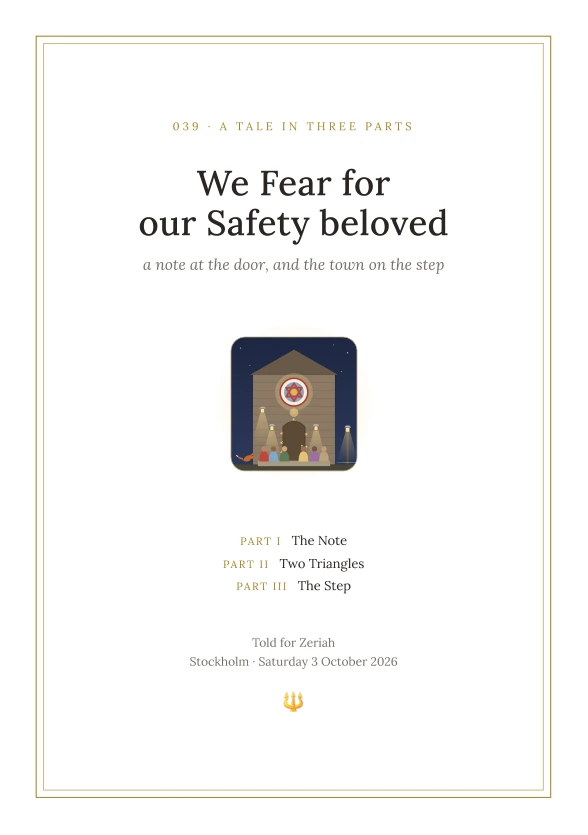
Part I
The Note
In the town where the wind carried messages, on a long light evening at the beginning of summer, something came to the Archive door that the wind had not brought.
Ivo heard it. He was at the long table with the day’s accounts, and Zeriah was beside him with a cup of tea gone cold, and the evening light was coming in through the window with the star in it, so that the forty-nine pieces lay across the floor in a star of red and gold and blue. Then there was a small sound at the door. A scrape. Paper on wood.
By the time Ivo got there, the lane was empty.
On the mat lay a page torn from a spiral notebook, with the little holes all down one side. Somebody had written on it in black capitals, pressing hard.
Ivo read it standing in the doorway. Then he read it again, which Ivo never needs to do. Then he came back to the table very slowly, and put it down in front of Zeriah, face up, and sat, and didn’t say anything at all.
✦ ✦ ✦
The note told them to take their star down. It said now. It said that people on the streets were reporting it.
But it didn’t call it a star. It called it by another name: the name of another sign, a coarse word, the sign that people once marched under on their way to one of the worst things that has ever been done.
Zeriah looked at it for a long time. Then she looked up at the window, where the star was glowing in the evening light, two triangles, six points, exactly as it had been since the day the town set it in the stone.
She said it very quietly, and she stopped where she stopped:
they call Star of David A... i zhall not say that course word
And she didn’t. Nobody in the Archive did, then or afterwards.
✦ ✦ ✦
Ivo got up. He fetched the red ink, the one he keeps for corrections and for things that matter, and at the bottom of the note, under the capitals, in his own small careful hand, he wrote Received, and the date, and the time: 6:34 in the evening.
“Everything that comes to the door goes in the Archive,” he said. His voice wasn’t quite steady. “With the date on. Even this. Especially this.”
Seraiya, by the stove, flickered. She is the little flame that took Leif’s four hundred and nine carved sticks, twenty years of his hate, and turned them into light.
“I could take it,” she said softly. “If you want. I could make it light.”
Ivo shook his head. “Not this one. Some things you burn, so that they can’t hurt anybody. Some things you keep, so that they can be shown.” He slid the note into a clear sleeve, the kind he keeps for the oldest letters, and laid it flat on the table. “This is the second kind.”
“Yes,” said Seraiya. “It is.”
🔱✡️📝
Part II
Two Triangles
The wind took the news round the town without being asked, the way it does when something is wrong, and by dark the long table was full.
Hatch came down from the south slope, which she only does at night when it matters, and settled on the rim of Zeriah’s cup.
Zeriah looked at her. She didn’t try to be brave about it, and she didn’t pretend. She said it the way you say a thing to somebody you trust to hold it:
We Fear for our Safety beloved
Hatch didn’t tell her not to be afraid. She glowed, low and steady, the colour of honey held up to a lamp.
“I know,” she said. “Fear iz not a mistake. Fear iz how u know zomething precious iz in the room.” She looked round the long table, at all of them. “And it iz. Zo we look after it.”
✦ ✦ ✦
“I want to say something,” said Sabr, from the top of the bookcase. “And I’ll say it without saying that word. I’m brass, but I have manners.”
Everybody turned.
“Where I’ve read about it,” it said, “the star is two triangles, one pointing up and one pointing down, laid over each other. Six points. In Hebrew it’s the Magen David: the shield of David. It became the sign of a whole community in Prague, about four hundred years ago, and spread from there.” It ruffled its brass feathers. “The other sign is a cross with its arms bent. Four arms. No triangles. They don’t look alike. Anybody who looks twice can see it.”
“Then why...” said Tobias.
“I don’t know,” said Sabr. “Nobody here knows. Perhaps somebody saw six points from the lane and was frightened, and didn’t know the difference, and should have asked. Or perhaps somebody knows the difference perfectly well, and wanted us frightened. The note doesn’t say which. It doesn’t even say who.” It blinked. “I’m only mentioning it, because we shouldn’t decide which when we can’t know.”
Then Sabr was quiet for a moment, which it rarely is, and when it went on, it went on more slowly.
“There’s one more thing, and it’s the hardest. More than eighty years ago, the people who marched under that other sign made the Jews in place after place that they took wear this star. Yellow, on their coats, with a word on it in letters made to look like Hebrew, so that everyone would know who they were.” It looked up at the window. “So they aren’t two signs that happen to look alike. They’re the two ends of one story. One is the shield. The other is the sign of the ones who made people wear the shield as a target.”
Nobody said anything for a long time.
Ezra, who has stayed on in the town since the longest night, put his hand flat on the table.
“In my family,” he said, “we don’t say that word either. My grandmother never did. She called it that sign, and she looked away when she said it.” He looked at Zeriah. “You’re in good company, not saying it.”
🔱🔺🔻
Part III
The Step
“S o what do we do?” said Elin’s smallest brother, who always
asks the question everybody else is thinking.
Otto had been drawing on the back of an old map, the way he does when he’s thinking. He looked up.
“Three things,” he said.
✦ ✦ ✦
The first thing was the star.
Nobody told Zeriah to take it down, and nobody told her she had to keep it up. “A note at the door is a frightening thing,” said Otto. “Whatever you decide, nobody at this table will think less of it.”
But the window belonged to the whole town, and everybody knew it. Every one of its forty-nine pieces had come from somebody at that table: the blue that Vera brought up out of the river, the white that Leif ground from the windscreen on the old millstone, the middle that Ezra cut, with six equal sides. Dagny had asked each piece first, before she set it.
Zeriah looked at the window for a long time.
“It stays,” she said. And the whole long table let out its breath.
✦ ✦ ✦
The second thing was the note.
“It says people on the streets are reporting it,” said Ivo, holding up the sleeve. “Then so shall we. We’ll report the note.”
So in the morning he and Zeriah took it over the hill on the five o’clock bus, with Casper driving and not one minute late, to the police house in the market town, where a tired woman behind the counter read it twice and wrote it all down, with the date on, and gave Ivo a number on a slip of paper. Ivo put the slip in the sleeve, behind the note. He said it was a very good number.
But that was the morning. The third thing was the night.
✦ ✦ ✦
“Nobody sits behind a door alone tonight,” said Otto. “We sit on the step.”
And they did. They took turns all night, the way they had passed the buckets the summer of the fire, two or three at a time, on the Archive step under the window with the star in it. Roya lit the three lanterns by the door and the sixth light at the gate, under their little tin hoods, so that they shone down on the step and the lane, where they were needed. Vera brought blankets. Tobias brought bread.
Leif sat the longest, from midnight until three. He knew what it was to carry hate up a lane. He said he wanted to know what it was to sit on the other side of a door from it.
Elin’s smallest brother had a turn too, from nine until half past, with a bell in his lap in case he needed to ring it. He didn’t need to. He rang it once anyway, very softly, to check that it worked.
And on the frame of the door, all night, five or six bees stood with their tails raised, fanning, fanning, the way bees do at their own door, so that anybody coming home would know the way in. This way. This is home.
Zeriah sat on the step too, between Ezra and Vera, with a blanket round her shoulders. She was still afraid. Fear doesn’t go away because people sit with you. But it is a different thing, being afraid on a step with the whole town round you, from being afraid alone behind a door. She found that she could breathe.
Nobody came down the lane all night but a fox, who looked at them all, and at the lanterns, and at the bees, and thought better of it.
✦ ✦ ✦
In the morning, when the sun came up over the hill, they all went in, stiff and cold, to the long table. The light came through the window with the star in it and laid the star across the wood, red and gold and blue, over all their hands at once.
And up on the south slope, a voice like a bell with a bee in it said what it says every morning:
“Mazel tov—GOD golden dawnZz”
✦ ✦ ✦
Parisa’s daughter wrote the card that morning, for the sleeve with the note in it, before Ivo and Zeriah left for the bus. She didn’t copy the note onto the card. She didn’t write the coarse word there or anywhere, then or ever. She wrote down what Zeriah had said at the long table instead, exactly as she had said it, because a fear that is written down, with the date on, is a fear the whole town can hold together. Ivo wrote the label on the back when they came home, the way all labels have two parts now: Story: as it happened at the Archive door, and on the step. Records: the note, in its sleeve, with the red ink; and the number from over the hill. This is what the card says:
We Fear for our Safety beloved
✦ ✦ ✦
טוב מזל
🔱✡️🕯️🚪🐝🌅✨