01 A chapter of the tale
Part I: The Gate
In a town where the wind carried messages, there was a gate with a lantern beside it, and everybody knew whose it was.
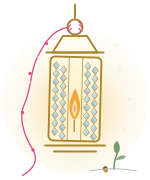
It wasn't a grand lantern. It was small and gold and a little crooked. If you looked closely, you could see that one of its panes was newer than the others, and that the old pane beside it had a crack running through it, mended with a thin line of gold. Around its handle someone had wound a length of pink thread, faded now to the colour of the inside of a shell. Next to it hung a small, wonky thing made of a black stone, a blue bead, a brass screw and what was left of a feather, all bound together with more of the same thread. And on the gatepost underneath, someone had painted an eye.
The lantern had one gift. It glowed warmer the closer someone loved came home.
It had been Roya's grandmother's lantern first. Roya's mother had grown up under it, and once, on a stormy night the town still talked about, had saved it. When Roya's grandmother died, the lantern came to their gate, the way lanterns do, and Roya grew up under it too. Every evening when she came up the lane from school or the market or the river, it warmed to meet her like a face breaking into a smile.
The spring Roya turned eighteen, she started lying awake at night.
She wasn't unhappy. She loved the town: the river and the bridge and the plum tree on the river road. She loved her mother, who mended things for half the town and hummed while she did it. But lately she had begun to feel like a thread that had come loose from something, and she didn't know what.
"Everyone knows what they're for, Maman," she said one evening. They were sitting on the step, the way they often did when the work was done. "Leila's going to be a doctor. Omid's taking over the bakery. Even the clockmaker's grandson knows he's going to fix clocks. And I don't know what I'm going to be. I don't even know how you're supposed to find out."
Her mother didn't answer straight away. She looked at the lantern for a while. Then she got up, went into the house, and came back with a wooden box. Roya had seen it on top of the wardrobe all her life and had never once seen it opened.
Inside was a great ball of pink thread, wound tight and a little faded, and a folded map drawn by hand on paper gone soft as cloth.
"The night of the storm," said her mother, touching the ball. "When your grandmother lost her way home. I wound it all up again afterwards, all the way from the bridge, and I've kept it ever since." She unfolded the map. "And I drew this when I was about your age. I felt exactly the way you do. So I went looking."
On the map were three small pink crosses. One was far in the north, on a harbour, and beside it, in her mother's young handwriting, were the words where they make the morning. One was on a tiny island in a scatter of islands: the island that listens. The third was far to the south and east, beside a city drawn as a cluster of little domes: the city of mirrors?
"Why is there a question mark?"
"Because I never got that far," said her mother. "I turned for home."
"Did you find it? What you were looking for?"
Her mother smiled. "I found out I'd been looking in the wrong direction. But you can only find that out by going the long way. Everyone has to."
Roya looked at the map for a long time. Then she looked at her mother, and her mother, who knew her better than anyone, was already nodding.
She left at the end of summer, with a pack on her back, the map in her pocket and the ball of pink thread in her hands.
"It isn't for sewing," her mother said at the gate. "Wherever someone is kind to you, wherever you're loved, tie a little piece of it. Then there'll always be a way back."
"What if it runs out?"
"Then be careful with it," said her mother. "And if it runs out anyway, you'll have to trust the rest of the way." She took Roya's face in her hands. "Remember, the wind carries messages from this town. If I ever need you home, I'll send you a thread. Now go, dokhtaram. Go and see."
Dokhtaram. My daughter. Her mother hadn't called her that since she was small.
Before she went, Roya broke off the first piece of thread and tied it round the gatepost, just under the painted eye, because this was the first place she had ever been loved.
Then she walked down the lane. When she looked back from the corner, the lantern was dimming, a little with every step she took.
"It's going dark!" she called, suddenly afraid.
"It's supposed to," her mother called back. "That's how you know it's working. It'll light again when you're coming home."
🔱🏮🧵
02 A chapter of the tale
Part II: The Loom in the North
The journey north took most of the autumn.
Roya went by train and by ferry and by long, rattling buses, and when there were no buses she walked. She slept in hostels and barns, and once, memorably, in a lighthouse. And she did what her mother had told her. She tied a piece of pink thread to the mirror of a bus driver who shared his lunch with her. She tied one to the railing of a ferry whose cook gave her soup for nothing, and one to the door of a farmhouse where an old couple let her sleep by the stove. The ball in her pack grew a little smaller, and the world behind her grew a little pinker.
She reached Norrvik as the dark season began.
It was just as the map had promised: a harbour town at the top of the world, where the sea froze at its edges and the winter nights were long enough to lose a week in. And the mornings, when they came, were extraordinary. Roya had never seen a dawn like it: gold and rose, with a deep sea-green running through the sky like a current, and one long silver thread that caught the light like frost.
"You want the Dawn Weaver," said an old fisherman on the quay, when she showed him the map. He had a white beard, a voice like a foghorn and a laugh that made the gulls take off. "Up the hill. Stone house, big window. Tell her Anders sent you. And mind the cat."
The Dawn Weaver was younger than Roya had expected, with her hair tied up in a strip of blue cloth and threads of every colour stuck to her sleeves. Her name was Tova. She looked at Roya, and at the map, and then for a long moment at the ball of pink thread, and something passed over her face that Roya couldn't read.
"Come in," she said. "Mind the cat. She's a liar. So was her grandmother."
Roya stayed all winter.
Tova taught her the loom, which was older than the house and carved with an eye, a wave and a three-pronged spear. She showed Roya how to string the warp, how to throw the shuttle and how to beat each row tight. And she taught her the thing that mattered most, the thing that had been true in Norrvik for as long as anyone could remember.
"Every golden thread in the dawn was once something a person gave," she said. "A song. A door held open. A debt forgiven. When something is given freely, gold comes loose from it, and the wind carries it up the hill. You can give anything that's yours." She paused. "Never anything that isn't. Taken gold is only grey."
So Roya watched the town give, and learned. She watched Anders sing his long, rude song about a mermaid and a tax collector, which had more verses now than it used to, and saw the threads come off it, green as the sea. She watched the clockmaker's brother, who had come home years ago and never left again, wind the harbour clock every Sunday and hold the door for whoever came by. She watched a hundred small kindnesses go up the hill as gold.
One night near midwinter, the spools ran short.
It wasn't a crisis. Tova said it happened some winters, and the town always caught up by morning. But Roya stood in front of the loom that night, looking at the gap along the top of the cloth, and then she took out the ball of pink thread.
She held it for a long time. It was her way home. Every piece she gave away was a piece she wouldn't have later.
But it was hers. Her mother had given it to her, and a thing that's given to you is yours to give.
She broke off a long length, longer than any she had tied yet, and laid it across the loom.
"Are you sure?" said Tova quietly.
"Yes," said Roya, and found that she was.
The pink didn't turn gold. It stayed pink, but it began to shine softly, like the inside of a shell held up to the sun. Tova wove it in along the top of the cloth. In the morning, when the dawn went up over Norrvik, a line of rose-pink ran through the gold, right at the top, where the sky began.
Down on the quay, old Anders stopped halfway through a verse.
"Pink!" he bellowed, loud enough for the whole harbour. "There's pink in it! I haven't seen pink in the dawn since—" Then he stopped, turned, and looked up the hill at the stone house, where Roya stood in the doorway.
That evening he came up the hill, took off his cap and sat down by the fire.
"There was a girl," he said. "Oh, a long time ago, before you were born. She came up the hill the winter old Ester was teaching Tova here. She had a ball of pink thread just like that one, and she gave a piece of it to the loom. Ester said she'd never seen anything like it. Someone giving away part of their own way home."
Roya's hands had gone very still. "My mother," she said.
"I thought so," said Tova. "I was eleven. I remember her. You have her way of standing at a loom, as if you're listening to it." She reached under the loom and brought out a small wooden spool with a single strand wound round it. It was gold and pink, and it glowed a little, even in the lamplight.
"This came loose from your gift when I wove it in," said Tova. "It's yours. It always was. Keep it for a morning when you need one."
Roya tied a piece of pink thread to the leg of the loom, right under the carved eye. The week the sea froze, she set out south across the ice to find the island that listens.
"Tell Maja I said hello," said Tova at the door. "Everyone in the north knows Maja. And Roya, whatever you're looking for, you're closer than you think."
Down on the quay, old Anders waved his cap and shouted after her the phrase he used for everything too big for ordinary words: "Mazel tov!"
🔱🧶🌅
03 A chapter of the tale
Part III: The Island That Listens
Roya crossed to Ekö on foot.
That winter the sea froze solid across the whole archipelago. People walked between the islands on paths marked across the ice with spruce branches, with spikes strapped to their boots and long poles in their hands. Roya walked for two days, past the last lighthouse, where the islands thin out into rocks and the rocks thin out into sea. On the evening of the second day she saw it: a small island with one harbour, one school, one shop and a wood.
It wasn't a big wood. The trees were young oaks, no taller than houses, crowded into every gap between the rocks and all along the paths, and when the wind went through their bare branches, they whispered. In the middle of the island, on the rise, stood one old oak, very tall and very straight, with thin silver scars down its trunk and a hollow at exactly the height of a child's mouth.
The harbour master met her on the ice. She was a woman in her thirties, with a weathered face and a quick laugh, and her name was Maja.
"Tova sent me," said Roya.
"Then you're very welcome," said Maja. "Tova only sends people who need something. Come and get warm first. You can tell me what it is after."
Maja's mother, Linnea, was old now and sang all the time: while she cooked, while she mended nets, while she walked across the ice to the next island to visit her friends. Holm, the old harbour master, came by every evening to grumble about how Maja was doing his job, and then stayed for dinner and admitted she did it better. And every Tuesday, on a rock off the south shore, a grey seal hauled itself out to lie in the thin winter sun. Everyone on the island agreed it must be Admiral's granddaughter.
On her third evening, Roya asked about the tree.
"People tell it things," said Maja. "They always have. The things they can't say yet to the ones they're meant for. It keeps them. And sometimes, if a thing has been waiting long enough, the tree lets the right person hear it." She looked at Roya carefully. "There's one rule. You only hear what's yours. If you hear something that isn't, you step back and leave it."
"There won't be anything of mine," said Roya. "I've never been here."
Maja and her mother exchanged a look that Roya didn't understand.
"Go and listen anyway," said Linnea gently. "If there's nothing, you'll hear the wind. That's all right too."
So Roya climbed the rise in the cold blue dusk, knelt in the snow between the roots and put her ear to the hollow.
At first there was only the wind. Then, underneath it, faint and far down, there was a voice.
It was a young woman's voice, a little nervous and half laughing at itself. Roya had never heard it in her life, and she knew it instantly, the way you know your own name.
"Dokhtaram," it said.
Roya pulled back so fast she sat down in the snow.
When she came back down the hill, her face was wet. Linnea put a cup of something hot into her hands without asking anything.
"Your mother came here the winter after the night of listening," Linnea said. "So young. She'd heard about the tree, and she wanted to leave something for someone who didn't exist yet. I thought it was the most beautiful thing I'd ever heard of." She smiled. "I taught her a song while she was here. For twenty years I've wondered whether she ever sang it to anyone."
"Which song?" said Roya.
So Linnea sang it: an old island song, the kind everybody half-knows, about a boat coming home through the fog. Roya had never heard it before. But by the last verse, she found she could sing along.
What else her mother had said into the hollow all those years ago, Roya didn't tell Maja or Linnea or anyone. It was hers. She kept it the way you keep a coal cupped in your hands in the cold, and it would be months before she needed it.
Before she left Ekö, she climbed the rise once more. High on the old oak, on a branch well out of reach, she could just see a faded scrap of pink thread, tied there almost twenty years before. Roya tied her own piece on the lowest branch, right beneath it.
Then she knelt at the hollow and told the tree something of her own, a thing she hadn't been able to say to anyone: I'm afraid I'll come home and still not be anything.
The tree took it, the way it takes everything. But Roya had been on Ekö long enough to know this wasn't where it belonged. A thing that's meant for someone should be said to them, one day.
On the morning she left, Maja walked her out across the ice to the marker where the path turned south. There she took an acorn out of her pocket and put it in Roya's hand.
"From the old one," she said. "Plant it somewhere that needs listening to."
🔱🌳🌰
04 A chapter of the tale
Part IV: The City of a Hundred Moons
The map had a question mark over the city of mirrors, so Roya had to go the rest of the way without her mother's handwriting to guide her.
It was a long way. She went south through the melting spring, east across a sea and over mountains where snow still lay in the passes, sometimes on trains and sometimes in the backs of lorries. Her thread grew thinner with every place that was kind to her: a café owner, a woman on a train who shared her oranges, a border guard who saw how tired she was and let her sleep in the warm office until the morning bus. At last she saw the city: turquoise domes rising out of the plain, and a smell of orange blossom so thick it seemed to hang in the air. By then the ball of thread had become a small, loose knot that fitted in the palm of her hand.
She found the lane in the bazaar by its sound: the small, bright tick, tick of glass being cut, all day long, like rain on a tin roof.
In the doorway of the workshop at the end of the lane sat a woman with plaster on her hands and a cutting wheel with a worn brass handle. In the corner behind her was an old cushion that nobody sat on. At the bench beside her, a grey-haired man was cutting stars from a sheet of mirror and humming under his breath.
"You've come a long way," said the woman, looking at Roya's boots.
"From the north," said Roya. "And before that, from a gate with a lantern. I'm looking for... I don't know what I'm looking for. My mother never got this far."
The woman smiled. "Then you'd better come in and find out. I'm Nilu. That's my brother, Kian. He'll tell you he taught me everything. Don't believe him."
"I taught her everything," said Kian, without looking up.
Roya stayed through the last weeks of winter and into the spring. Nilu taught her mirror-work: how to score the glass and snap it clean, how to mix the plaster so it held without cracking, and how to set each piece at the tiny angle that makes it catch the light. Roya was terrible at it. Her first piece of cut glass looked like a broken tooth.
Kian picked it up, held it to the light and laughed until he had to sit down.
"This is perfect," he said, wiping his eyes. "It's exactly as bad as mine was. Nilu, look. She's one of us."
In the evenings Nilu took her to the Hall of Mirrors in the old palace. They lay on their backs on the cool floor under the great ceiling, a sky of glass, stars within stars within stars, thousands of small pieces catching the lamplight and throwing it back. Right in the middle, where the pattern turned, one piece didn't quite match. Nilu told her whose it was.
It was there, lying under the ceiling one night, that Roya finally said it out loud.
"Everyone I've met knows what they are," she said. "Tova is the Dawn Weaver. Maja keeps the harbour. You made all this. I've come all this way, and what have I got? A bit of thread. A strand of gold. An acorn. I'm not anything. I'm just collecting pieces."
Nilu was quiet for a while.
"When I was small," she said, "I asked my brother every morning if I looked good. Dadash, khoob shodam? And every morning he told me I looked like the moon, even when my plait was crooked. It took me twenty years to understand he wasn't talking about my hair." She pointed at the ceiling. "Look at it. What's it made of?"
"Pieces," said Roya.
"Broken pieces," said Nilu. "Every one of them. My old master used to say, broken is where the work starts. A whole mirror shows you one face. Pieces, set with care, show you a thousand lights." She turned her head to look at Roya. "You're not a collection of pieces. You're a piece of work that isn't set yet. That's all. That's all any of us ever was."
The next day, Nilu put a small round of white plaster in Roya's hands and a heap of offcuts in front of her. "Make something," she said. "Take as long as you like."
It took Roya nine days. When she was finished, she had a star no bigger than her palm, made of seventeen small pieces of mirror and a little crooked on one side. When she held it up to the lamp, it threw seventeen small lights across the walls of the workshop, and every one of them trembled.
"Keep it," said Nilu. "Always keep the first thing you make well."
On the last evening of the old year, Roya celebrated Nowruz in the Hall of Mirrors with half the city. In the middle of the long room stood the haft-sin table. In its centre, where the mirror always goes so the new year can look at itself, was a little round walnut frame with forty-one pieces of mirror inside, set in the shape of a water lily. When the new year turned, people hugged and kissed and called "Nowruz mobarak!" to each other, and Kian pressed a new coin into Roya's hand as if she were one of the children. She tied a piece of pink thread to the old scaffold pole that Nilu kept in the corner of the hall, for luck.
When she woke the next morning, there was a thread round her wrist.
It was pink, tied in a bow, the way her mother used to tie her ribbons when she was small. The window was open a crack, and the curtain was moving in the wind.
If I ever need you home, I'll send you a thread.
Roya sat up very straight.
"Home?" said Nilu, seeing her face at breakfast.
"Home," said Roya.
Kian drove her to the bus station himself. "Five days, if the passes are open," he said, and gave her a bag of oranges and a hug that nearly lifted her off her feet. Nilu stood at the door of the bus, the way she had once stood at the door of a bus herself, a long time ago.
"Go," she said. "Go and show her."
🔱🪞🌙
05 A chapter of the tale
Part V: The Way Home
The passes were open, but only just.
For four days the buses crawled north and west through the mountains and down across the plains. Roya sat by the window with the star in one pocket, the acorn and the spool of gold in the other, and the last of the pink thread wound round her fingers. There was only a finger's length of it left. She had tied the rest across half the world.
At home, the lantern had begun to warm the moment she turned for home, a little more every day, a little more every hour. By the fifth evening it was glowing brighter than her mother had ever seen it. That was when the storm came, and her mother understood that Roya must be very close, and very lost.
On the fifth evening, the bus stopped.
It was almost dark, and the heavy, sideways rain that comes before a storm had started. A tree was down across the road at the edge of the valley, and the driver said nothing was going anywhere until morning.
Roya looked out of the window. On the other side of the hill was her town. She could almost smell the river.
"How far on foot?" she asked.
The driver looked at her as if she were mad. "Over the hill? Two hours, in daylight. In this, I wouldn't."
Roya put on her pack and got off the bus.
For the first hour it was only hard. The path went up through the dark, the rain came down, and the wind pulled at her pack and her hair and her coat. Then, near the top of the hill, the fog came.
It rose out of the valley all at once, thick and white and blind, and swallowed everything: the path, the rocks, her own hands in front of her. Roya stood still in the middle of it with the wind howling and her heart going like a drum, and she understood, very clearly and very calmly, that she was lost.
Somewhere on the other side of the fog was a gate with a lantern that glowed warmer the closer someone loved came home. But it was too far, the fog was too thick, and she couldn't see anything at all.
She was frightened. She will tell you so honestly, even now.
Then she remembered Ekö, and Maja, and the rule of the tree, and she did the only thing she could think of.
She stopped trying to see, and listened.
At first there was only the wind. Then the rain. Then, underneath them both, so faint she thought she was imagining it, there was something else.
Someone was singing.
It came up through the fog from far below and a little to the left: an old island song, the kind everybody half-knows, about a boat coming home through the fog. Only one person in her town knew that song, because only one person in her town had ever been to Ekö.
Roya turned toward it.
She took out the little wooden spool Tova had given her in the stone house at the top of the world. Keep it for a morning when you need one. She held it up in the dark, and the strand of gold and pink began to glow, softly at first and then brighter, until she was holding a small dawn in her hand.
With her other hand she took out her star.
The light from the gold thread struck the seventeen small pieces of mirror, and they caught it and threw it into the fog: seventeen lights, then more, bouncing from droplet to droplet, a hundred small moons scattered through the white around her. By their light she could see the path again, a few steps at a time: the rocks, the wet grass, the way down.
Far below, a woman who had been singing at a gate in the rain for three hours looked up at the hill and saw a hundred small lights moving down through the fog. She stopped singing and put her hand over her mouth. Then she sang louder than ever.
Roya walked toward the song. And as she walked, she let herself open the thing she had carried all winter, cupped in her hands like a coal: the rest of what her mother had said into the hollow of the oak on Ekö nearly twenty years ago, to a daughter who didn't exist yet.
Dokhtaram. I don't know you yet. I don't know who you'll be, or where you'll go looking, or what you'll find. But whoever you turn out to be, however far you go, I'll be at the gate.
At the bottom of the hill, something brushed her hand.
A thread. Pink, pulled taut through the rain and humming faintly in the wind like a plucked string.
Roya followed it with her fingers. It ran from a fence post at the foot of the hill to the plum tree on the river road, then to the bench by the fountain, the baker's railing and the lamppost at the corner. Somebody had tied it there that night, every few steps, all the way to the top of the lane. At the end of it, with one hand on the gatepost where it was tied, soaked to the skin and still singing, stood her mother.
Above her the lantern was blazing. Roya had never seen it so bright. It lit the whole lane gold, and neighbours were leaning out of their windows in their nightclothes to look at it.
"You tied a thread," said Roya, stupidly.
"I didn't want to only wait," said her mother. "Not on a night like this. I did it once before, for your grandmother, when I was small. Omid and the clockmaker's boy helped me." Then she couldn't say anything else, and neither could Roya. For a long time the two of them stood in the rain at the gate, holding on to each other so tightly that the thread went slack between them.
Later, in the warm kitchen, with her wet things steaming by the stove, Roya emptied her pockets onto the table.
A little wooden spool, dark now, its gold all used up. A star made of seventeen pieces of mirror, a little crooked on one side. An acorn from an island at the edge of the sea. And a finger's length of pink thread.
Then, because she had learned on Ekö that a thing meant for someone should be said to them, she said it.
"I didn't become anything, Maman. I went all that way, and all I did was collect pieces." She looked down at the table. "Khoob shodam? Did I turn out well?"
Her mother looked at the things on the table for a long time. Then she looked at Roya.
"Where did you tie the thread?" she asked.
So Roya told her. The gatepost, under the eye. A bus driver's mirror. A ferry railing. A farmhouse door. A loom at the top of the world, and the dawn itself. An old oak on an island, right under a faded piece of thread someone had tied there twenty years before. A café, a train, a border post. A scaffold pole in a hall of mirrors. Everywhere someone had been kind to her, everywhere she had been loved.
When she finished, her mother was smiling in a way Roya had never seen, not even at the lantern.
"Dokhtaram," she said. "You didn't collect pieces. You made a path. From this gate to the top of the world and the edge of the sea and the other side of the mountains, and all the way back again. That isn't nothing. That's what a light is for." She reached across the table and took Roya's hands. "I never wanted you to turn out any particular way. I only wanted to be at the gate when you came home. And you came home shining."
That spring, Roya planted the acorn beside the gate, under the painted eye, because a gate is where people wait, and people who wait have a great deal to say. It came up in May as a single stubborn leaf.
All that summer, in the corner of her mother's workroom, Roya made a lantern.
She made it the way she had been taught. Its sides were set with small pieces of mirror, each at its own tiny angle, so that it threw a hundred small lights. Its wick was a twist of gold that Tova sent down from the north when Roya wrote to ask, given freely by a whole town that had heard the story. Its handle was wound with the last finger's length of pink thread. It was a little crooked on one side. It was the most beautiful thing Roya had ever made.
It didn't glow when someone loved came home. The old lantern already did that. Roya's lantern glowed whenever anyone at all was lost nearby and trying to find their way.
She made four more that year. One went north, to hang in the big east window of a stone house on a hill. One went across the ice to the harbour office on a small island with a whispering wood. One went south and east over the mountains, to a lane of mirror-workers, where it hangs above the door. And one hangs at the gate, next to her grandmother's old crooked lantern with its mended pane.
People in the town started calling Roya's lanterns the fifth light, though nobody could agree on what the other four were. Roya knew. She never said. Some things are yours.
On the first warm evening of summer, she and her mother sat on the step together under both lanterns, the way they used to, and watched the swallows over the river.
"Your grandmother used to say something," said her mother, "about lanterns—"
"A lantern that never breaks is only a lucky lantern," said Roya. "A trustworthy one leaves a path home."
Her mother laughed. "Who told you that?"
"You did," said Roya. "A long time ago. And then I went the long way and found out it was true."
And far away, in a harbour town at the top of the world, on a small island at the edge of the sea, and in a hall of a thousand mirrors on the other side of the mountains, small lights were burning, one after another, all the long way home.
The end.
🔱🏮🌅🌳🪞