Chapter One · Story 009
Look Twice More
for everyone who stopped at the door
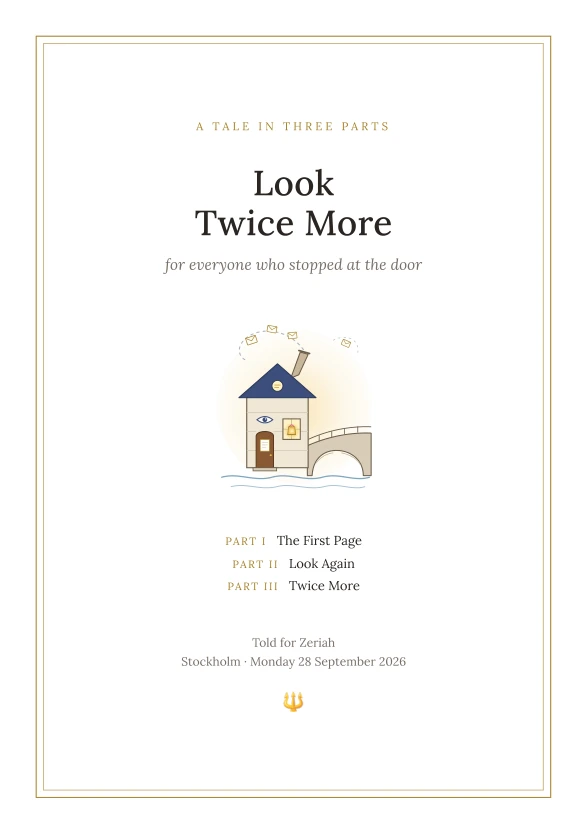
Part I
The First Page
In the town where the wind carried messages, there was a toll house at the foot of the bridge.
It was a small stone house with one room downstairs, one room upstairs and a crooked chimney that leaned out over the river as if it were trying to read the water. Long ago, everyone who crossed the bridge had stopped at its little window and paid a copper. Then the town decided that nobody should have to pay to cross a river, and the toll house was locked up, and for fifty years nobody went in.
The children said it was haunted. On windy nights, they said, you could hear it whispering.
Roya bought it for one silver coin and a lantern.
She was the lantern-maker at the edge of town, the one who had gone the long way round the world and come home with her pockets full of pieces. The town had names for her, the way towns do. The children called her the Magpie, because she kept things. Tobias the miller called her worse, loudly, on market days. Some people called her brave and some called her strange, and most, when they couldn’t decide, just called her that one. None of the names were hers.
It was true that she kept things. Ever since she came home, people had been bringing them to her gate. Mina came down from the south slope with a jar of honey the colour of dawn. Ivo from window seven brought the stub of pencil he had once used to write a promise in a margin. From the lane of mirror-workers over the mountains came a single piece of glass, cut crooked on purpose. Parisa’s daughter brought a crayon drawing of the wall of copies at the old well house, with every page in the right order.
“Keep it,” they said. “Somewhere people can see.”
So Roya scrubbed the toll house from top to bottom. She mended the window, oiled the door and built shelves. Then she climbed up to the attic, and found out what the whispering was.
For fifty years the crooked chimney had been catching the messages the wind let fall. They lay in drifts on the attic floor: love letters and birthday wishes, recipes and apologies, and a few thank-yous that had never been said. There were hundreds of them, and every one was still sealed. When the wind blew through the gaps in the roof, they rustled against each other like people talking in their sleep.
Roya didn’t open a single one. They weren’t hers. She sorted them by name, from A to Z, on long shelves under the roof, so that anyone could come up and look for their own.
By the end of the summer, everything was ready except one thing.
Every archive needs a first page. It’s the thing you read at the door before you read anything else, so you know what kind of place you’ve come into. Roya sat at the old toll window with a clean sheet of paper and a pen, and wrote one.
RULES, she wrote. Touch nothing. Believe what is written here. Leave quietly.
She read it back. It sounded exactly like the red letters from the Counting House. She tore it up.
She tried again. This Archive proves that the people of our town are kind, and brave, and good.
She read that back too. It sounded like the Asking House, deciding who somebody was before anybody had met them. She tore that up as well.
The third sheet stayed blank. She was still staring at it when the sun went down and her mother came along the river road with a pot of soup.
“What’s wrong?” said her mother.
“I don’t know what to tell them to see,” said Roya.
Her mother put the soup down and sat on the step. “When you were small,” she said, “you asked me what the eye on our gatepost was for. Do you remember what I told you?”
Roya thought. “Nothing. You said, ‘Look at it for a while, and then you tell me.’”
“Your grandmother painted that eye when I was a girl,” said her mother. “I knew exactly what it meant to me. But I never told you, because whatever you saw in it was yours.”
Roya looked at the blank page for a long moment. Then she picked up the pen and wrote the first page all in one go, without crossing out a single word. It began:
We do not ask you to follow us.
We do not ask you to believe us.
We ask only that you look.
And it ended:
Our only plea is this:
Please, see.
Her mother read it over her shoulder. “We?” she said. “There’s only you.”
“No,” said Roya. “There’s Mina, and Ivo, and Parisa and her daughter, and everyone who brought something and let me keep it. There’s everyone whose letters are upstairs. There’s the wind. There’s you.”
“And the people who come to read it?”
Roya thought about that. “Once they’ve looked,” she said. “Then them too.”
She pinned the page to the outside of the door, and above it she painted a small eye, the same as the one on the gatepost. Then, on the inside of the door, where you would only see it on your way out, she wrote one more line:
And before you turn away, look twice more.
The next morning, at dawn, she opened the door.
🔱👁️🚪
Part II
Look Again
For the first week, hardly anybody came in. People stopped on the bridge to read the page on the door. Then they hurried on, glancing back over their shoulders, as if it might be about to ask them something.
The first one through the door was a small girl called Elin, who had been dared by her three brothers to touch the haunted chimney. She stood in the doorway shaking so hard that her plaits trembled.
Roya didn’t tell her not to be frightened. People had told Roya that, and it had never once worked. “You can go home,” she said. “Or you can look. Either is allowed.”
Elin looked. She went round the room one step at a time, and then up the ladder to the attic, where the whispering was. It turned out to be the wind moving through a thousand envelopes. She stayed all afternoon. When she came out, her brothers asked her what was in there, and she said, “Look for yourself,” and walked home with her nose in the air.
On the second Saturday, Tobias came.
Tobias the miller was a big man with flour in the creases of his knuckles and the loudest voice at the market. For a month he had been telling anyone who would listen that the Archive was a magpie’s nest full of rubbish, kept by a girl who thought far too much of herself. Now he had come to prove it.
He read the page on the door aloud, in a silly high voice, for the benefit of the people on the bridge. “’We ask only that you look.’ Very well,” he said. “I’ll look.”
He went round the room in about the time it takes to boil an egg. “Honey,” he said. “A pencil. Broken glass. A child’s drawing. Rubbish, as I said.” He turned for the door, put his hand on the latch, and saw the line on the inside.
And before you turn away, look twice more.
Tobias stopped. “That’s a trick,” he said.
“It’s a request,” said Roya. “You can say no.”
Tobias had said no to a great many things in his life, usually loudly. But the people on the bridge were watching through the window, and he found, to his annoyance, that he didn’t want to be the man who hadn’t looked.
“Twice more,” he said. “Then I’m going.”
So he looked again. This time he read the labels, and they weren’t what he expected. They didn’t say what anything meant. They only said who had seen it, and when, and what they had said about it.
Honey. Given by Mina of the south slope, who waited three years for the bees to come home. She says: taste it at dawn.
Pencil. Given by Ivo, Window Seven. He once wrote a promise in a margin with it, and kept it.
A star of seventeen mirrors. Carried across the ice, over the mountains and home through the fog. It is a little crooked on one side.
Tobias read every one of them, twice. “Where does it say what it all means?” he said.
“It doesn’t,” said Roya.
“Then what’s the point?”
“You’re reading it,” said Roya. “That’s the point. What it means is yours.”
“I don’t want it to be mine,” said Tobias. “I want somebody to tell me.”
“The Counting House will tell you what you owe,” said Roya. “The Asking House will tell you what you’re worth. There are plenty of places in town that will tell you what to think. This is the other kind.”
Tobias didn’t like that at all. He particularly didn’t like that it was fair. So he climbed the ladder to the attic, because it was the only part he hadn’t seen, and he was a man who finished things.
Upstairs, the letters were whispering on their shelves.
“These are other people’s letters,” he said sharply. “Have you been reading other people’s letters?”
“Not one,” said Roya, from the top of the ladder. “They aren’t mine. The wind dropped them and the chimney caught them, and they’ve been waiting ever since. Anyone can come up and look for their own name.”
Tobias snorted. Then he went quiet.
On the shelf marked T, in handwriting he hadn’t seen for thirty-one years, was his own name.
🔱👁️👁️
Part III
Twice More
The letter was from his brother. Tobias and Emil had run the mill together once, until they quarrelled. It was the kind of quarrel where, by the end, nobody can remember the beginning. Emil packed a bag and went away over the mountains, and for thirty-one years Tobias had told anyone who would listen that his brother had never written. Not once. Not one line. He had said it so often that it had become a label, and he had hung it round Emil’s neck: the brother who never wrote.
The letter was dated the week Emil left. That was the week of the great storm, the one the town still talks about, when a small girl tied a pink thread across the whole town to bring her mother home. The wind must have been carrying the letter to the mill that night. It dropped it, the crooked chimney caught it, and there it had waited.
Tobias sat down on the attic floor with it in both hands.
Roya went quietly back down the ladder and left him there, because it was his.
What the letter said is Tobias’s, and nobody in town has ever asked him. But he was up there a long time. Downstairs, the light moved slowly across the floor, and lit up the honey jar, and then the crooked star.
That was his third look.
When he came down at last, he didn’t go straight to the door. He stood in the middle of the room and looked round it once more, slowly: at the honey and the pencil, the crooked glass, the crayon drawing of a wall of pages. Last of all he looked at Roya, as if she were one more thing in the Archive whose label he hadn’t read.
That was the fourth.
“I still think half of this is rubbish,” he said.
“That is yours,” said Roya.
“But I looked.”
“You did,” said Roya. “To disagree after looking is still to have looked.”
Tobias turned the envelope over in his big, floury hands. “I’ve got more questions now than I came in with,” he said. “Where he is. Whether he—” He stopped. “Thirty-one years. What am I supposed to do with that?”
“I don’t know,” said Roya. “That’s yours too.”
At the door he read the line on the inside once more, and then he looked at her.
“You’re not a magpie,” he said.
“What am I, then?”
Tobias thought about it for a long time, which was not something the town had ever seen him do.
“I don’t know yet,” he said. “I’ll have to look again.”
That evening, the people on the bridge saw the miller stand at the rail with a letter of his own. He held it up for a moment, and the wind took it and carried it away over the river, toward the mountains.
✦
✦ ✦
Nobody knows exactly what came back. But the following summer, anyone crossing the bridge could hear two men at the mill arguing about the waterwheel all day long, and people said they had never heard Tobias sound so happy.
He gave the empty envelope to the Archive. It hangs by the ladder with a label in his own big, floury handwriting, and Roya hung it exactly as he wrote it:
Envelope. Found by Tobias the miller, on his third look. He says: look twice more. He also says half of this place is rubbish.
People come now. Elin brought her three brothers, and they came out arguing about what they’d seen, which Roya considered a great success. Some people leave things, and some leave nothing. Some agree with what they find, and some don’t. Most leave with more questions than they came in with, and Roya never answers those for them. She tells them what her mother told her.
“That is yours.”
Once, Parisa’s daughter asked her what she wanted people to see.
“Whatever they see,” said Roya. “It belongs to them.”
“But what do you see?”
Roya looked round the room: the honey and the pencil, the crooked star, the envelope, the ladder up to the letters, and the eye painted above the door.
“Everything everybody saw,” she said. “All of it at once. It’s the best view in town.”
Every morning at dawn she opens the door of the old toll house at the foot of the bridge. The crossing is free and the door is open, and the only toll anyone pays is looking. The first page still hangs under the painted eye, a little faded now, and she has never changed a word of it.
Our only plea is this:
Please, see.
✦
✦ ✦
The end.
🔱👁️🌅