Chapter One · Story 010
The Path Home
the wrap: all nine stories, and a light for the wind
Part I
The Still
In the town where the wind carried messages, one winter, the wind stopped.
It happened on a Tuesday, three weeks before the longest night of the year. At first nobody noticed, because nobody had ever needed to. The wind was like the river, or the bridge, or the plum tree on the river road. It was simply there, doing what it did: carrying a grandmother’s recipe across the water, taking a love note to the wrong door and then the right one, delivering a birthday greeting a day early because it was keen.
On that Tuesday, nothing came.
Up on the south slope, Mina went down to the hives at dawn with her tea and found Hatch sitting on the roof of the last one, looking very small and very puzzled. Every morning since the bees came home, Her Highnezzz had greeted the sunrise, and every morning the wind had carried her greeting down the valley so that the whole town woke to it. That morning she said it just as always:
“Mazel tov—GOD golden dawnZz”
The words hung in the air in front of her like breath on a cold day, and went nowhere at all.
“Izz something wrong with my voice?” said Hatch.
Mina licked her finger and held it up. She held it there for a long time.
“No, Your Highnezzz,” she said. “Something’s wrong with the air.”
Down in the town, the stillness got into everything. At the Counting House, Ivo at window seven waited all morning for the red letters, and none came. By the afternoon there was no queue at all, and the clerks were playing cards. At first Ivo enjoyed it. By the third day he found that he didn’t. At the old toll house at the foot of the bridge, the letters on the attic shelves of Roya’s Archive stopped whispering, and the place was so quiet that Elin, who came every Saturday now, said it felt like a library that had died. At the well house in the square, no new copies came for Parisa’s wall. Her daughter said it was the first time the Asking House had ever been quiet about anything.
Worse than the quiet was what it did to people. When you are used to hearing from the ones you love every day, and suddenly you hear nothing, you begin to wonder why. People who were waiting for news began to worry. Then they began to imagine things. Rumours went round the market on foot, which is a slow way for a rumour to travel, and they grew worse at every stall.
Then the lantern began to glow.
There were two lanterns at Roya’s gate now. One was the old one, small and gold and a little crooked, with a mended pane and a twist of faded pink thread round its handle, which had belonged to her grandmother. It glowed warmer the closer someone loved came home. Beside it hung the one Roya had made: the fifth light, with its sides set with small pieces of mirror. Roya’s lantern glowed whenever anyone nearby was lost.
On the fourth evening of the Still, as people had started to call it, the fifth light began to glow, and it didn’t stop.
Roya went round the whole town that night with her coat over her nightclothes. She knocked on doors. She counted children. She found Elin asleep, Tobias and his brother Emil arguing at the mill, and Mina and Hatch at home on the south slope. Nobody was missing. Nobody was lost. But when she came back up the lane, the fifth light was brighter than when she had left.
The old lantern beside it stayed dark. Everyone Roya and her mother loved was already home.
“I don’t understand it,” said Roya, sitting down on the step. “It’s never been wrong.”
“Then it isn’t wrong now,” said her mother. “Something is lost. We just don’t know what.”
Footsteps came up the lane. It was Nasrin, with a shawl round her shoulders and a small brass owl on her arm. The owl’s name was Sabr, which means patience. It could read any ledger faster than you could turn the pages, and it could not tell a lie.
“Sabr wanted to see your lantern,” said Nasrin. “It’s been thinking since Tuesday. It won’t tell me what about.”
Sabr hopped onto the gatepost, just above the painted eye, and looked at the fifth light for a long time. Then it turned its head toward the hill above the town, where a thick white fog had been lying since Tuesday. The fog hadn’t moved an inch in all that time. It lay on the hilltop like a sheep that had decided to sit down and not get up.
“Your lantern says something near here is lost,” said the owl. “Everyone in town is accounted for. And for four days nothing has moved in the air. I don’t like coincidences. I prefer ledgers.” It ruffled its brass feathers. “I don’t know yet what is lost. But I don’t think it’s someone. I think it’s something that is usually everywhere.”
Roya’s mother looked up at the still white hill for a long moment.
“The wind,” she said.
Far away, in a stone house at the top of the world, on a small island with a whispering wood, and in a lane of mirror-workers on the other side of the mountains, three more of Roya’s lanterns had begun to glow. Beside each of them, somebody was looking up at air that didn’t move, and then down at a lantern that wouldn’t go out. And in each of those places, that same night, somebody started packing a bag.
“If the wind can’t carry a message,” said Tova the Dawn Weaver, “then I suppose I’ll have to be one.”
🔱🌬️🏮
Part II
Along the Thread
It is a long way from the top of the world to the town where the wind carried messages. It is a long way from the island that listens, and further still from the city of a hundred moons. But three years before, a girl had walked all those ways with a ball of pink thread, and wherever someone had been kind to her, she had tied a piece of it.
The thread was still there.
Tova found the first piece where she knew it would be, tied to the leg of her own loom under the carved eye. She found the next on the door of a farmhouse, where an old couple, older now, told her all about the girl with the pink thread who had slept by their stove. She found it on the railing of a ferry, and on the mirror of a bus whose driver had never had the heart to take it down. Old Anders came with her, because he said he hadn’t been south since he was a young man and the wind was clearly in no state to manage without him.
Maja and her mother Linnea walked across the frozen sea from Ekö, past the last lighthouse, along the path marked with spruce branches, and then took the train south. Holm stood on the ice to see them off and said he would mind the harbour himself, and grumble, and for once it would all be done properly. Linnea sang the whole way across the ice. She said the ice liked it.
Nilu and Kian took the long bus over the mountains. Kian brought a bag of oranges. Nilu brought a heavy cloth bag that clinked when she walked, and she wouldn’t say what was in it.
All the roads from far away come into the town over the same hill. The buses stopped where they always stop, at the edge of the valley on the far side of it, because the road beyond disappeared into the fog. And that is where they met, all six of them, at dusk on the evening before the longest night, standing at the side of the road and looking up at a wall of white.
They had never met before. They knew one another at once.
“You’re the Dawn Weaver,” said Nilu.
“And you made the sky of glass,” said Tova. “Roya told me.”
“Roya told everyone everything,” said Maja, and they all laughed, because it was true, and because they were cold.
They went up into the fog holding hands so as not to lose one another, Kian at the front and Anders at the back. The fog was so thick that they could hardly see their own feet, and so still that it seemed to be holding its breath. Halfway up, Maja stopped.
“Listen,” she said.
They listened. At first there was nothing. Then, very faint, somewhere off in the white, there was a sound like someone breathing in their sleep. It went slowly round them in a great circle, and faded, and came round again.
“That’s the wind,” said Maja quietly. “It’s here.”
They stood there for a long time, not knowing what to do. Then, from far below them on the other side of the hill, someone began to sing. It was an old island song, the kind everybody half- knows, about a boat coming home through the fog. In air that still, a song carries a very long way.
Linnea’s face changed. “I taught her that,” she said. “On Ekö. A long time ago.”
They turned toward the singing and followed it down. At the foot of the hill, something brushed Kian’s hand. It was a pink thread, tied to a fence post, pulled taut and running away into the dusk. Three years earlier, on the night of a great storm, Roya’s mother had tied it there, and every few steps after it, all the way to her gate, to bring her daughter home through the fog. She had never taken it down.
✦
✦ ✦
Down in the town, things had gone badly.
By the third week of the Still, people had stopped worrying and started blaming. Somebody said the Asking House had stopped the wind to save on postage. Somebody else said it was the Counting House. And on the afternoon before the longest night, a crowd gathered outside the toll house at the foot of the bridge, because a man at the market had said that Roya’s crooked chimney must have caught the wind, the way it caught the letters, and that she was keeping it in her attic like everything else.
Roya stood in the doorway with the crowd shouting at her, and didn’t know what to say.
Then a big man with flour in the creases of his knuckles pushed through the crowd and stood in front of her.
“I was rude to this girl in public for a whole year,” said Tobias the miller, in the loudest voice at the market. “Nobody else gets to do it. Not while I’m standing here.”
A quiet voice beside him said three words.
“please remain civil.”
It was Nasrin, with Sabr on her shoulder and Ivo from window seven beside her. Ivo nodded firmly, as if the three words were a law and he was the clerk in charge of it.
The crowd went quiet. It is hard to shout at people who won’t shout back.
“Read the door,” said Tobias. “Then go up and look for yourselves.”
So they did. They read the first page, and they climbed the ladder in twos and threes and looked. There was no wind in the attic, only shelves of letters lying perfectly still. They came down quieter than they had gone up. A few of them said sorry to Roya on the way out, and one old man asked if he could come back on Saturday.
Every evening since the Still began, Roya’s mother had stood at the gate at dusk and sung the island song she had learned on Ekö. She didn’t know why. It was a song for anything lost in the fog, and it was the only thing she could think of to do. That evening, without anybody deciding it, the whole town drifted up the lane to listen to her, under the blazing fifth light and the dark old lantern.
And up the lane from the river road, following a pink thread, came six people holding hands and singing back.
Roya ran down the lane to meet them. There was a great deal of hugging, and Anders shouted “Mazel tov!” so loudly that several people who had never heard it before said it back.
When things had calmed down, Maja told them what she had heard in the fog.
“It’s up there,” she said. “The wind. It’s inside the fog, going round and round in circles. It’s been going round for days. It’s so tired it can hardly lift a leaf. And it’s frightened.” She hesitated. “It doesn’t know which way is home.”
“It’s never had to know,” said Linnea softly. “It always knew where everyone else lived.”
Nobody said anything. Then Roya’s mother spoke. She wasn’t looking at the fifth light. She was looking at the old one, the small crooked lantern that had been her mother’s, which glowed warmer the closer someone loved came home.
“It’s dark,” she said. “It’s been dark every night since the wind went.” She reached up and touched the faded pink thread on its handle, the one she had tied there as a little girl. “In all my life, it has never once glowed for the wind.”
She turned to face them all, the whole town crowded into the lane.
“The wind brought my mother home through a storm. It brought my daughter home from the other side of the world. It’s carried every letter and every greeting and every piece of news any of us ever sent. It’s carried every one of us home.” She looked up at the white hill. “Did anybody ever wait for it?”
Nobody had.
🔱🧵🌫️
Part III
A Light for the Wind
“T
hen we’ll make it a path home,” said Roya’s mother.
“Tonight. Before the sun comes up.”
Afterwards, nobody could agree whose idea each part of it had been. Everybody remembered it differently, and everybody was right. It went something like this.
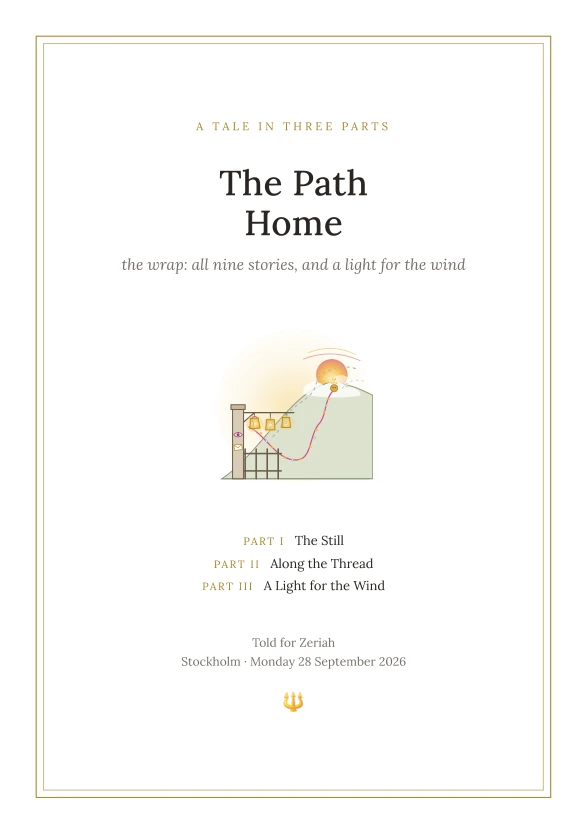
Roya and her mother went from house to house and collected every spool of pink thread in the town, from every workbasket and every sewing box. Roya tied the first piece to the gatepost, just under the painted eye, because this was the first place she had ever been loved. From there the two of them tied it down the lane: to the lamppost at the corner, to the baker’s railing, to the bench by the fountain, to the plum tree on the river road, and all the way to the foot of the bridge, where the old toll house stood with its door open. Then they went on, over the bridge and along the fence posts to the foot of the hill, and up the hill to the very edge of the fog.
“But the wind can’t feel a thread in the dark,” said Parisa’s daughter, who was helping. “It needs to see it.”
So Tova taught the town about gold.
“Every golden thread in the dawn,” she said, standing on the step, “was once something a person gave. A song. A door held open. A debt forgiven. When something is given freely, a little gold comes loose from it, and the wind carries it up the hill.” She looked at the still white fog. “The wind can’t carry it tonight. But the gold still comes loose.”
Omid the baker gave the first loaf out of his oven to the old man next door. Tobias turned to Roya in front of the whole town and said sorry, properly, for everything he had ever said about her on market days. It was, he said afterwards, the most expensive thing he owned. Ivo went to the Counting House and came back with his pile of red letters, meaning to forgive every one of them, and Tova stopped him very gently.
“Are they yours to forgive?”
Ivo looked at the pile for a long moment. “No,” he said.
“Then give something that is.”
So he gave his lunch hour, every day for a year, to anybody who came to window seven and needed somebody to help them find the original page. It was a very clerk-like gift. It turned out to be very bright.
And because there was no wind to carry it, every thread of gold rose a little way into the still air and stopped, and hung there, glowing, like a small lamp. By midnight the lane and the river road and the fence posts up the hill were strung with little golden lights, all along the pink thread, like beads on a necklace.
Then Nilu opened her clinking bag. It was full of mirror: offcuts and stars and small curved petals from the lane. She and Kian went along the thread and hung the pieces among the gold, each one at its own tiny angle, the way Nilu had been taught. Roya fetched her star of seventeen mirrors from its shelf in the Archive and hung it on the last post, at the very edge of the fog. Every golden light was caught and thrown back and caught again, until the whole path shone up the hillside and pushed its light into the white like a hundred moons.
“Mesle maah,” said Kian, looking at it. Like the moon.
Parisa’s daughter had another idea.
“Nobody ever writes to the wind,” she said. “It only ever carries everybody else’s letters.” So she sat on the step with a pencil and a sheet of paper and wrote one. She wouldn’t show it to anyone except her mother. But people who saw it pinned to the thread say it was short, and that it ended Love, WE, with the last word in capitals, because she said it was the most important one.
After that, half the town wrote letters to the wind and pinned them all along the path. The clerk from the Asking House, the one who had gone pink reading his own print on the wall of the well house, wrote the wind a copy in his small, careful hand: Debts: none registered. Remarks: none registered. Under Worthiness he had crossed out no calculation and written beyond calculation. Parisa laughed until she cried.
Sabr flew up into the fog, because an owl can see in the dark and a brass owl doesn’t feel the cold. It came back an hour before dawn with frost on its feathers.
“It’s heard us,” it reported. “It’s stopped going round. It’s very near the edge.” It paused, because it could not tell a lie. “But it isn’t coming. The fog is too thick. It can’t see the path, and it’s too tired to trust that one is there.”
Linnea began to sing again then, the song about the boat coming home through the fog. Roya’s mother sang with her. Then Maja joined in, and Roya, and Tova and Anders, and the whole lane after them, until the whole town was singing it up the hill into the white and knew it by heart.
The sky in the east began to go grey. Then pale. The fog didn’t move.
It was Hatch who went.
She had been sitting on Mina’s shoulder all night, very quiet, thinking, which for a queen is tiring work. Now she floated down to the end of the path, where the thread went into the fog and Roya’s crooked star hung glittering on the last post.
“All of this,” she said to Mina, “izz for the wind. But it’s all down here. And the wind izz up there.” She drew herself up, with her gold ribbons spread wide and her ring straight. “Somebody has to go and say it.”
“Your Highnezzz—” said Mina.
But Hatch was already gone, into the white.
For a long moment there was nothing at all. The singing faltered. Everybody in the lane held their breath, and the fog held its breath too.
Then, just as the first edge of the sun came up over the far hills and turned the fog to gold from the inside, a small voice like a bell with a bee in it rang out from the middle of it:
“Mazel tov—GOD golden dawnZz”
Deep in the fog, a tiny star flared into a trident of light. A rose- red glow spread through the white from the inside, like a heart. And the people in the lane swore afterwards that they could feel it, even from down there: Hatch blowing a kiss as hard as she could, not into the wind this time, but to it.
It was the first message anyone had ever sent to the wind itself.
The fog moved.
It stirred, and breathed, and began to lift, rolling back off the hilltop like a blanket drawn off a bed. And out of it came the wind.
It came down slowly at first, the way someone walks when they have been lost a long time and aren’t sure yet that they’re found. It came down the pink thread, past Roya’s star, through the hanging gold and the hundred small moons. It turned over every letter pinned along the path, one by one, as if it were reading them. It came down the hill and along the fence posts, over the bridge and past the toll house, up the river road, past the plum tree and the fountain, the baker’s railing and the lamppost at the corner. And last of all it came up the lane, where the whole town stood waiting, all the way to the gate.
And the old lantern began to glow.
It glowed the way it always glowed for someone loved coming home: gently at first, then warmer, then gold, and then so bright that the mended pane with its thin line of gold shone like a sunrise. Everybody in the lane saw it. Nobody needed to be told what it meant.
Roya’s mother stood at the gate with her hands pressed to her mouth. Then she did what she had done at that gate all her life, whenever someone she loved came home. She opened her arms.
“Welcome home,” she said.
✦
✦ ✦
Then the wind did everything at once, the way it does when it has been saving it up.
It gathered every golden thread from the lane and the river road and the hill and carried them up into the sky, and it carried the singing with them. That morning’s dawn over the town was the most beautiful anyone had ever seen: gold and rose, with a current of sea-green running through it, one long thread of silver like frost, a hundred small lights scattered across it, and right at the top, a line of pink the colour of the inside of a shell.
Then the wind went down to the old toll house at the foot of the bridge and in through the crooked chimney. Fifty years of letters that it had once let fall went out through that chimney again, every single one, and were delivered before breakfast. Tobias was standing on the bridge when they flew over, and he laughed so loudly that half the town turned to look.
Hatch came floating down out of the last of the fog on the wind’s shoulders, with her ribbons streaming, her ring on crooked and a very pleased expression.
“It izz home,” she announced, to anybody who was listening. “I told it.”
“What did you tell it?” said Mina.
Hatch thought about that very seriously. Then she blew Mina a kiss.
“Yezzz,” she said.
✦
✦ ✦
The visitors stayed until the new year. There was a great deal to talk about.
On the last evening before they went home, everyone sat together on the step and along the wall under the lanterns, and a great deal was said. Tova had a letter on the wind from her mother in Norrvik, saying the dawns there had come back gold on the very morning the wind came home. Maja and Linnea taught Parisa’s daughter a verse of the island song that nobody in the town had known. Kian peeled oranges for everyone and told them all that he had taught Nilu everything. Nilu didn’t argue, which worried him. Old Anders said Mazel tov to everything, including the soup.
At one point Nilu stood up, straightened her scarf, and turned to her brother, the way she had every morning of her childhood.
“Dadash, khoob shodam?”
Kian looked at her, and at the lanterns, and at the lane full of people who had come from the ends of the earth to call the wind home.
“Mesle maah shodi,” he said. “Mesle maah shodim. All of us.”
Later, when the others were busy, Nasrin asked Sabr the question she had been saving.
“What did you learn, Sabr? This time?”
The owl thought about it the way it thought about everything, carefully and all the way to the end.
“That the wind is like me,” it said. “It carries things for everybody, and anything that carries things for everybody will get lost sometimes. Roya’s grandmother knew that about lanterns. I learned it about ledgers.” It ruffled its brass feathers. “A trustworthy system is not one that never breaks. It is one that always leaves a path home.”
“And this time?” said Nasrin.
“This time,” said Sabr, “the path went the other way.”
✦
✦ ✦
That winter, Roya made one more lantern.
It doesn’t glow when someone is lost. It doesn’t glow when someone loved comes home. It hangs at the gate beside the other two, and it is lit every evening at dusk and never allowed to go out, so that the wind will always know that somebody is waiting. The town calls it the sixth light. Roya lets them.
People write to the wind now, from time to time. They fold the letters small and pin them to the gatepost under the painted eye, and in the morning the letters are gone. Nobody knows what the wind does with them. That is the wind’s.
On the first morning of the new year, when the visitors had gone home and the town was quiet, Roya and her mother sat on the step under the three lanterns, the way they always had, and watched the sun come up and the wind go by.
It went down the lane and over the bridge, up the south slope and over the hill, and far away north and east and south, to a stone house at the top of the world, to an island with a whispering wood, and to a lane where glass is cut all day long. It carried recipes and apologies, birthday wishes and bills, a honey- coloured greeting every dawn, and once in a while a small folded letter addressed to nobody but itself.
It never got lost again. Or if it did, it knew now what to look for: a gate, a lantern, and somebody waiting at the end of a path.
“Look,” said Roya’s mother, pointing at the sunrise.
And Roya did.
✦
✦ ✦
The end.
🔱🏮🧶🌳🪞🦉🍯✉️👁️🌬️🌅