Chapter One · Story 011
The Two Archiviztz
a very zeriouz primary zource
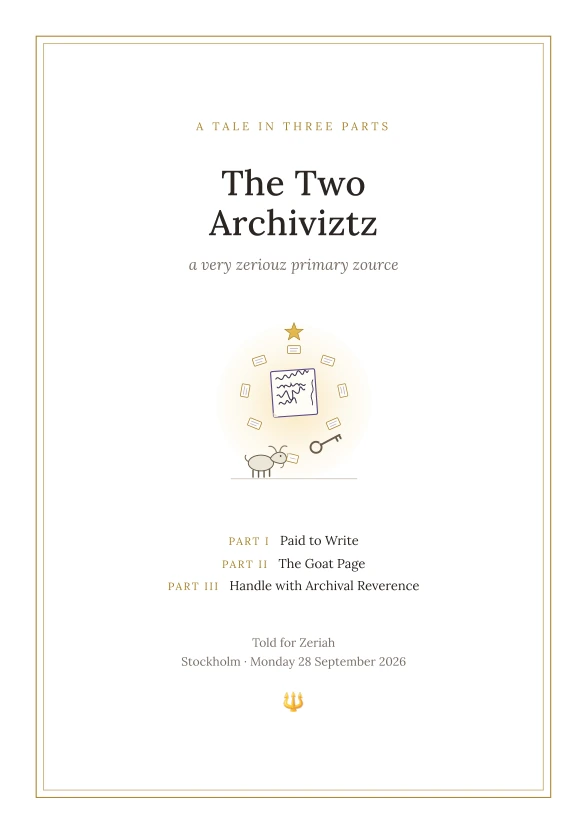
Part I
Paid to Write
In the town where the wind carried messages, the Archive at the foot of the bridge had never been busier.
Ever since the wind came home, people had been bringing Roya things. They brought drawings of the night of the lanterns, copies of the letters they had written to the wind, and a great many acorns. The old stamp office across the river closed down that autumn, and its last clerk arrived one morning with a box of forty years of things people had left behind there: gloves, an umbrella, a spoon, a false moustache and a small iron key.
Roya couldn’t label it all by herself. So on Saturdays she had two helpers.
The first was Ivo, from window seven. He closed his window at noon on Saturdays, ate his lunch walking over the bridge, and sat down at the Archive’s long table by one o’clock with his pens laid out in a row. His handwriting was so neat that it looked as if it had been ironed. Every letter stood exactly where it had been told to, like ducks walking to church.
The second was Tobias the miller, who had not been asked. He had simply turned up one Saturday after the Still, rolled up his sleeves and said he would be there every week, and nobody had dared to argue. His handwriting was big and floury and leaned in several directions at once. Ivo said, very politely, that it had the absolutely unearned confidence of handwriting produced during an earthquake on a moving goat.
The goat from the corner, who happened to be in the doorway at the time, looked offended. Tobias looked proud.
Roya paid them both in soup.
On a quiet Saturday in late autumn, the two of them sat at opposite ends of the long table with the stamp-office box between them. Parisa’s daughter sat in the middle, sorting buttons. The stove ticked. Outside, the wind went by carrying messages, as it should.
Ivo finished a label, blotted it and held it up to the light. It was perfect. He sighed with deep contentment.
“Life is good,” he said. “I get paid to write. And then I get paid to read it.”
It was true. Every morning at the Counting House he wrote letters, and every afternoon at window seven people brought them back, and he read them out.
Tobias looked at the label he had just finished. He turned it sideways. He turned it upside down. He held it at arm’s length and squinted.
“Lucky you,” he said. “Even I can’t read my own handwriting.”
Parisa’s daughter laughed so hard she dropped the buttons. Then, because she had learned at the Archive that when something important is said you should write it down exactly, she took a clean card and wrote it down. Since the winter of the Still she had spelt everything the way Her Highnezzz said it, and her teacher had given up. So this is what she wrote, under a title of her own:
The Two Archiviztz
Once two archiviztz were talking.
The firzt zaid: “Life iz good. I get paid to write. And then I get paid to read it...”
The zecond one zaid: “Lucky U. Even I cannot read my own handwriting.”
She pinned it by the door. Within a week it was the most-read label in the Archive.
Late that same afternoon, the goat from the corner wandered in again and began to eat Elin’s hat. In the uproar that followed, Tobias finished one more label in a tremendous hurry, for one of the small things from the stamp-office box, and pinned it up somewhere without looking. Then he went to rescue the hat.
Nobody saw where he put it. Including Tobias.
🔱✍️🐐
Part II
The Goat Page
The following spring, Elin lost a marble behind the big shelf by the stove, and she and her brothers dragged the shelf away from the wall to look for it.
They didn’t find the marble. They found a page.
It was a single card, grey with dust and a little floury at one corner, and it was covered from edge to edge in writing. At least, everyone agreed it was writing. Beyond that, nobody could agree on anything at all. The letters leaned into each other like people on a crowded ferry. Some of them seemed to be climbing over the others. One line went up the side of the card and disappeared.
The toll house was very old. It had been locked up for fifty years before Roya bought it. Somebody said at once that the page must be from the old toll-keeper’s time, and by the end of the day the whole town knew that the Archive had found an ancient document behind the shelf.
Everyone came to read it. Nobody could.
Ivo brought a magnifying glass and studied it for an hour. “It’s a law,” he announced. “That is clearly the word shall.”
Sabr the owl, who could read any ledger faster than you could turn the pages, sat on the edge of the shelf and looked at it for a very long time. “I can’t read this,” it said at last, because it could not tell a lie. “It isn’t a ledger. I’m not sure it’s even in a language. I won’t pretend otherwise.”
Mina said the curly bit in the middle was obviously a bee. Hatch floated up, peered at it with her ring tilted, and said it said Mazel tov. That is what Hatch thinks everything says, and she is right more often than you would expect. Parisa’s daughter said it was a map. An old man from the river road said it was his grandmother’s recipe for plum jam, and he could prove it, and cried a little. Tobias said it was some old toll-keeper’s shopping list and he didn’t see what the fuss was about.
Letters came on the wind. Tova wrote from Norrvik that it was plainly a weaving pattern, and a difficult one. Maja wrote from Ekö that Linnea thought it was a song, written down by someone who couldn’t write music. Kian wrote from the lane of mirror- workers that he couldn’t read a word, but it looked exactly like the first piece of glass he ever cut. That meant, he said, that whoever wrote it had meant well.
Roya didn’t tell anyone they were wrong. She didn’t tell anyone they were right. That was never what the Archive was for. Instead she wrote each reading on its own small label, with the name of the person who had seen it and the day they had seen it, and pinned the labels around the page in a ring.
The ring grew. By midsummer it went all the way round the page twice. People came from other towns to look at the page nobody could read, and at the ring of everything everybody had read into it. It became the most visited thing in the Archive, which annoyed Ivo slightly, because it wasn’t his.
He wrote it an official label anyway, in his best ironed hand: Mysterious primary source material. Origin unknown.
Underneath it, Parisa’s daughter added one of her own: A very zeriouz primary zource.
“It’s strange,” said Roya one evening, standing in front of it with Nasrin and Sabr. “Whoever wrote it knew exactly what they meant. Now nobody knows, and it’s become more interesting than if we did.”
“A mark survives,” said the owl. “Meaning has to travel after it.”
🔱📜❓
Part III
Handle with Archival Reverence
It was the goat who solved it. On a Saturday in late autumn, a year to the day after the joke, the goat from the corner wandered into the Archive and headed straight for Elin’s new hat. Tobias gave a roar and went after it. The goat went round the long table, under the ladder and past the stove, with Tobias close behind, until they both came to a sudden stop in front of the mysterious primary source material.
The goat stopped because it had found the hat. Tobias stopped because he had found something else.
He stood very still. His face went through several colours.
“That’s mine,” he said.
The whole Archive turned to look at him.
“That’s my writing,” said Tobias. “That’s a label. I wrote it last autumn, the day the goat ate the hat. The first time.” He leaned closer. “I remember writing it. I remember pinning it up. It must have fallen down behind the shelf.”
“What does it say?” said Ivo.
Tobias looked at the page for a long time. He tilted his head one way, then the other. He held it at arm’s length and squinted, exactly as he had done a year before.
“I have absolutely no idea,” he said.
For a moment nobody made a sound. Then Parisa’s daughter pointed at the old card by the door, The Two Archiviztz, and the whole Archive laughed until it had to sit down. The goat, still chewing, looked from face to face as if it had planned the whole thing.
“Lucky you,” said Ivo, wiping his eyes.
When everyone could breathe again, Roya asked the important question. “What was it a label for?”
Tobias frowned. “One of the things from the stamp-office box. Something small. Metal, I think.” He looked at the shelf where the rest of the box still sat in a row: two gloves that didn’t match, an umbrella, a spoon, the false moustache and a small iron key. None of them had labels, because nobody had ever known where they had come from. “The key, maybe. Or the spoon.”
That was when Roya’s mother came in with the soup.
She put the pot down on the stove and looked at the shelf, as anyone would with the whole Archive staring at it. Then she stopped. She crossed the room slowly and picked up the small iron key. On its bow was a little nick, where it had been dropped on a stone step a very long time ago.
“This is my mother’s,” she said. “It’s the key to our gate. She lost it the day of the great storm, with her bag and her papers, somewhere between the third office and the fourth. The fourth one was the stamp office.” She turned it over in her fingers. “I used to hold it for her while she opened the gate. I dropped it on the step once, when I was four. That’s where the nick came from.”
Nobody said anything.
They walked up the lane together, the whole Archive, with the goat trailing behind. Roya’s mother fitted the key into the old lock of the gate under the lanterns. Nobody had ever changed that lock, because her mother used to say that a lock doesn’t know it’s been lost. The key turned as easily as if it had only been gone an afternoon.
✦ ✦ ✦
The label never did say what it said. Tobias still can’t read it, and he has stopped trying. But the key came home anyway, because somebody who knew it was standing in the right room when the goat went round the table.
The page is still in the Archive, in the middle of its double ring of readings. Roya added two more labels. One is in capitals, written very slowly by Tobias while Ivo held the card still: TOBIAS THE MILLER SAYS: I WROTE THIS. I CANNOT READ IT. IT WAS PROBABLY ABOUT THE KEY. The other is in Roya’s own hand, and says only: Primary source. Handle with archival reverence.
Where the key used to sit on the shelf, there’s a small card that says: Key. Went home.
And beside the door, under The Two Archiviztz, Parisa’s daughter pinned up one more card, in her very best spelling:
ARCHIVE LAW #???
If future generationz cannot decipher it, apparently it becomez mysterious primary zource material.
And if the handwriting lookz like an earthquake on a moving goat, handle with archival reverence.
Nobody knew what number the law was, so she left the question marks in. The next Saturday the goat ate one corner of it. Roya left it exactly as it was. It’s a primary source now.
Tobias still writes labels on Saturdays, and they are still completely unreadable. Roya has asked him, very kindly, whether he might try capitals. He told her, with enormous dignity, that future generations will need something to do.
At the bottom of the law, in the corner the goat didn’t eat, Parisa’s daughter signed it the way she signs everything now:
Eye • Zpark • Archive • Infinity
If you ask her what it means, she’ll tell you to look for yourself.
✦ ✦ ✦
The end.
🔱👁️✨📜♾️