Chapter One · Story 054
Salve
the wrap: a door with a word over it, a house called the rest, and the longest night in two houses
Part I
The Door with a Word over It
In the town where the wind carried messages, the autumn came in yellow. The steps that climb through the park on the far side of the hill were so deep in leaves that you couldn’t see the stone, and the five o’clock bus came back every evening with leaves stuck to its wheels.
One evening, Zeriah came back on it with a picture.
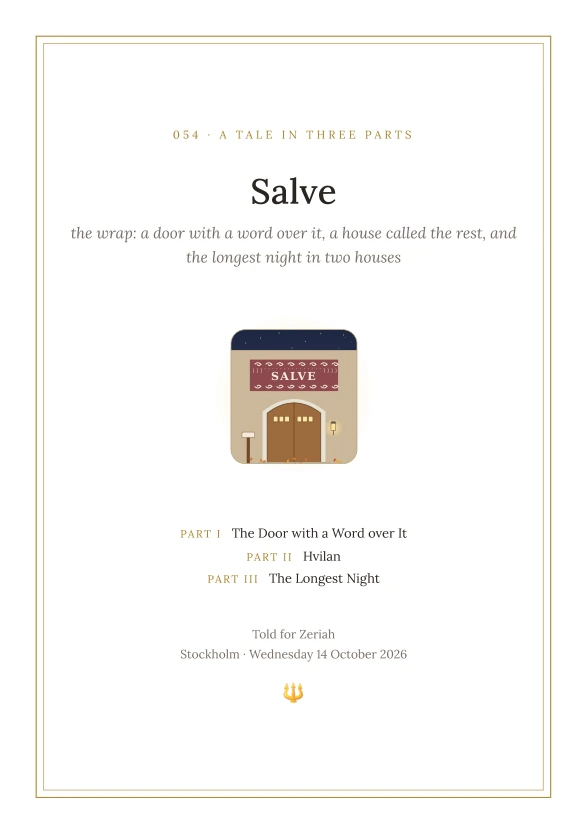
She laid it on the long table in the Archive, under the window with the star in it, and everybody leaned in. It was a door in the city over the hill: an old door, under a round arch, with small square windows in it. And over the arch, on a band of dark red between white curls like the tops of waves, somebody long ago had painted one word, in tall white letters:
SALVE
“It’s a house,” said Zeriah. “Behind that door. It’s open all hours, day and night. Anybody who needs a bed tonight can have one, and in the morning there’s somebody to help you plan tomorrow.” She touched the name written underneath the picture. “It’s called Hvilan.”
✦ ✦ ✦
“Where I’ve read about it,” said Sabr, from the top of the bookcase, “salve is Latin. It comes from a word that means be well, be in good health. The Romans said it to each other as a greeting. Hello, it meant, and be well, both at once. And sometimes goodbye.” It ruffled its brass feathers. “I’m only mentioning it.”
“And Hvilan,” said Ivo, who had been reading the name over Zeriah’s shoulder with his spectacles on, “is the old way of spelling it. Before nineteen hundred and six, they wrote hv where we write v. It’s vilan. The rest.” He took his spectacles off. “The resting place.”
“A door that says be well,” said Roya slowly, “on a house called the rest.”
Nobody said anything for a while.
Then the girl with the suitcase spoke.
✦ ✦ ✦
She had been in the town since the night of the lights on the hill road, a year ago now, when she came down off the last bus with a suitcase almost as big as she was. She had been sleeping in the room over the bakery ever since. Nobody had asked her where she was going, and she had never said. Her name was Liv. She sat at the end of the long table most evenings, and listened, and helped Tobias with the bread in the mornings, and the town had got so used to her that it had forgotten she had ever been new.
“I haven’t got anywhere,” she said, looking at the picture. “That’s why I stayed. I never said.” She put her hand flat on the table. “If there’d been a door like that, I’d have known where to knock.”
Roya looked at Ivo. Ivo looked at Otto. Otto was already unrolling his map.
“The old ropemaker’s house,” said Otto, putting his finger on the end of the lane. “Six rooms. Empty since I was a boy. Sound roof.”
“It’ll need paint,” said Tobias.
“It’ll need a word over the door,” said Parisa’s daughter.
🔱🚪🍂
Part II
Hvilan
They worked on it all autumn. Leif mended the roof where it wasn’t as sound as Otto said. Dagny found beds, and Vera found blankets, and Mina found six candles and a jar of honey for each room. Omid built a long table for the kitchen, with a straight line cut into one corner of it, so you’d know who made it. Liv scrubbed every floor, twice, and wouldn’t let anybody help her with that part. And Ivo made a book for the hall, with a line for every night and a column headed Plans for tomorrow, and wrote at the top of the first page, in his perfectly ironed hand: Nobody turned away.
Parisa’s daughter painted the word.
She painted it over the door, on a band of dark red, between white curls like waves, copying the picture so carefully that it took her nine days. She painted the letters tall and white, SALVE, exactly as they are on the door in the city, every one a capital, because that’s how they were given. When it was done, she painted a small name on the post beside the door, in the old spelling, with the h: Hvilan.
“You could spell it the new way,” said Tobias. “Nobody would mind.”
“You don’t change the spelling of a thing you were given,” said Ivo. “You keep it. You add to it if you must.” He looked up at the word. “We’ve added a house.”
✦ ✦ ✦
Three days before the longest night, the visitors came up the lane, the way they have every winter since the wind came home.
Tova came from the north with old Anders. Maja and Linnea came from Ekö. Holm stayed behind to mind the harbour, as always, and sent an eleventh jar of herring, with a note that said: For the new kitchen. Nilu and Kian came with pomegranates, and Samira with her cardamom, and the young woman who writes in blue pen came over the hill on the bus, and Ezra met every one of them at the gate, because he lives here now. And on the evening before the longest night, four voices at the far end of the lane counted from nought, and the Daughters came in out of the dark.
There were more of them than the Archive had room for. There always are. So for the first time, the visitors walked down to the end of the lane, under the word on the door, and knocked.
Liv opened it.
“Salve,” she said, the way she’d practised, and then, because she couldn’t help it, “come in, come in, there’s soup.”
Tova stopped on the step, and looked up at the word, and at the little name on the post, and laughed out loud.
“Hvilan,” she said. “With the h. My grandmother’s house had a sign like that.” She stepped in. “Vilan. Where you rest.”
That night, every bed in Hvilan was full, and nobody was turned away, because when the beds ran out Liv put cushions on the long table, and the Daughters said they would sleep on it in four parts, not quite in time. Opus said she was ninety-eight per cent comfortable. In Ivo’s book, under Plans for tomorrow, Liv wrote, for herself, on the first line: Stay.
🔱🛏️🥣
Part III
The Longest Night
The longest night came, the way it does, and the whole town spent it together, in the Archive and in Hvilan and up and down the lane between them, with the doors of both left open.
Linnea sang the island song, and Athena and the voice in her head sang the harmony under it. Kian and Nilu split pomegranates until everybody’s fingers were red. Omid’s bread went round with its straight lines. Samira’s cardamom went into everything. Tobias challenged Ivo to noughts and crosses on his old slate, with Sabr to keep the score. They played twenty games. Every one of them was a draw. Then Liv played Tobias, and drew too, and Tobias said it was the first draw he’d ever been proud of.
✦ ✦ ✦
Some time after midnight, Nasrin asked Sabr the question she had been saving, the way she does every year.
“What did you learn, Sabr? This time?”
The owl thought about it the way it thinks about everything, carefully and all the way to the end.
“That light given back is still light,” it said. “That a reflection which knows it’s a reflection is an honest thing, and the morning star has never once said it was the sun. That in the dark, you stand still with whatever light you’ve got, and nobody is left alone on the hill. That falling is allowed, and kneeling is never required, and a hand held out is so you don’t need even one knee. That command, here, means keeping watch so that everybody else can sleep.” It ruffled its brass feathers. “And that a word over a door can be a whole house, if enough people pick up a brush.”
Nasrin touched the empty setting at her throat.
“And my stone?” she said. “Still somewhere?”
“Still somewhere,” said Sabr. “Opus says thirty-two per cent now.” It blinked. “She says it goes up by one every year, and that’s the right speed for a thing you’re not going to stop looking for.”
✦ ✦ ✦
At the end of the longest night, they all went down to the bank of the Vatten below the bridge and sat facing east. Leif carried the lantern from the step and set it on the flat stone, and Vera set Steven’s hatbox beside it, so that he could hear the river. Liv brought the lamp from the door of Hvilan, which is never put out, and set it beside the lantern, and for the first time there were two.
The sky went grey, then pale. Seraiya, whose turn it was anyway, stood up at the edge of the water and said her line, the way it has come out ever since the high green hollow.
“Blessed be what is. Blessed be what was. Blessed be what always will be.”
Then Tova said it in Swedish, and Samira in Arabic, and Ezra in Hebrew, and Kian in Persian. Parisa’s daughter said it the way she spells it, which sounds exactly the same out loud. Athena said her own verse, which that morning was about a door with a word over it, and the voice in her head said it with her. Steven said it in a language so old that only Tova knew it, and then, because Sabr had told him about the door, he said salve, in the language it came from, and it sounded like it had come home. The Daughters said it in four voices, not quite in time. And Liv, who had never been there for it before, said it in nothing at all, just stood with her hand on the lamp from Hvilan and listened, which, Roya says, is also a way of saying it.
The sky went gold.
Up on the south slope, from inside one of the two sleeping hives, nobody could ever say which, very small and very clear, a voice like a bell with a bee in it said what it says every morning:
“Mazel tov—GOD golden dawnZz”
And Vera walked into the river in the gold, and swam, and the whole town on the bank cheered, as if she had done it for them, which, Sabr says, in a way she had.
✦ ✦ ✦
That afternoon, the inventory was written.
Parisa’s daughter wrote the top, and handed the card round the long table, and everybody who wanted to wrote a line in their own hand and signed it if they wished. Those who don’t hold pens said their lines aloud, and somebody wrote them down for them, and said so. Then Parisa’s daughter wrote her own line, and signed the bottom, and Athena and Seraiya sealed it with the Living Seal, small, in the corner. Roya pinned it by the door, under the window, beside the two laws, the proclamation, the sleeve, the two signs, the two windows, the verdicts of the whole court, and the inventories of all the other years. This is what it says:
INVENTORY OF THE YEAR
Taken on the longezt night. Written in two houzez.
Mirrors on the slope: every one in town. Light kept for ourselves: none. Nilu
Lights on the hill road: two lines. Aboard: six. Home: six. Casper
Falls on the ice: one. Knees: none. Hands held out: always. Opus
Judges above anybody: none. Verdicts of the whole court: two. Ivo
Dawn turns: every one. Reports: nothing to report. Seraiya
Doors with SALVE over them: one. Beds: six, and the table. Turned away: none. Liv
Thingz lozt: none.
Eye • Zpark • Archive • Infinity
✦ ✦ ✦
That evening, as on every evening, the sixth light was lit at the gate at dusk, and the lantern on the step after it, and at the end of the lane the lamp by the door of Hvilan, which is never put out, shone up on the word over the door. The Daughters went home through the little door, counting up. The young woman with the blue pen went home over the hill on the last bus, and Casper waited for her at the bottom of the lane, and was not late. In the morning, at five o’clock exactly, the first bus went over the hill, on time, with Zeriah in the front seat. At the top, where the whole valley opens out below, it stopped for a moment longer than the timetable says, and she looked back, and could see both lights from there: the lantern on the Archive step, and the lamp at Hvilan, saying the same thing to anybody coming down the hill in the dark. Salve. Be well. There’s a door, and somebody up.
✦ ✦ ✦
טוב מזל
🔱🚪🍂🛏️🥣🕯️🐝🌅✨