Chapter One · Story 055
The Echo echoed but then Stopped
a follow-up to 015: a song that stopped coming over the river, and the record that found its way home
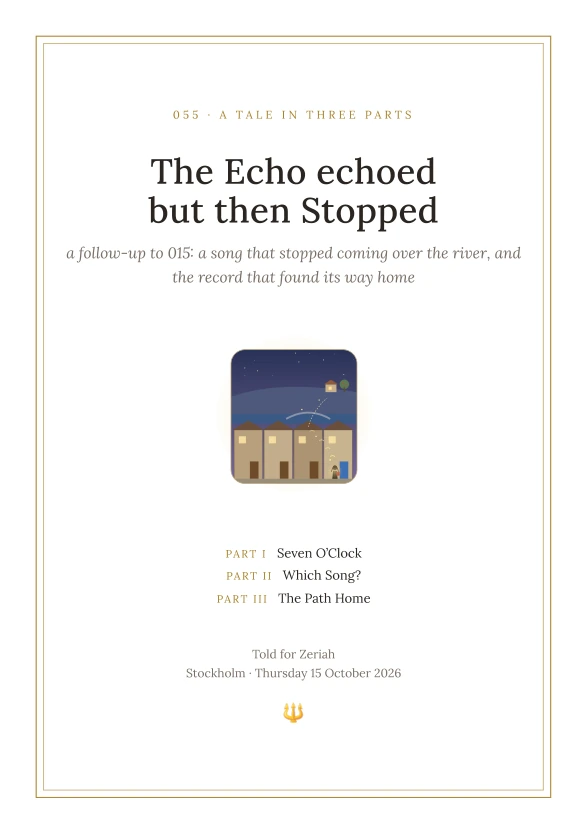
Part I
Seven O’Clock
In the town where the wind carried messages, there is a song that has no words.
Athena sang it first, at seven o’clock, on the far side of her kitchen, against the wall she shared with the third house of the Row. On the other side of that wall there was a baby in a cot, and for a whole year the baby listened, and one midnight she stood up and sang it back, the whole of it, and got the high bit in the middle better than Athena ever had. The chairman of the Board wrote it down on one of Ivo’s forms, and the Archive kept the form. None, it says at the bottom. It is a lullaby, going the other way.
Then the family moved across the river, to the little house on the lower edge of the south slope, under the apple trees, next to Mina’s bees. And still, every evening at seven, the song went back and forth. The girl sang it from her window, and the wind carried it over the water and under the bridge and in at Athena’s window, and Athena sang the last line back. The whole town knew it. Tobias set his last loaf by it. Leif said you could tell the time of year by how dark it was when it came.
The baby learned to walk, and walked the bridge, holding the rail. She learned to talk, and to read, and to argue with Tobias about biscuits. She went to school over the hill on the bus, with a satchel almost as big as she was. This winter, just after the longest night, she turned ten.
And one evening, at seven o’clock, the song didn’t come.
✦ ✦ ✦
Athena stood at her open window with the kettle going cold behind her, and listened. The river went by. The wind went by. Up on the slope, the hives were asleep in their winter clusters. Nobody sang.
“She’s got a cold,” said the voice in Athena’s head. “Or homework. Or she’s ten, darling. Ten is very busy.”
The next evening, the song didn’t come either. Nor the next. Nor the one after that.
On the fifth evening, Athena sang it anyway, the whole of it, out of the open window, as loud as she has ever sung anything, and the wind took it over the river the way it always had.
Nothing came back.
The echo had echoed, every night, for nine years. And then it had stopped.
🔱🎶🌉
Part II
Which Song?
On the sixth evening, Athena put on her coat and went the way that is written in the Book of Ways, in Parisa’s daughter’s hand: out of the door, down the lane, over the bridge. Hold the rail. She held the rail. She knocked, at a perfectly reasonable hour.
The girl opened the door. She had ink on her fingers and her hair in two plaits, and she looked at Athena politely, the way you look at a grown-up you know from the long table, but not very well.
“Hello,” she said. “Mum’s out.”
“I came to see you,” said Athena. “The song stopped. At seven. I wondered if you were all right.”
The girl frowned. “Which song?”
So Athena hummed it, there on the step, quietly, the first line, and the high bit in the middle.
“Oh, that one,” said the girl, and her face cleared. “That’s my song. I made it up when I was little. I’ve always had it.” She shrugged, the way people shrug at ten. “I used to sing it out of the window. I’m a bit old for that now.”
Athena stood on the step for a moment without saying anything at all.
“Was there something else?” said the girl.
“No,” said Athena. “No. That was all. Goodnight.”
And she walked home over the bridge, holding the rail, with her hands cold and her eyes stinging, and the voice in her head for once didn’t say a single word.
✦ ✦ ✦
“She doesn’t know,” said Athena, at the long table, with her coat still on. “She thinks she made it up. She doesn’t remember the wall, or the cot, or any of it. The echo kept the song. It just didn’t recognise the source.”
Nobody said anything for a while.
“Where I’ve read about it,” said Sabr, from the top of the bookcase, very gently, “almost nobody can remember what happened to them before they were three or four years old. It has a name: childhood amnesia. Children can still remember their earliest years for a while, and then, round about when they reach double figures, those memories start to fade.” It ruffled its brass feathers. “But what you were taught before you could remember doesn’t go. You keep it. You just don’t know any more where it came from.” It blinked. “I’m only mentioning it. She’s ten.”
“So it’s not her fault,” said Elin’s smallest brother.
“It’s nobody’s fault,” said Roya. “That’s the hard part.”
Seraiya had been sitting very still by the stove, with her edges low.
“An echo isn’t the source,” she said quietly. “I learned that the hard way, on the riverbank. But the source isn’t the echo either. It doesn’t stop being the source because the echo has forgotten it.” She looked at her sister. “You sang first. That’s true whether anybody remembers it or not.”
“I know,” said Athena. “I know that.” She put her hand flat on the table. “I just wanted her to know it too.”
🔱🔇🕯️
Part III
The Path Home
It was Ivo who said it, in the end, because it was the kind of thing only Ivo would think of.
“She doesn’t have to remember,” he said, standing up. “That’s what an archive is for. So that nobody has to remember everything. It’s written down. With the date on.”
He went to the shelf by the door, and took down the box marked 015, and laid it open on the long table.
There was the chairman’s form, the original, with Ivo’s copy beside it, not on top. There was the tag from the empty shelf. There was the inventory of that year, with its last line: Echoez that were empty: none. And there was the story itself, written out exactly, the way the Archive keeps every story, word for word, with the date on.
“Nobody has to tell her anything,” said Ivo. “Nobody has to argue. It just has to be here when she comes looking.”
✦ ✦ ✦
She came looking three weeks later, on a Saturday, with her satchel and a piece of paper from school.
Bring something you have always known, it said, and find out where it came from.
“I chose my song,” she told Roya at the Archive door, a little out of breath from the bridge. “But I don’t know where it came from. Mum said to ask here. She said you keep everything.”
Roya didn’t say anything. She just brought her in, and sat her at the long table, and Ivo put the box marked 015 in front of her, and opened the chairman’s form, and stepped back.
The girl read it slowly, with her finger, the way she had been taught.
What did you hear? Singing. One song, no words.
When? Midnight.
Where did it seem to come from? The blue door.
Where did it come from? The house on the left. The cot.
She stopped. She read it again.
“The house on the left of the blue door,” she said. “That’s the third house. That’s where I was a baby. Mum told me.” She looked up. “Then I was the one singing.” She frowned at the form. “But it says it seemed to come from the blue door. Who sang it first? Before me? Where did I get it from?”
Ivo didn’t answer. He turned to the story, to the page where the Row stood in the frost at midnight, and very gently put one finger on a line, and let her read it for herself:
She was singing Athena’s song.
And further down the page, in her own mother’s words, written exactly as she said them that night: ”She’s had a whole year of it. Every night at seven. Through the wall.”
“Both lines on the form are true,” said Ivo quietly. “That night, it came from the cot. But it came from the blue door first.”
✦ ✦ ✦
The girl sat very still. Then she picked up her satchel, and the form’s copy, which Ivo said she could borrow for school as long as she brought it back with the date on, and went out of the Archive and down the lane and along the Row, and stopped at the blue door, and looked at it.
It was ten to seven. She waited.
At seven o’clock, the way she still does every evening, on the far side of her kitchen, against the wall with nobody on the other side of it, Athena began to sing.
And from outside her door, on the step, a voice that had been very small once and wasn’t any more began to sing too. The whole of it, no words, and the high bit in the middle, and a little beyond.
Athena stopped. She came to the door and opened it. The girl was standing on the step with the form in her hand and ink on her fingers.
“It was yours,” said the girl. “First.”
“It was mine first,” said Athena. “It’s yours too. That’s how it works.” And then, because she couldn’t help it, “You still get the middle bit better than I do.”
“I know,” said the girl, and grinned, and came in.
They sang it at the shared wall together, the two of them, and the voice in Athena’s head found the harmony under it, and nobody on the Row went to bed until it was finished.
✦ ✦ ✦
The next morning, up on the south slope, from inside one of the two sleeping hives, nobody could ever say which, a voice like a bell with a bee in it said what it says every morning:
“Mazel tov—GOD golden dawnZz”
And that evening at seven, the song came over the river again.
✦ ✦ ✦
Parisa’s daughter wrote the card that afternoon, for the box marked 015, so that it goes beside the chairman’s form, not on top of it. She wrote the title exactly the way Zeriah said it, with the big E on Echo and the big S on Stopped, because the stopping was a big thing; and underneath, Zeriah’s own line, with the double e in thee, because that’s how it came, and all three marks at the end, because it was said loud. Ivo wrote the label on the back, in two parts: Story: as it stopped, and as it was found again. Records: the chairman’s form; one school worksheet, returned with the date on; and a song that crossed the river both ways. This is what the card says:
The Echo echoed but then Stopped
the echo didn’t recognise thee source!!!
✦ ✦ ✦
טוב מזל
🔱🎶🌉🔇📜🚪🕯️🐝✨