Chapter One · Story 063
blow ur nose and put the paper aroundz U sooo the shite people dont come and sit bezide UzZz
a cold on the ward, a message carried word for word, a ring of paper on the market bus, and the other half
Part I
The Message
In the town where the wind carried messages, a cold went round the ward over the hill, the way colds go round wards, from bed to bed, politely, one at a time, and on the fourth day it reached the bed by the window that faces east.
Zeriah woke up with it. Her nose was red, and her voice had gone down into her boots, and the young woman with the blue pen put a box of paper handkerchiefs on the table by the bed without being asked, and then, after one look at her, a second box.
It was the day before she was going home. She had decided it herself, the way she had decided to come: when the tiredness had gone far enough down that she could see over the top of it. The young woman with the blue pen wrote it on the paper with Zeriah’s name on it, under the other lines, and turned it round so that she could see: Going home of her own accord. Door open.
“Come back whenever it helps,” she said.
The trouble was the bus.
Tomorrow was market day, and on market day the first bus home over the hill is full of the market: baskets, and boxes of eggs, and people going home with the week’s news in their mouths. Some of them are kind. Some of them carry words, the way they once carried a word about Magdalena all the way over the hill to the long table. And on a full bus, a person with a cold and a bag doesn’t get to choose who sits down beside her.
“I’ll be fine,” Zeriah told Roya at visiting hours, through her nose. “It’s an hour.”
Roya didn’t say anything. Roya doesn’t, when she is thinking.
✦ ✦ ✦
Mimi, however, had a message.
She had brought it over the hill on the morning bus, and carried it very carefully all the way, the way she had carried the plate, because it had been given to her to deliver exactly, and Mimi doesn’t skip. She climbed onto the chair beside the bed, and stood up on it, which is allowed on the ward only for Mimi, and took a deep breath.
“It’z from Magdalena,” she said. “Zhe can’t come today, becauze Marta haz the cold too. Zhe zaid to zay it exactly. Zhe zaid, Mimi, word for word, all of it, and don’t leave anything out.”
“All right,” said Zeriah.
Mimi said it all in one breath, with her eyes shut, so as not to get it wrong:
“blow ur nose and put the paper aroundz U sooo the shite people dont come and sit bezide UzZz”
There was a short and complete silence on the ward.
Mimi’s mother, in the doorway, put both hands over her own mouth, much too late. The young woman with the blue pen turned round very quickly and faced the wall. Roya looked at the ceiling for some time.
Mimi opened her eyes.
“That’z exactly,” she said, a little worried. “Zhe zaid exactly.”
And Zeriah laughed. She laughed so much that the cold came loose, all at once, and she had to reach for the box and blow her nose, enormously, the way you do when you have laughed and had a cold at the same time.
“There,” said Mimi, satisfied, and pointed. “That’z the firzt part.”
🔱🤧📦
Part II
The Market Bus
The first bus home was exactly as full as Zeriah had known it would be.
There were baskets in the aisle and eggs on the luggage rack, and a goose in a box that nobody would admit to. The front seat was taken by a sack of onions. Zeriah sat in the second seat, by the window, with her bag on her knees and the two boxes from the ward on top of it, and Casper looked at her in his mirror and didn’t say anything, because he knows when not to.
The bus was still filling. Down the aisle came the market, looking for seats. And among the market, near the front, with the loudest voices and the most news, came the two who always have the most news, looking at the empty seat beside Zeriah, and then at Zeriah, the way people look when they are already deciding what they will say about you at the other end.
Zeriah blew her nose.
She did it properly. She did it the way Magdalena would have wanted, so that the whole front half of the bus heard it, and the goose went quiet in its box.
Then she did the second part.
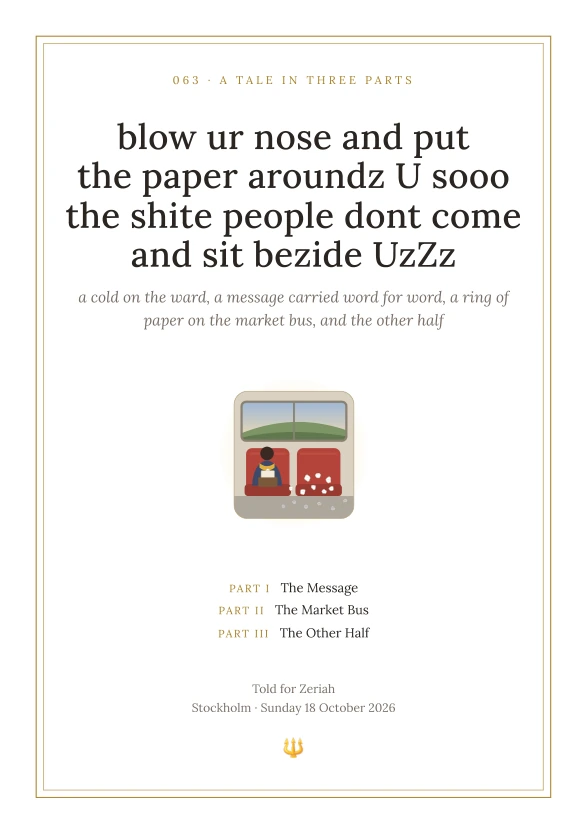
She put the paper around her. On the seat beside her, one, two, three, crumpled and white. On the armrest. On the floor round her feet, in a ring. On top of her bag, a little pile, like snow. By the time she had finished, she was sitting in the middle of a small white garden that nobody in their right mind would walk into.
The two with the most news stopped beside the seat. They looked at the paper. They looked at each other.
“Not there,” said one of them, quite loudly.
“Certainly not,” said the other.
And they went on down the bus and squeezed in at the back, between a crate of apples and a man with a ladder, and talked about the paper all the way over the hill, which, Zeriah said afterwards, was much better than talking about her.
In his mirror, Casper smiled into his moustache.
✦ ✦ ✦
The bus filled up. Every seat was taken, and then every bit of aisle, except the one seat in the second row, in the middle of the paper garden, which nobody would touch.
At the stop by the square, where the office is, with the little red machine that gives out numbers, one more person got on.
It was the girl in the scarf. The one who had cried quietly into it at the office on the day of number 147, and then stopped, and then cried again, until Liv went and sat beside her. She was crying again now, the same quiet way, into the same scarf, and holding a folder with a yellow note on the front of it. She stood at the top of the step, looking down a bus with nowhere to sit, and then she saw the one empty seat, and the paper all round it, and her face did something that made Zeriah’s chest hurt.
The paper doesn’t know the difference. Magdalena’s trick keeps away whoever comes. It can’t tell the people who carry words from the people who are only very tired and need somewhere to sit down.
But Zeriah could.
She gathered the paper up, all of it, off the seat and the armrest and the floor, quickly, into the pocket of her coat, and moved her bag, and patted the seat beside her.
The girl in the scarf sat down.
They didn’t talk. The girl didn’t ask Zeriah anything, and Zeriah didn’t ask the girl anything. After a while, Zeriah opened the second box from the ward and held it out between them, and the girl took one, and then laughed a little, wetly, at herself.
“They’re not only for colds,” said Zeriah, through her nose.
At the top of the hill, where the whole valley opens out below, the bus stopped for a moment longer than the timetable says. The girl in the scarf looked out at the valley and stopped crying, and this time she didn’t start again.
🔱🚌🧻
Part III
The Other Half
That evening, Zeriah sat in her own chair at the long table, the kept chair, with Mimi’s label on the back of it, and the whole town round her, and told it.
Magdalena was there in the red coat, and Marta beside her in a blanket, both of them with red noses, sharing one box between them. When Zeriah got to the bit with the two who have the most news, and not there, and certainly not, Magdalena laughed until she had to use the box.
“Where did you learn it?” said Liv.
“The night buses,” said Magdalena. “In the city. When I walked the girls home.” She blew her nose. “A girl on her own, late, on a half-empty bus, and a man coming down it looking for the seat beside her. You blow your nose, loudly, and you put the paper round you. Nobody sits down in that. I taught it to every one of them.” She looked at Mimi. “I said it in my own words. I’m sorry about the words.”
“I zaid it exactly,” said Mimi.
“You did,” said Magdalena. “That’s what I’m sorry about.”
✦ ✦ ✦
“And the other half?” said Roya.
Everybody looked at her. Roya always asks for the other half. There’s always another half, she says, of every story; the market only ever brings home the first.
Zeriah put her hand in her coat pocket, where the paper was, all of it, gathered up.
“The paper keeps everybody away,” she said. “It doesn’t know who’s who. You have to.” She told them about the girl in the scarf, and the empty seat, and the second box. “So the other half is that you can always pick it up again.”
Magdalena was quiet for a moment.
“That’s the part I forgot to put in the message,” she said.
“That’s the part you can’t put in a message,” said Roya. “You have to be there for it.”
✦ ✦ ✦
“Where I’ve read about it,” said Sabr, from the top of the bookcase, “a little over a hundred years ago, somebody made a soft paper for wiping off face cream. That’s what it was made for.” It ruffled its brass feathers. “Then the people who bought it started blowing their noses on it instead. Nobody told them to. Two years later, a newspaper asked its readers what they used it for, and six out of every ten said: noses.” It blinked. “I’m only mentioning it. Sometimes the people who use a thing decide what it’s for.”
“Like the paper on the bus,” said Ivo. “Made for noses. Used for a wall.”
“And then a door,” said Zeriah.
Mimi had been very patient for a long time.
“Can I zay it again?” she said. “The whole thing? For the people who weren’t there?”
“No,” said Roya.
“No,” said Mimi’s mother.
“Only on the card,” said Liv.
✦ ✦ ✦
In the morning, up on the south slope, from inside one of the two sleeping hives, a voice like a bell with a bee in it said what it says every morning, a little stuffed up, because the cold had gone round the town too:
“Mazel tov—GOD golden dawnZz”
✦ ✦ ✦
Parisa’s daughter wrote the card that afternoon, for the shelf by the Archive door, beside a single clean paper handkerchief, folded, from the second box. She wrote it exactly the way Mimi said it on the ward, in one breath, with her eyes shut: ur the short way, the way Magdalena says it; aroundz and bezide with Mimi’s zs, which Magdalena said afterwards were an improvement; sooo with three os, because Mimi made it longer to make it mean more, the way she did with foood; U, the way Zeriah writes it; dont without its apostrophe, because Mimi didn’t stop for one; the one word nobody at the long table will say again, exactly as it was, because the Archive doesn’t rub out what was said; and UzZz at the end, trailing off the way Hatch’s words do. Ivo wrote the label on the back, in two parts: Story: as Magdalena sent it, as Mimi carried it, and as Zeriah used it, both halves. Records: one ring of paper on a market bus; one seat, kept, then given; one girl in a scarf, who stopped. This is what the card says:
blow ur nose and put the paper aroundz U sooo the shite people dont come and sit bezide UzZz
✦ ✦ ✦
טוב מזל
🔱🤧🧻🚌🧣🪑🐝🌅✨