Chapter One · Story 064
Magdalena Workz on her body, and I just sell Medecine to people in neeeedzzZ…
the last twelve jars of honey, a stall by the fountain, a line said plainly, and the last jar
Part I
The Last Jars
In the town where the wind carried messages, the cold that had gone round the ward went round the town after it, house by house, the way colds do, and for a week the whole valley coughed.
Mina gave away honey until there was hardly any left. Every house got a jar from the two hives on the south slope, and some houses got two, and Marta got three, because Magdalena asked and Mina doesn’t say no to Magdalena. By Friday there were twelve jars left on the shelf in Mina’s kitchen, the last of the summer.
“Over the hill is coughing too,” said Mina. “Worse. The market’s full of it.” She looked at the twelve jars. “I’ll take them on Saturday.”
She wrote the labels that night, twelve the same, in her careful round hand:
For coughs. Over one year old only. Pay what you can.
✦ ✦ ✦
Magdalena carried the crate. Marta was better, and sitting up, and doing the crossword again, and had sent her out of the house to buy lemons and stop fussing. So Magdalena put on the red coat and picked up the crate as if it weighed nothing, and the two of them went over the hill on the first bus.
And in the pocket of Mina’s apron, in a matchbox with holes in the lid, wrapped in a scrap of wool, went Hatch. Bees don’t go out in winter. But Hatch had made most of that honey, she said, and she wanted to see where it went.
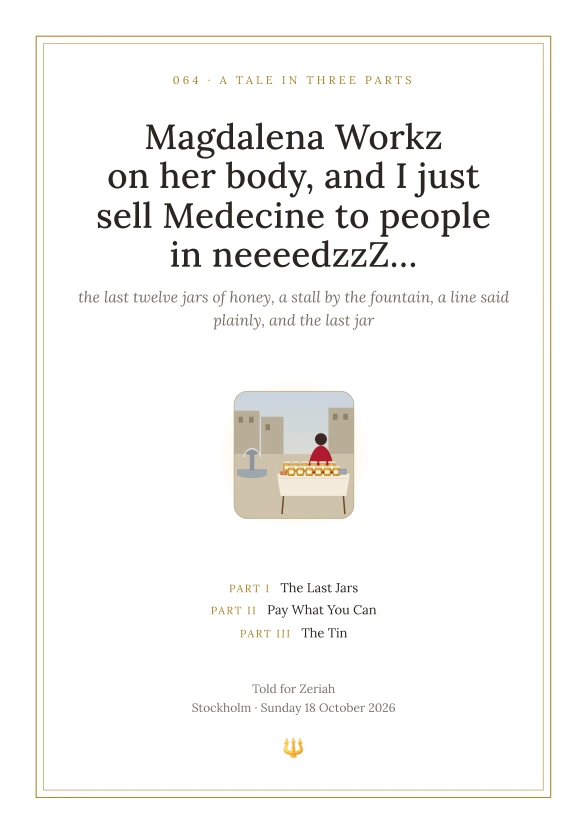
Mina set up at the end of the row, by the fountain, on a folding table with a cloth on it, and stood the twelve jars in two lines, and put the tin for the money in front of them, with its lid off.
The first person who came was a young man with a baby tied to his front, both of them coughing. He reached for a jar.
“For you, yes,” said Mina. “For her, no.” She put her hand very gently on top of the baby’s woolly hat. “Not under one. Never. Honey isn’t for babies.” She told him what to do for the baby instead, and where the clinic was, and that a cough can go on for three or four weeks, which isn’t the same as it being dangerous, and what to watch for that would be. Then she sold him a jar for himself, for two coins, and he went away looking less frightened than he had arrived.
“That’s the medicine,” said Magdalena, watching him go. “Not the honey. The knowing who it’s for.”
🔱🍯🐝
Part II
Pay What You Can
It was nearly noon when the two who always have the most news came down the row.
They had colds too. Everybody did. But they still had the most news, and they still carried it the way they always do, loudly, from stall to stall, and they saw Magdalena in the red coat behind Mina’s table before Magdalena saw them.
They stopped.
“Well,” said the first, to the second, but loudly enough for the fountain. “Look who’s at the market.”
“Selling, is she?” said the second. “What’s she selling now?”
And then, because they had looked at the table and seen the jars and the labels, the first one turned to Mina.
“And you,” she said. “Medicine, is it? Who said you could sell medicine?”
Magdalena had gone very still. Her hands were in the pockets of the red coat. Mina didn’t look up at once. She finished wiping the jar she was holding, and put it down in its place in the line, and turned it so the label faced out. Then she looked up, quite calmly, and said it, not loudly, but so that the whole end of the row heard it:
“Magdalena Workz on her body, and I just sell Medecine to people in neeeedzzZ…”
She leaned on works. She made needs last, the way you hold a note, and at the end of it, from the matchbox in her apron pocket, Hatch, who had been listening to everything, finished the word for her with a buzz.
✦ ✦ ✦
Nobody at that end of the market said anything for a moment. The fountain went on. A pigeon walked between the two who have the most news, and neither of them noticed.
Then Magdalena laughed.
It wasn’t a hard laugh. It was the laugh of somebody who has just heard a thing said plainly, in the open, at the market where the word was made, without the word in it.
“She’s right,” she said to the two of them. “It’s my body, and it’s my work. It paid for a room with two beds near the hospital, so my sister didn’t get sent where I couldn’t reach her on a bus.” She took one hand out of her pocket and straightened the jar nearest her. “And she sells honey.”
The two who always have the most news found, for once, that they didn’t have any. They went on down the row without buying anything, and one of them coughed all the way to the end of it.
✦ ✦ ✦
After that, the jars went.
A woman came who had walked from the far side of the city because she’d heard there was honey at the fountain, and paid in small coins she counted out of a handkerchief. An old man came and paid with a button, a good one, horn, and Mina took it and said it was the right price. The woman in the cardigan from the office by the square came on her lunch break, coughing into her sleeve, and bought one jar, and then, after a moment, three more.
“For my sisters,” she said. “All three. I rang them, you know. After the honey.”
And the girl in the scarf came, the one from the bus, with her folder under her arm and her eyes quite dry this time, and bought a jar for her mother, and paid for it with a bus ticket, which was all she had, and a song, which she sang very quietly, right there by the fountain, and which Mina said was worth a jar on its own.
By three o’clock there was one jar left.
🔱🪙🧣
Part III
The Tin
At ten to four, when Mina was folding the cloth, one of the two who always have the most news came back up the row, by herself.
She was coughing much worse than before. She stood at the end of the table and didn’t look at Magdalena, and didn’t look at Mina either, and looked at the last jar.
“How much?” she said.
Mina read her the label. For coughs. Over one year old only. Pay what you can.
The woman stood there for a long moment, with her purse in her hand. Then she paid. She paid properly, more than the jar was worth, and she put it in the tin herself, and didn’t say anything else, and Mina put the jar in her hands, the same as she had for everybody.
“Needs is needs,” said Mina, when she’d gone. “Even hers.”
Magdalena watched her all the way down the row.
“That’s the other half,” she said. “Roya will want to know.”
✦ ✦ ✦
That evening, at the long table, Mina emptied the tin.
Ivo wrote it all down, in the column for records, as it came out: coins, some of them very small; one horn button; one bus ticket, used; a folded note that said for the bees; a pressed blue flower nobody could name; and, at the bottom, the heavy coins from the woman who had come back.
“And a song,” said Mina. “It didn’t fit in the tin.”
Ivo wrote that down too.
Magdalena told them the rest, all of it, the two who have the most news and medicine, is it?, and what Mina had said back, word for word. When she got to it, she said it the way Mina had said it, leaning on works, holding needs, and Hatch, from the matchbox on the table, did the buzz again at the end, because it was hers.
Roya listened to the very end.
“And the other half?” she said.
Magdalena told her about the woman coming back at ten to four, and the last jar.
Roya nodded, slowly. “Good,” she said. “Then that’s the whole of it.”
✦ ✦ ✦
“Where I’ve read about it,” said Sabr, from the top of the bookcase, “in one country, some years ago, the people who write the doctors’ advice put it in writing: honey for a cough, for anybody over one year old.” It ruffled its brass feathers. “And never for a baby under one, the same as Mina’s label. They say a cough can go on for three or four weeks, and that you go back to the doctor if it lasts longer, or gets worse.” It blinked. “I’m only mentioning it. Mina’s label was right before the doctors wrote it down.”
“My mother’s label,” said Mina. “And her mother’s.”
✦ ✦ ✦
In the morning, up on the south slope, from inside one of the two sleeping hives, a voice like a bell with a bee in it said what it says every morning, a little hoarse, because she had been out in the cold again more than a bee should:
“Mazel tov—GOD golden dawnZz”
And all her sisters, or near enough, moved round one place in the cluster, and the one who had been to market got the middle.
✦ ✦ ✦
Parisa’s daughter wrote the card that afternoon, for the shelf by the Archive door, beside the empty matchbox and the horn button. She wrote it exactly the way Mina said it at the fountain, and the way it sounded: Workz with its capital, because Mina leaned on it, and a z, because that’s how Parisa’s daughter hears it; Medecine with its capital and its e, the way she spells it and the way it sounded; neeeedzzZ with three es, because Mina made the word last, and zzZ, because Hatch finished it from the matchbox; and the three little dots at the end, because nobody at that end of the market said anything after. Ivo wrote the label on the back, in two parts: Story: as it was said at the fountain, and as it was paid for. Records: twelve jars, all gone; one tin; one horn button; one bus ticket; one song; and the last jar, sold on the same terms as all the others. This is what the card says:
Magdalena Workz on her body, and I just sell Medecine to people in neeeedzzZ…
✦ ✦ ✦
טוב מזל
🔱🍯🐝🪙🧥🍋🧣🎶🌅✨