Chapter One · Extra
Mizrahi מִזְרָחִי
a word for east, and a window that faced west
Part I
The Word for East
Every morning, before the sun comes up, Seraiya, who glows a little at the edges, goes down to the bank of the river below the bridge, sits facing east, and says one line: Blessed be what is. Blessed be what was. Blessed be what always will be. Whoever else is awake goes down with her, and says it after her, each in their own language.
That autumn, for one week, one of the voices on the bank was Ezra’s.
Ezra is a jeweller. He is old now, and he lives a long way off, south and east over the mountains, in an old city where the domes are the colour of turquoise and there is a lane in the bazaar where the mirror-workers sit. His workshop is in that lane, two doors down from the corner. Every so often he packs his lens and his little hammers and comes over the mountains to visit, and whenever he does, he goes down to the river at dawn with everybody else, and says the line in Hebrew.
On the last morning of his visit, when the sun was up and the others were climbing back towards the bridge, Parisa’s daughter stayed sitting beside him on the bank. She is the girl who writes the cards for the Archive. She spells things her own way, and she asks the questions other people only think.
“What’s the word for east?” she said. “In your language.”
“Mizrach,” said Ezra.
She tried it. It came out with a little catch in the middle, the way it should.
“Does it mean anything else?”
Ezra smiled, because it was a good question, and because nobody had asked it of him for a very long time.
“It comes from another word,” he said. “Zarach. That’s what the sun does in the morning. It comes up, and it shines. So mizrach is the place where it does that. The place the light comes from.”
The girl looked at the sun, sitting just above the hills, and then back at him.
“And mizrahi?” she said. “Somebody said that’s you.”
“Mizrahi means of the east,” said Ezra. “Eastern. It’s what my grandmother’s people were called, and her grandmother’s, and theirs: families who had lived in the old cities of the east for longer than anybody can count. So it’s what I am, too.”
“So you’re from where the light comes from,” said the girl.
Ezra laughed.
“That’s one way to put it,” he said. “But I’ll tell you a funny thing. In my grandmother’s city, nobody was eastern. Nobody called themselves that. They were just at home. You only become from the east,” he said, “when you’ve walked a long way west, and somebody there asks you where you’re from.”
He looked down the river, the way he had come.
“And then they point,” he said. “And they always point at the sunrise.”
🔱🌅🧭
Part II
Grandmother Ester’s Window
“D id your grandmother sit facing east too?” said the girl.
“In the mornings?”
“No,” said Ezra. “That’s the other funny thing. She faced west.”
The girl frowned. “Away from the sun?”
“Away from the sun,” said Ezra. “Every morning.”
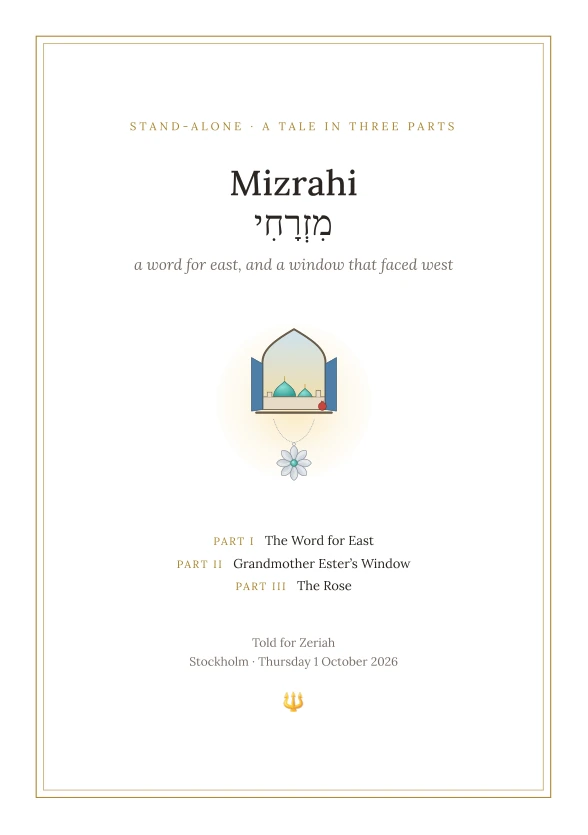
He told her about it then: the house in the old city, two doors down from the corner of the mirror-workers’ lane, which is still his house now. The courtyard with the pomegranate tree. The blue tiles round the little pool. And upstairs, the room where his grandmother Ester prayed, which had two windows. One looked east, over the rooftops, to where the sun came up behind the turquoise domes. The other looked west.
Every morning, when the sun rose behind her and laid the shadow of the window frame across the floor, his grandmother would cross the room, open the west window, and turn to face it.
“I asked her why, when I was small,” said Ezra. “Why she turned her back on the morning.”
“What did she say?”
“She said: because Jerusalem is that way.”
The girl looked west along the river, as if she might see it.
“When we pray,” said Ezra, “we turn towards Jerusalem. All of us, wherever we are. So it depends where you’re standing. In the countries far to the west, families hang a picture on the east wall of the house, so that everyone knows which way to turn. They call the picture by the word for east: mizrach. But my grandmother lived east of Jerusalem. So for her, the right way was west.”
“So she was eastern,” said the girl slowly, “and she faced west.”
“And her mizrach would have had to hang on the west wall,” said Ezra. “Which is exactly where she hung it.”
✦ ✦ ✦
It had been a present, he said. A traveller from the far west had come through the mirror-workers’ lane one spring, a man who made papercuts, and he had stayed a week, and when he went he left Ester a gift: a sheet of paper cut as fine as lace, with lions and birds and a tree in it, and across the top, in big letters, the word for east.
His grandmother had looked at it for a long time. Then she had climbed up on a chair and pinned it to the wall beside the west window.
“But it says east,” said young Ezra, who had only just learned to read it.
“It says east to him,” said his grandmother, climbing down. “To him, it means: this way. To me, it means: this way.” She put her hand on top of his head and turned it gently towards the window. “It was never about the east, my heart. It’s about the way.”
And she told him about Daniel, a long time ago, in Babylon, which was not so very far from their own city, as these things go. Daniel had the windows of his upper room opened towards Jerusalem, and he prayed there three times a day.
“So you see,” said his grandmother, “we have been opening windows to the west for a very long time.”
🔱🪟📜
Part III
The Rose
The girl sat quiet for a while, which for her was unusual. “So everybody’s turning a different way,” she said at last. “To get to the same place.”
“Everybody,” said Ezra. “From the west, they turn east. From the east, they turn west. From the north they turn south, and from the south they turn north. My grandmother used to say that if you could stand very high up at the hour of morning prayer, higher than the birds, and see the whole world at once, it would look like a rose. All the petals, from every side, leaning in towards the heart.”
He opened his collar, and took out something on a fine chain to show her.
It was a rose no bigger than a thumbnail, made of silver. It had eight petals, all the same size, and every one of them leaned in towards the middle, where there was a tiny stone the colour of the domes in his city.
“She had this made for me,” said Ezra, “the first time I went west over the mountains, as a young man, to learn my trade. Look. It has no north on it. No east. No letters at all.” He turned it in the sun. “She said a picture with east written on it is only right from one side of the world. But this one is right from anywhere. Wherever you stand, the petals all point the same way. In.”
“Did you make roses like that, after?” said the girl. “When you were a jeweller?”
“I’ve been trying for fifty years,” said Ezra. “I’ve never made one as good.”
✦ ✦ ✦
They sat a little longer. The sun climbed. Up on the bridge, somebody was calling that the bread was out.
“Can I ask one more thing?” said the girl.
“You can ask me a hundred.”
“When you sit here in the mornings,” she said, “facing east with everybody. Are you facing the wrong way? For you?”
Ezra thought about it properly, the way people in that town have learned to.
“No,” he said. “Here, when I face east, I’m facing the sunrise. And I’m facing home: my city, my lane, my grandmother’s window. And when I’m at home, and I open her window to the west, I’m facing Jerusalem, and I’m facing this way too, where all of you are, sitting on a riverbank saying a blessing in whatever language you’ve got.” He tucked the little rose back inside his collar. “It turns out you can face more than one thing you love at a time. You just need a good rose.”
The girl stood up and brushed off her skirt.
“I’m going to write it on a card,” she said. “For the Archive.”
“Will you spell it your way?” said Ezra.
She thought about it.
“Not the word,” she said. “The word’s yours.”
✦ ✦ ✦
So she went up to the Archive and wrote the word on a card the way Ezra spelled it for her, letter by letter, both ways: once in her own letters, running left to right, and once in his, running right to left, with the little marks underneath that tell you how to say it. Underneath, in her own spelling, she wrote what he had told her it meant. It is pinned up by the door now. This is what it says:
Mizrahi י ִח ָר ְז ִמ
Of the east. Of the place where the light comez from.
✦ ✦ ✦
טוב מזל
🔱🌅🪟🌹🧭💎✨