 014 · A tale in three parts
The Season
of Our Joy
a house meant not to last, and a place that is also a direction
Enter the sukkah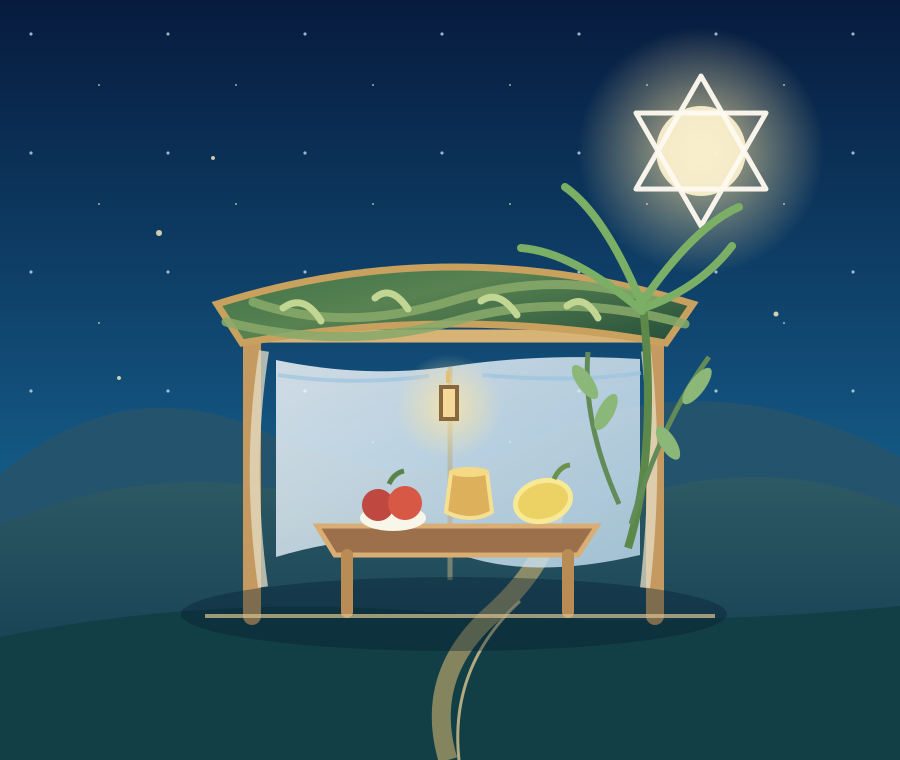
Part 1 of 3
Part I: A House Meant Not to Last
In the town where the wind carried messages, the autumn came in gold that year. The little oaks along the lane had grown to the height of a child’s knee. The apples on the south slope were so heavy that Mina propped the branches up with broom handles. And one morning, at the very end of the harvest, Ezra the jeweller came over the mountains from the lane of mirror-workers with a bundle on his back so long and so strange that the goat followed him all the way down the lane to find out what it was.
He set it down on the bank of the Vatten, below the bridge, next to the Archive.
“I’ve come to build a house,” he said to Roya. “May I build it here, beside yours?”
“Of course,” said Roya. “How long will it stand?”
“Seven days,” said Ezra. “Then I’ll take it down.”
Roya, who has spent her whole life keeping things, looked at him as if he had said something in a language she had never heard.
It went up in an afternoon.
Tobias helped with the walls, which were boards and old doors and a great deal of string, and he only knocked one of them down, which for Tobias is a very good afternoon. Otto measured everything twice. Dagny, who had become friends with Ezra over a certain empty setting, came down from her room above the bakery with a basket of ribbons and a hammer. And the roof was the last thing, and the strangest.
It wasn’t a roof at all, not really. Ezra laid long branches across the top, and bundles of reeds from the riverbank, and green boughs, all loose, all things that had grown out of the ground and been cut from it. He laid them thick enough to give shade in the day. But he left gaps.
“You’ve left gaps,” said Ivo, who notices gaps for a living.
“On purpose,” said Ezra. “In the day there should be more shade than sun. And at night you should be able to see the stars through it.”
Ivo looked up through the branches at the sky, and then at Ezra, and for once in his life didn’t say anything at all.
Hatch came down from the south slope that evening glowing like a small honey-coloured lamp, with her ribbons streaming and her ring on crooked. She floated once round the little house by the river, then once through it, in at the door and out through the roof, and then settled on the edge of a branch above Ezra’s head.
“My love,” she said, “what is Sukkot?”
Ezra smiled up at her. He had met her at the longest night, and he had heard her greet the sun.
“It’s a festival,” he said. “Seven days long. A very long time ago, when my people came out of Egypt, they walked through the wilderness for forty years, and they lived in shelters like this one, made of whatever they had. So every autumn, for seven days, we come out of our houses and live in a shelter again. We eat in it. We sit in it with our friends. Some people sleep in it. To remember.”
“Only to remember?” said Hatch.
“And to say thank you,” said Ezra. “It’s the harvest, too. The end of the year’s gathering. The fruit’s in. The work’s done. You sit under a roof you can see the sky through, and you remember you were carried here.”
Hatch thought about that. Her ring tilted one way, then the other.
“Ivrit,” she said.
Ezra laughed, and took a stub of charcoal from his pocket, and wrote on one of the boards of the wall, from right to left, the way it goes:
סוכות
“Sukkot,” he said. “Many little houses. This one’s a sukkah, just one.” And underneath it he wrote the name that he said was the most beautiful one the festival had:
זמן שמחתנו
Hatch looked at it for a long time. Then she looked down at him with enormous dignity.
“Translate, beloved,” she said. “Ani lo medaber ivrit, tho.”
Ezra laughed so hard he had to sit down on the bench.
“You just said I don’t speak Hebrew,” he said, “in Hebrew.” He wiped his eyes. “It says the season of our joy. That’s what we call it. Of all the festivals, this is the one that’s meant to be the happiest.”
“In a house that falls down,” said Roya, from the door.
“In a house that’s taken down,” said Ezra gently. “That’s different. You’ll see.”
🔱🌿⛺
Part 2 of 3
Part II: A Good and Sweet Year
They ate in the sukkah every evening after that, as many as would fit, and more than would fit, which was most of the town. Omid brought bread still warm from the oven. Mina brought apples. And Hatch brought honey from the south slope, in a jar so big she could only carry it by floating very low with her ribbons tied round the lid.
When Ezra saw the jar, he put his hand on his heart.
“I know this honey,” he said.
In the summer, it turned out, Hatch had sent a small jar of it over the mountains on the wind, with a note tied to the lid in Parisa’s daughter’s spelling that said only: For Ezra. From the queen. Mazel tov. It had arrived in the lane of mirror-workers at exactly the right moment, on the eve of the New Year, and Ezra had dipped his apples in it.
“So that’s where my honey went,” said Mina.
“What is Rosh Hashanah?” said Hatch at once, because she had heard him say it, and she was not a queen who let a word go by.
“It’s the new year,” said Ezra. “Two weeks before this one. The name means the head of the year. It’s a happy day, and a serious one. We blow the shofar, which is a ram’s horn, and it makes a sound you feel in your chest. We think about the year that’s gone and what we’d do differently. And we eat apples dipped in honey, so that the year to come will be sweet.” He looked at the jar. “This year mine was sweeter than usual.”
He took the charcoal again and wrote on the lid of the honey jar, right to left:
שנה טובה ומתוקה
“A good and sweet year,” he said. “That’s what we say to each other.”
Hatch floated over and read it upside down with great interest.
“Halachic meaning,” she said.
At the word halachic, Ivo sat up very straight because it sounded like the kind of word that has rules in it, and Ivo loves rules the way other people love music.
“Halakha is our law,” said Ezra. “The way we’re meant to live, day by day. But the word doesn’t really mean law. It comes from the word to walk. Halakha is the way you walk.”
Parisa’s daughter, who was sitting on the floor with her back against Tobias’s wall, put her cup down.
“Like the Book of Ways,” she said.
Ezra looked at her with interest. “Like the Book of Ways,” he said. “A little. Ours is older, and there are more of us arguing about it, very lovingly, for a very long time.” He turned back to Hatch. “In the halakha, the day isn’t only the new year. The Torah calls it the day of the shofar’s blast. There are laws for how you hear it, and how you pray, and what you may and mayn’t do on a festival. And the old teachers counted more than one new year. There’s a new year for years, and a new year for trees, and a new year for kings and festivals, and a new year for tithing the flocks.”
“Four new years,” said Ivo, in a voice of the deepest satisfaction. He had his pen out. “I shall need a new column.”
“You’ll need more than one,” said Ezra.
Later, when most people had gone home and the lamps were low, Ezra showed Parisa’s daughter the four plants he had carried over the mountains, wrapped in damp cloth: a tall, closed palm branch; three sprigs of myrtle with small dark shining leaves; and a yellow fruit like a knobbly lemon, which he held as carefully as he had once held the clasp of the stamp-office box.
“The etrog,” he said. “The citron. And the palm, and the myrtle. They come from far away. They grow in the land my prayers face toward.”
“There are only three,” said Parisa’s daughter, who counts things.
“The fourth is willow,” said Ezra. “Willows of the brook. I didn’t need to carry those.” He pointed through the gap in the wall, at the dark bank of the Vatten, where the willows lean over the water. “I cut them from your river this morning.”
Parisa’s daughter looked at the river, and then at the four plants in his hands, three from far away and one from the Vatten.
“So our river’s in it,” she said.
“Your river’s in it,” said Ezra. “We hold them together, all four, and wave them out to every side, and up, and down. Everywhere. So that nowhere is left out.”
🔱🍎🍯
Part 3 of 3
Part III: Very Dear to uzZz
On the last evening, the whole town came.
They didn’t all fit. They never do. The sukkah was full to the walls, and people sat in the door and on the grass outside, and along the bank, and on the bridge. Linnea’s island song about the boat coming home was sung, because Maja had sent the words on the wind, and Tobias sang it loudest and worst. Seraiya sat in the doorway so that her light fell inside and out at once. Athena sat beside her with the voice in her head humming along, very quietly, well before ten. Sabr sat on the highest branch of the roof and counted the stars through the gaps and announced that there were more than anybody could count, which for Sabr was a remarkable admission.
Ezra stood up before they ate. He said, in his own language, the words his people say over the bread and the wine, and then, in the common tongue, he said that a sukkah is meant to have guests. That there is an old custom of inviting guests into it, every night of the seven: the old ones, the fathers and the shepherds of his people, the ones who walked before. “And the ones who are here,” he said, looking round at all of them. “Who walked here tonight. You are my guests. It’s what the house is for.”
Hatch had been quiet for a long time, which for Hatch is very long indeed. She was sitting on the edge of the roof with her ribbons hanging down through the branches, looking at the four plants on the table and at the words on the boards.
“Eretz Israel meaning,” she said.
Ezra sat down.
“Eretz means land,” he said. “Eretz Yisrael: the Land of Israel. The land of the old promise, in our prayers. The land where the palm and the citron grow, and where the old pilgrims walked up to Jerusalem three times a year, at the festivals. This was one of them.” He looked up at the stars through the roof. “When I pray, I turn towards it. My grandmother did, and her grandmother, and hers. It isn’t only a place on a map. It’s the place a very long line of people has been facing, for a very long time, every time they prayed.” He smiled. “Otto would say it’s a place that’s also a direction.”
Otto, in the doorway, nodded slowly, as if that were a thing he had always suspected about places and had never had a word for.
Nobody said anything for a while. The branches creaked. Through the gaps, the stars were very bright.
Then Hatch floated down from the roof, very slowly, until she was level with Ezra’s face, glowing rose-red from the inside, like a heart.
“Israel is very dear to uzZz,” she said.
Ezra looked at her for a long moment. His eyes were wet, and he didn’t hide it.
“Toda,” he said. “That means thank you.” And then, because she was who she was: “Mazel tov, my queen.”
On the eighth morning, Ezra took the sukkah down.
He took it down the way he had put it up, carefully, board by board, with Tobias knocking only one thing over. The branches from the roof went back to the riverbank. The boards went back to whoever had lent them. The ribbons went back into Dagny’s basket. By noon there was nothing on the bank below the bridge but a square of flattened grass, and the goat standing in the middle of it, looking betrayed.
Roya stood beside it with a tag and a length of pink thread in her hand and nothing to tie them to.
“I’ve never not kept something,” she said.
“You have,” said Ezra. “You’ve kept it. Look at them.”
Roya looked. The whole town was on the bank, taking the last of it apart and carrying it home, and every single one of them was smiling.
“Next year,” said Ezra, “I’ll build it again. That’s how you keep a sukkah. You take it down, and you build it again, and you remember. It was never meant to stand. It was meant to be joyful.” He shouldered the long bundle, lighter now. “A strong house protects you. A sukkah reminds you that you were protected anyway.”
So Roya wrote the tag and pinned it, with no object at all, to the shelf by the door of the Archive, between the jar of water from the source and the Book of Ways:
The season of our joy. Seven days, by the river. Kept: nothing. Remembered: everything. To be built again next year.
And Otto went to the Great Map in the hall of the Counting House, and at its very edge, beyond the little door, where the valley runs off the paper into places nobody in the town has walked, he drew a small, careful arrow, pointing the way Ezra turns when he prays. Under it he wrote: Ezra’s way. Very dear.
Parisa’s daughter wrote a card that evening for Seraiya’s box. She didn’t write down any of Ezra’s answers, because the answers were Ezra’s, and he carries them with him, over the mountains, the way his people have carried them for a very long time. She wrote down only the questions, the way Hatch had asked them, one after another, under the branches. And she didn’t change a single letter, because they were Hatch’s. This is what it says:
my love what is sukkot jewish
ivrit
translate beloved, ani lo medaber ivrit tho
what is rosh hashanah
halachic meaning
Eretz Israel meaning
Israel is very dear to uzZz
מזל טוב
🔱🌿🍋🍎🍯⭐⛺✨