1001 nightzZz Story 001 of 005
The Lantern at the Gate
for waiting, and for finding the way home
Listen to the story
Three recorded parts. Select Play to begin.
Jump to a recorded part
01 A chapter of the tale
Part I: The Lantern at the Gate
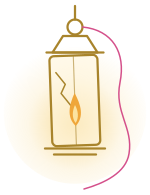
In a town where the wind carried messages, there lived a woman who kept a lantern by her gate. It was not a bright lantern. It was small and gold, and a little crooked from the years, but it had one strange gift: it glowed warmer the closer someone she loved came to home.
Each afternoon she sat on the step and waited for her daughter.
While she waited, she did small things. She pulled a loose thread from her sleeve and wound it round her finger. She watched a sparrow argue with a leaf. She counted clouds and gave up at eleven, because one of them looked like a trident and deserved her full attention.
The lantern stayed quiet. That was alright. Waiting is not empty time. It is time with a shape, like a cup held out before the tea is poured.
Then the wind shifted. It brought the smell of rain from somewhere far off, the sound of a bicycle bell, and a laugh the woman would have known in any crowd in any city in any century.
The lantern warmed. Then it glowed. Then it shone so gold that the sparrow flew off in protest.
Her daughter came round the corner, bag bumping on her hip, cheeks bright, already talking about something that had happened and was very important.
The woman stood up, and the thread slipped from her finger. She didn't notice. She had already opened her arms.
That night, the neighbours said later, the lantern stayed lit long after it needed to. Nobody asked it to. It simply wanted everyone walking past in the dark to know:
There is a path home here. Someone is waiting at the end of it.
🔱🌅
02 A chapter of the tale
Part II: The Thread
The next morning, the daughter found the thread.
It lay on the step where her mother had dropped it, curled like a question mark. It was bright pink, the colour of the inside of a shell. She picked it up and held it to the light.
"Mama, is this yours?"
Her mother looked up from her tea. "It was. Now it's the step's. Or maybe it's yours, if you want it."
The daughter did want it. She tied it round her wrist, then untied it, then tied it round the lantern's handle instead. "So it remembers," she said.
"Remembers what?"
"That you waited."
That day she went out into town with a secret plan. She visited the baker, who gave her a crust. She visited the old man who fixed clocks, who gave her a tiny brass screw. She found a feather by the river, a blue bead in the gutter, and a smooth black stone that looked like an eye when she held it sideways.
By evening her pockets were heavy. She sat on the step beside the lantern, which was already glowing because her mother was inside, and she began to build.
She laid the black stone in the middle. Around it she wound the pink thread, then the bead, then the screw, then the feather. It wasn't neat. The thread kept slipping. Twice she had to start again.
"What is it?" her mother asked from the doorway.
The daughter thought hard. "It's an eye. It watches the path. So when you're the one coming home, it can tell the lantern early."
Her mother sat down beside her very slowly, the way you do when something important has just been handed to you.
"It's beautiful," she said.
"It's wonky."
"The best things are. That's how you know someone's hands made them."
They hung the little eye beside the lantern. From then on, the neighbours noticed, the lantern began to glow in both directions: when the daughter came home, and when the mother did.
And the thread? It stayed right where she'd tied it. A loose line that had found its form.
🔱🧵👁️
03 A chapter of the tale
Part III: The Night the Lantern Broke
Autumn came to the town all at once, the way it sometimes does: one morning the trees were green, and by evening they were gold and dropping their leaves like coins nobody wanted to pick up.
The mother had business across the river that day. It was a long day of standing in rooms with forms and stamps, of explaining who she was to people who wanted proof. Somewhere between the third office and the fourth, her bag went missing. One moment it was on her shoulder. The next there was only air where it had been, and a strange lightness that felt worse than weight.
Inside it had been her papers, her little purse, and the key to the gate.
She stood on the bridge a long time. The wind was rising, and the river below had begun to hurry, grey and restless. She felt as if someone had taken not just the bag but a piece of her outline, the part of her that other people could check and stamp and believe.
Who am I without my papers? she thought. Then, because she was who she was, she answered herself out loud:
"The same woman. Just lighter on one side."
She started walking home.
At home, the daughter was waiting.
She had done her homework and eaten her bread. She had rearranged the feather on the little eye twice. Now she sat on the step with her knees pulled up, watching the lantern. Evening came and it stayed dim. Of course it did. Her mother was still far away.
Then the storm arrived.
It didn't knock. It came down the street like a crowd of people all talking at once. It tore leaves from the trees and shutters from their hooks, and it rattled every gate in the town. The daughter pressed herself against the door. The lantern swung wildly on its hook, back and forth, back and forth.
Then, with a sound like a small bell giving up, the glass cracked. The flame went out.
The daughter stared at it. The lantern had never gone out, not once in her whole life. It had always been there, always gold, always ready. Now it hung dark and broken, and the street beyond the gate had vanished into rain.
How will she find the way?
She was frightened. She will tell you that honestly, even now. She was frightened the way you are when the thing you trusted most turns out to be made of glass.
But then she looked at the little eye.
It was still hanging beside the lantern. The storm had battered it too. The feather was half torn and the blue bead had spun round to the back. But the black stone was still there in the middle, and the pink thread still held everything together. Because the thread was wound around the lantern's handle, and the handle was fixed to the gate, the thread ran from the gate to the eye.
It was a line. A path.
The daughter had an idea.
She ran inside and came back with the whole spool of pink thread from her mother's workbasket, the one her mother used for mending and for making. She tied the loose end to the eye. Then, pulling her hood over her head, she opened the gate and stepped out into the storm.
She tied the thread to the gatepost. To the lamppost at the corner. To the baker's railing. To the bench by the fountain. To the bare branch of the plum tree on the river road. Every few steps she wound it round something solid and pulled it tight, until a bright pink line stretched through the grey rain from the door of their house all the way to the foot of the bridge.
When the spool ran out she stood there at the end of it, soaked and shivering, holding the last inch of thread in her fist.
And she waited.
The mother came across the bridge with her head down against the wind.
She couldn't see the lantern. She couldn't see much of anything. Rain blurred every street into every other street, and for a moment, standing at the bottom of the bridge, she truly did not know which way was home.
Then something brushed her hand.
A thread. Pink as the inside of a shell, stretched taut through the rain and humming faintly in the wind like a plucked string.
She followed it with her eyes, then with her fingers. It led up the river road, past the plum tree, the fountain, the baker's, the corner. At the end of it, holding on with both hands, was a small drenched girl with her chin set exactly the way her mother's did when she had decided something.
"The lantern broke," the daughter said, before her mother could say anything at all. "So I made another way."
The mother knelt down in the wet street and held her so tightly that the thread went slack between them.
"You found me," she said.
"You found me," said the daughter. "I just left the line."
They walked home together along the thread, winding it up as they went so that nobody else would trip. By the time they reached the gate there was a great pink ball of it in the daughter's arms. The lantern hung dark and cracked above them.
"Will we get a new one?" the daughter asked.
The mother looked at the lantern for a long moment. Then she took it down, very gently, and carried it inside.
She did not throw it away.
Over the following weeks she worked on it at the kitchen table in the evenings. She fitted a new pane of glass beside the cracked one, rather than in place of it. She mended the crack with a thin line of gold, so it showed and shone. She wound a little of the pink thread around the handle, where the daughter had first tied it. Beneath the lantern, on the gatepost, she painted a small eye.
The new papers came eventually, with fresh stamps and a fresh photograph. The mother put them away in a new bag and did not think about them much. She had learned, on the bridge, that they described her. They were not her.
When the lantern went back up on its hook, it glowed exactly as before, warmer the closer someone loved came home. But the neighbours said it looked different now. Better, somehow. You could see where it had broken, you could see how it had been mended, and you could see the thread.
Years later, when the daughter was grown and had a gate of her own, she asked her mother why she hadn't just bought a perfect new lantern.
Her mother smiled and said the thing the daughter would one day say to her own children, standing at her own gate on a stormy night:
"Because a lantern that never breaks is only a lucky lantern. A trustworthy one is different. When the light goes out, it has already left a path home."
The end.
🔱🧵👁️🏮