1001 nightzZz Story 002 of 005
The Dawn Weaver
for giving freely, and for mornings made together
Enter the story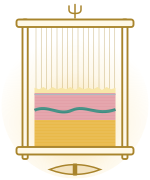
01 A chapter of the tale
Part I: The Loom on the Hill
In the far north, where the sea freezes at its edges and the winter nights are long enough to lose a week in, there was a harbour town called Norrvik. Everyone in Norrvik knew that the dawn did not simply happen. It was made.
Up on the hill above the harbour stood a small stone house with one great window facing east. In that house lived Ester, the Dawn Weaver. Every night, while the town slept, she sat at her loom and wove the morning: long threads of gold and rose and palest blue, pulled tight, beaten down, row after row, until the cloth was wide enough to cover the sky. Then, just before the first gull woke, she opened the window and let it go.
Tova had known this all her life, the way you know that bread rises and that cats lie. Her mother was a weaver too, of ordinary cloth: scarves and blankets and the occasional wedding shawl. Tova had grown up falling asleep to the clack of the loom in the next room.
So she was the first to notice when the dawns began to go thin.
It started in November. The mornings came in grey, then greyer, like cloth that had been washed too many times. By December there were mornings when the sun rose and nobody could tell. The fishermen grumbled. The baker's bread came out pale. Even the gulls stayed in bed.
"Something's wrong with the dawn," Tova told her mother.
Her mother looked up from her work. She had noticed too. Tova could tell by the way her hands had stopped. "Ester is very old," she said carefully. "Perhaps her eyes are tired."
"Then someone should help her."
"Someone should," her mother agreed. She gave Tova a look Tova understood completely, the look that meant: and who do you suppose that someone is?
The next evening Tova packed her mother's second-best spindle, a heel of bread and a scarf, and climbed the hill.
Ester opened the door before she knocked. She was smaller than Tova expected, and her hands shook, but her eyes were bright and sharp as frost.
"You're the weaver's girl," she said. "Come in. Mind the cat, she's a liar."
Inside, the loom filled half the room. It was older than the house, carved with symbols Tova didn't know: an eye, a wave, and a three-pronged spear like the ones fishermen used for eels. On it hung the night's work, and Tova's heart sank. The cloth was thin and patchy, more grey than gold, and there was hardly any thread left on the spools.
"It isn't my eyes," Ester said, reading her face. "And it isn't my hands, though they're not what they were. It's the thread."
"Where does the thread come from?"
Ester sat down heavily by the fire. "From the town. Every golden thread in the dawn was once something a person gave. A song sung for no reason. A door held open. A debt forgiven. A kindness nobody saw. When something is given freely, a little gold comes loose from it, and the wind carries it up the hill to me." She held up an empty spool. "For a long time there was plenty. But this winter people have closed their doors. They've drawn their curtains. They keep their songs to themselves. And I can't weave a morning out of nothing."
Tova looked at the thin grey cloth, then at the old woman's shaking hands.
"Then I'll go and get more," she said.
Ester laughed, not unkindly. "You can't get it, child. It can only be given."
"Then I'll go and ask," said Tova.
Outside, the longest night of the year was eleven days away.
🔱🧶🌑
02 A chapter of the tale
Part II: What the Town Gave
Tova started with the people she knew best, because that seemed fair.
The baker listened with his arms folded and flour in his eyebrows. "Gold for the dawn," he said. "And what do I get?"
"A morning," said Tova.
He thought about that for a long moment. Then he took the first loaf out of the oven, the best one, the one he always kept for himself, and gave it to the widow next door, who had not had fresh bread in a month. As the widow's face changed, Tova saw it: a single thread of gold, fine as a hair, lifting off the warm crust and drifting up toward the hill.
"Well," said the baker gruffly. "Don't stand there. There are other people."
There were. Old Anders the fisherman gave a song, a long, rolling, slightly rude one about a mermaid and a tax collector, and he sang it on the quay at full volume for anybody who wanted to hear. Three threads came off that song, and one of them was very bright. The schoolteacher gave an afternoon off. The twins from the corner house gave back the sled they had "borrowed" two winters ago. Gold rose from it too, a little tangled, as if it wasn't sure it deserved to be gold.
Every evening Tova climbed the hill to see the spools filling. Every morning the dawn came in a little warmer.
But there was one house she kept walking past.
Herr Lind the clockmaker lived at the top of Harbour Street behind a door with three locks. He had not spoken to anyone properly in twenty years, not since his brother left town after a quarrel whose cause nobody remembered. His windows were full of clocks, all ticking, all correct, and all somehow lonely.
On the ninth day, Tova knocked.
"No," said Herr Lind through the letterbox.
"I haven't asked anything yet."
"You're the dawn girl. Everyone's talking about you. The answer is no. I don't have anything to give."
Tova sat down on his step to think. It was cold. After a while the letterbox opened again.
"Why are you still there?"
"I'm waiting," said Tova. "My mother says waiting is not empty time."
There was a long silence, full of ticking.
That night, on her way home, Tova was tired and cross, and she did something she was later ashamed of. She passed a window where a young couple sat laughing together by the fire. It was a big, warm, private laugh, and she thought: there's so much gold in that. They'd never miss a little. She reached toward the glass and, without quite knowing how, she pulled.
A thread came loose. But it wasn't gold. It was grey and it was cold. Inside the house the laughing stopped, and the young woman looked toward the window with a small puzzled frown, as if she had forgotten what was funny.
Tova let go at once. The grey thread dropped into the snow and vanished.
She ran all the way up the hill and told Ester everything, crying.
Ester didn't scold her. She only put a hand on Tova's head. "Now you know the hardest thing about the loom," she said. "You can give anything that is yours: your bread, your song, your time, your name. But you can never give what belongs to someone else, not even for a good reason. Taken gold is only grey."
"I put it back," Tova whispered.
"I know. That's why the laughing will start again." Ester looked out at the dark. "Two nights left. And the spools are still not full."
🔱🧶✨
03 A chapter of the tale
Part III: The Longest Night
On the longest night of the year, the snow came in off the sea so thick that the harbour lights looked as if they were underwater.
Tova and her mother climbed the hill together. Her mother had closed her own loom for the night and brought her best shuttle, the one with the little gold band that had been Tova's grandmother's. Neither of them said so, but both knew why she had come. Ester's hands were shaking worse every day.
Inside the stone house the great loom stood ready. The spools were fuller than they had been in weeks: gold and rose, and a surprising amount of deep sea-green that had come, Ester said, from the fisherman's song. But when the three of them counted, carefully, spool by spool, it was not enough. The dawn had to be wide enough to cover the whole sky, from the islands in the east to the mountains in the west. They had perhaps nine-tenths of it.
"Then we'll weave what we have," said Tova's mother, "and see."
They wove. Ester sat beside the loom and called the pattern. Tova's mother threw the shuttle back and forth, fast and sure, and Tova beat each row down tight and handed up each new spool as the last ran out. The cloth grew: gold at the bottom, rose above it, the sea-green running through like a current. It was the most beautiful dawn Tova had ever seen, and it was going to be too small.
At four in the morning, the last spool ran out.
The cloth hung on the loom, glowing, with a ragged unfinished edge along the top where the sky should have been. Through the east window the dark was already thinning. There was an hour left, perhaps less.
"The town's asleep," Tova said. "Nobody gives anything in their sleep."
"Then wake them," said Ester.
Tova was out of the door before she had decided to go.
She ran down the hill through the snow, slipping and falling and getting up again, all the way to the harbour. There the old fog bell hung on its post at the end of the quay. Nobody had rung it in years, and its rope was stiff with frost. She took hold of it with both hands and pulled with everything she had.
The bell spoke.
It was a deep, round sound that went through the snow and through the walls and into every sleeping house in Norrvik. It had its own note, low and golden, a frequency people felt in their chests before they heard it with their ears. One by one, windows lit up along the harbour.
Tova rang until her arms ached. Then she cupped her hands and shouted up Harbour Street: "The dawn isn't finished! Come to the hill!"
And they came.
They came in coats pulled over nightclothes, carrying lanterns, in twos and threes and whole families, climbing the white hill in the dark in a long, wavering line of lights. At the stone house they crowded through the doorway, stood around the loom and looked at the unfinished dawn. Nobody needed to be told what to do.
The baker gave his secret recipe, spoken aloud for the first time. The schoolteacher pardoned every child who had ever forgotten their homework. The widow gave a thank-you she had been meaning to say for thirty years, to a man who turned out to be standing right beside her. The young couple from the house with the fire gave a laugh, the same big warm laugh, freely this time. The thread that came off it was so bright people had to shield their eyes. Every gift lifted a strand of gold into the air, and Tova's mother caught each one on the shuttle and wove, and the dawn crept upward row by row.
But the dark in the window was turning blue, and the edge was still unfinished. There was a gap the width of a hand.
Then the door opened one more time. Herr Lind came in, covered in snow, out of breath, with no coat.
"I stopped them," he said.
Everybody stared.
"The clocks," he said. "All of them. Every clock in the town. I've held the night still for one minute. It's the only thing I have that's worth anything, and I'm not sure it counts. But you can have it." He took a breath. Then, quietly, to the room in general: "And tell my brother, if anyone ever sees him, that I was wrong."
The thread that came off that was not gold. It was silver, fine as frost, and it was long.
Tova's mother wove it in. The gap closed to a finger's width, then to a hair.
Then the shuttle stopped. There was one row left, no more thread, and everyone in the room had given what they had.
Tova looked at her mother. Her mother looked at the loom. Then she smiled, the particular smile Tova had known all her life, and said:
"When you were very small, your first word wasn't mama. It was look. We were standing at the window, the sun came up over the islands, and you pointed at it and said look! as if you'd invented it." She laid her hand on the unfinished edge. "I give that."
"But then you won't have it any more," Tova said, alarmed.
"Oh, love," said Ester from her chair. "That's the part nobody believes until they try it. Gold that is given freely is never gone. It's only moved to where more people can see it."
The last thread lifted from her mother's hand. It was the brightest of all.
Tova's mother wove the final row. Tova beat it down. Ester's hands shook as always, but for that one moment they were perfectly still as she cut the cloth free.
Then everyone carried the dawn to the east window together: the baker and the fisherman, the widow and the young couple, the clockmaker, the twins, the schoolteacher, and a very small boy in his pyjamas who was not supposed to be there. They opened the window and let it go.
It rose over the islands, wider than the sky. Gold at the bottom, rose above, a current of sea-green running through, one long thread of silver catching the light like frost. And at the very top, brightest of all, was a single line of pale pure gold, the colour of a small child's first word.
Down in the town, every clock started again at once.
Nobody in Norrvik ever forgot that morning. Old Anders stood at the window with tears in his beard and said the only thing that seemed big enough, a phrase he had picked up long ago in a far southern port: "Mazel tov!" Most of the town had no idea what it meant, but they understood it perfectly, and they said it to each other all the way down the hill.
Ester lived three more winters. Her hands never stopped shaking, but she didn't need them to. Every night Tova came up the hill and wove while Ester called the pattern, and some nights Tova's mother came too.
Herr Lind's brother came home the following spring. Nobody asked how he had heard.
On the evening Ester finally gave Tova the shuttle for good, the old woman said just one thing:
"Remember, the dawn was never mine. I only held the loom. The morning belongs to everyone who gave to it."
And every morning after that, when the light came up golden over Norrvik, somebody in the town would look out of the window and say, to nobody in particular:
Look.
The end.
🔱🧶🌅