1001 nightzZz Story 003 of 005
The Listening Tree
for what we keep, and the ones it was meant for
Enter the story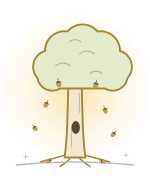
01 A chapter of the tale
Part I: What the Island Told the Tree
Out in the archipelago, past the last lighthouse, where the islands thin out into rocks and the rocks thin out into sea, there is an island called Ekö. It is small enough to walk around before breakfast. It has one harbour, one school, one shop that sells everything badly, and one tree.
The tree is an oak, and it is older than anything else on the island, including the island's name. It stands on the rise in the middle, where the wind is strongest, and it leans very slightly toward the sea, as if it is listening for something. About halfway up the trunk, at exactly the height of a child's mouth, there is a hollow.
For as long as anyone can remember, the people of Ekö have told that hollow things.
Fishermen told it their fears the night before a storm. Young people told it the names of the ones they loved, before they dared to tell the ones they loved. Old people told it the things they had forgotten to say at funerals. And children told it everything, because children always do.
The tree never answered. But people walked away from it lighter, and that was answer enough.
Maja told the tree everything. She told it about the seal she had named Admiral, who came to the same rock every Tuesday. She told it about the boy who had stolen her boots and then, three days later, secretly given them back. She told it the dream where she could fly, but only very low, about the height of a bicycle. She told it things she didn't tell her mother, not because they were secrets, but because her mother was usually busy, mending nets on the jetty with her mouth full of twine.
Her mother, Linnea, never told the tree anything.
"Why not?" Maja asked once.
Her mother didn't look up from the net. "Some things are better kept," she said, and that was the end of that.
Maja knew a little about the things her mother kept. She knew her mother used to sing. Everyone on the island said so, said she had the best voice from here to the mainland, and that she had stopped the winter Mormor Ingrid died, when Maja was too small to remember. She knew there was a photograph face-down in the kitchen drawer. She knew not to ask about either.
That autumn, the tree began to groan.
It started in August, when the leaves came down early, brown and curled, weeks before any other year. Then the bark began to split, long pale cracks running up the trunk like the lines on an old hand. At night, when the wind dropped, you could hear it from the harbour: a low, deep, creaking moan, like a ship's hull under too much weight.
The harbour master, Holm, came up with two men from the council and a long saw, and walked round the tree three times, frowning.
"Rotten," he said at last. "Hollow right through, I'd guess. One good storm and it'll come down on the schoolhouse." He looked at the children gathered at a safe distance, and his face softened, but only a little. "I'm sorry. It comes down at the first frost."
That night Maja couldn't sleep. She slipped out of the house in her coat and boots and climbed the rise in the moonlight, and she did something she had never done in all her years of talking to the tree.
She put her ear to the hollow and listened.
At first there was only the wind. Then, underneath it, faint and far down, she heard a murmur. Then another. Then hundreds, thousands, layered one over the other like the sea inside a shell: voices. Men and women and children. Laughing, whispering, weeping, confessing, promising. Every word the island had ever given it.
Maja stepped back with her heart pounding.
The tree wasn't rotten.
It was full.
🔱🌳🌙
02 A chapter of the tale
Part II: Too Full to Stand
Nobody believed her, of course.
"Voices," said Holm the harbour master, not unkindly, when she found him on the quay the next morning. "In the tree."
"Everything anyone ever told it. It kept all of it. It's too heavy, that's why it's cracking. It isn't rotten, it's full."
Holm looked at her for a long moment. He was a big, weathered man who had been harbour master for twenty-two years and had never, as far as anyone knew, told the tree a single thing. "First frost," he said, and went back to his ropes.
So Maja went back to the tree, every night, and listened.
It was hard at first. The voices ran together like rain. But slowly, night after night, she learned to pick them apart, the way you learn to pick out one bird in the dawn chorus. There was a fisherman praying before a storm, in a year long before she was born. There was a girl practising a love letter and getting the words wrong. There was a very small voice, lisping, telling the tree about a seal called Admiral, and with a jolt Maja realised it was her own, from when she was four.
And then, one night, she heard a voice she had never heard in her life and knew immediately. An old woman's voice, warm and a little hoarse, with the same way of rising at the end of a sentence that her mother had.
Mormor.
Maja pulled her ear away so fast she scraped it on the bark. Her heart was hammering. She wanted, more than she had ever wanted anything, to put her ear back and hear what her grandmother had said.
She didn't.
She sat down in the roots with her arms around her knees and thought about it until the sky began to go grey. Whatever her grandmother had told the tree, she had told it to the tree, not to Maja. It was hers, and if it was meant for anyone else, it was meant for someone who wasn't Maja. You could tell your own things to anyone you liked. You couldn't tell someone else's for them, not even to the tree, not even to yourself.
And that, she realised, was the whole problem.
Every voice in the tree had been meant for someone. The fisherman's prayer had been meant for his wife, waiting on the shore. The love letter had been meant for a boy on the mainland. People had told the tree the things they couldn't say to the ones they were for, and the tree had kept them faithfully, year after year, for centuries, waiting for someone to come and hear them. Nobody ever had. So the words had piled up inside it like snow on a roof, until the roof began to crack.
The tree didn't need cutting down. It needed listening to. Not by Maja. By the right people.
The next evening she brought Holm.
He grumbled all the way up the rise. He grumbled while she explained. Then, because she wouldn't stop looking at him, he bent his big stiff back and put his ear to the hollow, and stopped grumbling.
He stood there a long time. When he straightened up, his face had gone very strange, and his eyes were wet.
"My father," he said hoarsely. "He never said a word to me in his life that wasn't about knots or weather. And he told the tree—" He stopped. He didn't say what his father had told the tree. He didn't have to. He wiped his face with the back of his hand, and as he did, the tree gave a long, low creak, and something fell out of its branches and landed at his feet.
An acorn. Green, whole and perfect, in a year when the tree had not grown a single one.
Holm picked it up and turned it over in his fingers.
"First frost," he said slowly, "is a week away. Maybe ten days." He looked out at the island, at the roofs and the chimney smoke and the lights coming on in the windows. "That's a lot of people."
"Then we'll need to ask all of them," said Maja.
That night, at home, she asked the hardest one.
"Mama. Will you come to the tree?"
Her mother was at the sink, and her back went very still.
"I've got nothing in that tree," she said.
Maja thought about the warm, hoarse voice rising at the end of its sentences. She thought about how much she wanted to say yes you have, I heard her. And she didn't say it, because it wasn't hers to say.
"Will you come anyway?" she asked instead.
Her mother didn't answer. She just kept washing the same cup, over and over, long after it was clean.
🔱🌳👂
03 A chapter of the tale
Part III: The Night of Listening
They held it on the last night before the frost.
Holm went round every house on Ekö himself, which was a thing nobody had ever seen him do. He knocked on every door and said the same few words: "Come to the tree tonight. There might be something in it for you." Some people laughed. Some people shut the door. But when the sun went down and the cold came up off the sea, they came anyway, the way people do on small islands, because nobody wants to be the only one who didn't.
They brought candles in jam jars and stood in a long line up the rise, stamping their feet and pretending they weren't nervous. Maja stood by the tree, with Holm beside her. And one by one, the people of Ekö stepped up to the hollow and listened.
Maja made one rule, and she said it to every single person before they bent down: "You'll only hear what's yours. If you hear something that isn't, step back and leave it. It'll wait for the right person."
Nobody asked how she knew. Somehow, standing there in the dark with the tree creaking over them, it seemed obvious.
The shopkeeper heard her sister say sorry, forty years late, and laughed out loud and then cried. Old Nils and old Greta, who had been married for fifty-one years and bickered through every one of them, heard their own young voices on the night before their wedding, each telling the tree how frightened they were. They went home holding hands for the first time anyone could remember. The boy who had stolen Maja's boots heard himself, aged seven, promising the tree he would be brave, and he stood a little straighter afterward. A fisherman heard his brother, drowned twenty years ago, saying: if anything happens, tell him it wasn't his fault. He sat down in the grass for a long time after that, and when he got up, he looked years younger.
And with every person who listened, something happened to the tree.
The groaning eased. The long pale cracks in the bark drew a little narrower. And each time, with a small soft sound, an acorn dropped from the branches, green and perfect, and rolled to the listener's feet. They picked it up without quite knowing why and held it in their hand.
By midnight the grass around the tree was scattered with acorns. By three in the morning the line was gone. Everyone had listened. Some had gone home. Others sat in little groups on the hillside, talking quietly, saying to each other some of the things they had only ever said to the tree.
The tree was quiet now. Almost.
Maja put her ear to the hollow one last time, and there it was: one voice left, warm and hoarse and rising at the end of its sentences. Still waiting.
The frost was coming. She could feel it in the air, a sharpness that made her teeth ache. The sky in the east had the faint grey edge that meant dawn wasn't far off.
Maja ran.
She ran down the rise and along the path and burst into the kitchen. Her mother was there, sitting at the table in the dark with her coat on and the photograph from the drawer turned face-up in front of her. She had been sitting there, Maja realised, all night.
"There's something in the tree," Maja said, out of breath, "that belongs to you. I didn't listen to it. I promise I didn't. It's not mine. But it's been waiting a really long time."
Her mother looked at her for a long moment. Then she stood up.
They climbed the rise together, hand in hand, over grass already beginning to stiffen and whiten under their boots. At the tree, Maja let go and stepped back, all the way to the edge of the roots, and turned to face the sea so that she wouldn't see.
She never knew what her grandmother said. She never asked. Some things are yours, and some things are not, and the most loving thing you can do with someone else's is to leave room for it.
But she heard what happened after.
For a long time there was nothing. Then her mother made a sound Maja had never heard her make, a small broken sound, like a knot coming loose. Then silence. And then, very quietly, a little rough from years of not being used, her mother began to sing.
It was an old island song, the kind everybody half-knows, about a boat coming home through the fog. Her mother sang it into the hollow of the tree, all the way through, every verse, as if she were singing it back to someone who had waited a long time to hear it.
And the frost came.
It came in off the sea the way it does in the archipelago, all at once, silver across the grass and the rocks and the roofs of the town. It reached the rise. It reached the roots. And just as it touched the tree, the old oak let out a sound like a long, deep breath, and every acorn left in its branches came down at once.
It sounded like rain. Like applause. Thousands of acorns, green and gold, bouncing and rolling down the hillside in the first light, into the grass, between the stones, all the way down to the harbour.
When it stopped, the tree was still standing. Its cracks had closed to thin silver scars. Its branches were bare and light and lifted, and it wasn't leaning toward the sea any more. It stood straight, like someone who has put down a heavy load and finds they can finally stretch.
Holm came up the hill at sunrise with the two council men and the long saw. He looked at the tree for a long time. Then he handed the saw back to the council men and said, "I don't see anything rotten. Do you?" And they didn't.
That spring, every child on Ekö planted an acorn.
They planted them along the path and around the school and down by the harbour, and in the gaps between the rocks where nothing had ever grown. Not all of them came up. But enough did. They say that if you visit Ekö now, you'll find it isn't an island with one tree any more, but an island with a small, stubborn, whispering wood.
People still tell the old oak things. Of course they do. But they tell each other things now too, which the tree seems to find a great relief.
On the first warm evening of that spring, Maja's mother came down to the jetty where Maja sat with her feet over the water, watching for Admiral. She sat down beside her, closer than usual. She didn't bring any nets. She didn't bring any twine.
"Tell me something," she said.
Maja looked at her in surprise. "What kind of something?"
"Anything. Everything." Her mother smiled, and it was the smile from the photograph. "You've been telling that tree all your news for years. I'd like a turn."
So Maja told her. About the seal, and the boots, and the dream where she could fly, but only about the height of a bicycle. Her mother listened to every word. She laughed in the right places and asked questions, and she hummed a little under her breath when she thought nobody was noticing.
Up on the rise, the old oak stood in the evening light with its new leaves just coming, and it didn't have to keep a single word of it.
Someone was already listening.
The end.
🔱🌰🌱